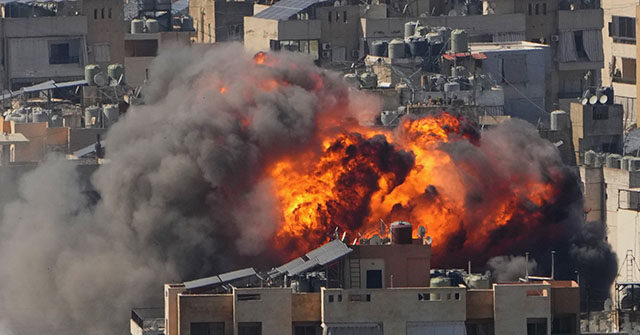
The Israeli military said on Sunday that it targeted commanders from the Quds Force, the elite foreign espionage unit of Iran’s Islamic Revolutionary Guard Corps (IRGC), with airstrikes on Beirut.
“The IDF conducted a precise strike targeting key commanders in the IRGC’s Quds Force’s Lebanon Corps who operated in Beirut,” said a statement from the Israel Defense Forces (IDF) on Sunday.
“The commanders of the Quds Force’s Lebanon Corps operated to advance terror attacks against the state of Israel and its civilians, while operating simultaneously for the IRGC in Iran,” the statement said.
“The Lebanon Corp connects the Hezbollah terrorist organization and the Iranian terror regime, supports Hezbollah force-building, and functions as the connection between senior IRGC personnel and Hezbollah leadership,” the statement explained.
“The Iranian terror regime operates systemically in the heart of the civilian population in Iran and Lebanon, cynically exploiting the civilian population as human shields to advance terror attacks,” it added.
The IDF said “steps were taken to mitigate harm to civilians, including the use of precise munition and aerial surveillance,” before the strike, which reportedly targeted the Ramada Hotel in central Beirut.
An Israeli military source told Reuters the attack targeted “five senior Quds Force members, including intelligence and finance personnel.” According to the Lebanese Health Ministry, four people were killed in the strike.
The IDF later published a list of the five targets, including three Quds Force intelligence operatives, a Hezbollah representative, and perhaps most importantly Majid Hassini, a senior financial operative of the Quds Force Lebanon Corps who coordinated Iranian payments to Hezbollah, Hamas, and other terrorist proxy forces.
Last Wednesday, as Hezbollah was stepping up its rocket and drone attacks on northern Israel, the IDF issued an unusual warning to Iranian regime officials in Lebanon, giving then 24 hours to leave the country, or else the IDF would “target them wherever they are found.”
“The IDF warns that it will not tolerate any presence of representatives of the Iranian terror regime in Lebanon,” the statement said.
The Lebanese Health Ministry claimed the death toll from renewed hostilities between the Iran-backed Hezbollah group and Israel reached 394 with Sunday’s strike. The ministry claimed 83 of the dead were children and 42 were women, but it makes no other distinction between civilians and Hezbollah military personnel. The IDF says it has killed 200 Hezbollah militants so far, while Hezbollah has yet to release a casualty count.
Hezbollah dragged Lebanon into the Iran war on Monday by launching rocket attacks against Israel, to the consternation of some Lebanese officials who said the terror group should not unilaterally seize control of their country’s foreign policy.
Lebanese Prime Minister Nawaf Salam on Monday declared all Hezbollah military activity to be “illegal and forbidden,” and ordered Lebanon’s armed forces to arrest violators, although it remains unclear if they have the strength and willpower to do so.
On Monday, the IDF struck the Beirut headquarters of Al-Qard al-Hasan (AQAH), a “charity” affiliated with Hezbollah. AQAH is actually an alternative financial system and “bank” that provides interest-free loans (in accordance with Islamic law) and other services. It plays a major role in facilitating Iran’s financial support for Hezbollah.
The association has been under U.S. sanctions since 2007 for financing Hezbollah’s terrorist activities, including weapons purchases and salaries for terrorist operatives. The U.S. Treasury Department’s Office of Foreign Assets Control (OFAC) added more sanctions against entities linked to AQAH in February 2026.
“Hezbollah continues to use AQAH to facilitate its destabilizing militant activities, undermining the Lebanese people’s ability to rebuild while enabling the group’s own interests,” OFAC said last month.
Israel struck AQAH facilities in other parts of Lebanon last week to disrupt Hezbollah’s financing. Israeli military spokesman Avichay Adraee on Friday called on Lebanese residents to “quickly withdraw your money” from AQAH “before it disappears.”
“If you do not act quickly, you will not be able to do so, and all your money will go to Hezbollah’s treasury,” he warned.
Heavy Israeli strikes pounded the southern suburbs of Lebanon over the weekend, after the IDF ordered civilian residents to evacuate last week. Almost eight percent of the Lebanese population has been covered by these evacuation warnings.
Some Lebanese Christians have disregarded the evacuation warnings and sought to continue their normal activities, arguing that they have no connection to Hezbollah and should not be considered part of its war against Israel:
Lebanese President Joseph Aoun on Monday called for internationally mediated direct negotiations with Israel for a ceasefire.
Aoun cast blame on all sides, saying the current refugee situation and humanitarian crisis was “caused by attempts to destroy Lebanon by an aggressor who does not respect the laws of war or international laws, especially the international humanitarian law, and an armed group outside the state that does not give any weight to the interests of Lebanon or the life of his people.”
In addition to brokering ceasefire talks, Aoun called on the international community to support the Lebanese army’s efforts to “control the areas of recent tension, confiscate all weapons, and disarm Hezbollah and its warehouses and depots.”