The United States builds about 90 Tomahawk missiles per year—far too few to maintain its current rate of fire against Iran.
The Tomahawk cruise missile has been arguably the defining weapon of Operation Epic Fury’s opening days, when the US Navy launched hundreds of Tomahawks against Iranian targets. Used to strike radar installations, command centers, missile sites, and naval facilities, the US operation has so far hinged upon the effectiveness of the Tomahawk.
The heavy use of the Tomahawk highlights both the weapons’ effectiveness and the growing concerns within the defense community regarding the time and difficulty required to replenish the system. At present, it takes 24 months to make each Tomahawk missile—and the United States has burned through them at an astonishing clip in Iran, with potential consequences elsewhere in the world.
What Is a Tomahawk Missile?
- Year Introduced: 1983 (continuous updates since)
- Number Built: Unknown; thousands
- Length: 18 ft 3 in (5.56 m) without booster
- Diameter: 20.4 in (0.52 m)
- Launch Weight: 2,900 lb (1,300 kg)
- Propulsion: Williams International F107-WR-402 turbofan, with solid fuel booster
- Launch Platform: Varies; can be launched from VLS, torpedo tubes, TELs
- Guidance System: Redundant GPS, INS, TERCOM, DSMAC, active radar homing systems
- Range: Depends on variant; typically 900+ nmi (1,000 mi, 1,700 km)
- Top Speed: ~570 mph (920 km/h)
- Payload: Depends on variant; typically ~690 lb (310 kg) warhead
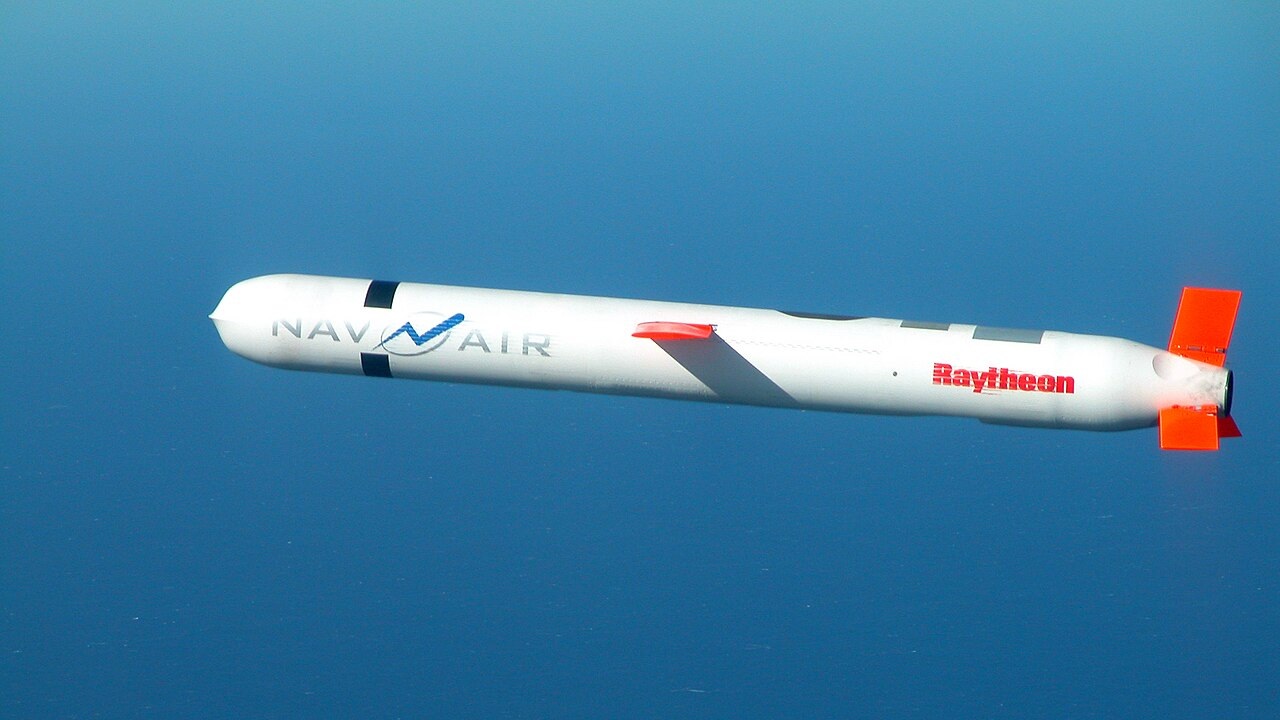
The Tomahawk is a long-range, precision-guided cruise missile, the cornerstone of US strike capability since the Cold War.
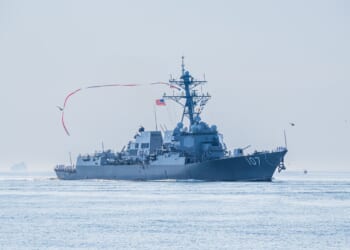
It is primarily launched from US Navy destroyers, cruisers, and submarines. Capable of flying at low-altitude to evade radar, at subsonic speeds, with the range to strike targets hundreds of miles inland, the Tomahawk uses several advanced guidance systems, all working together, to offer precision targeting. These guidance systems include GPS navigation, inertial navigation system (INS), Terrain Contour Matching (TERCOM), and Digital Scene Matching Area Correlation (DSMAC). This combination allows Tomahawks to navigate complex routes and strike targets with accuracy.
In the first 72 hours of Operation Epic Fury, the US Navy reportedly launched around 400 Tomahawk missiles—roughly 10 percent of the US’s ready-to-fire inventory. The scale of this depletion is significant. In fact, it exceeds the total number of Tomahawks produced over the past five years, which raises concerns about the possibility of stockpile depletion. The concerns are especially pronounced because of how long it takes to build a single Tomahawk.
If the United States were to run out of Tomahawks—or even run dangerously low—the consequences could be dire. In a narrow context, Iran’s armed forces could operate with greater impunity, scaling up missile launches at US bases in the region without the same fear of retaliation. More broadly, if China were to determine that US arsenals were nearly empty, it might be incentivized to start a war over Taiwan before the Pentagon could restock.
What Goes into Building a Tomahawk?
Defense conglomerate Raytheon (RTX), based in Waltham, Massachusetts, is the primary contractor responsible for the Tomahawk missile. However, Raytheon in turn relies on a complicated network of subcontractors and smaller firms for the missile’s thousands of components.
As a result, producing a Tomahawk missile is a slow and complex process. From the moment the US places an order, a missile usually takes 18 to 24 months to complete—a sprawling timeline that reflects the complexity of the system, which requires thousands of precision components. The total cost of each missile ranges from $2 million to $4 million, depending on variant.
Specifically, the Tomahawk includes:
- A solid rocket booster for launch and the Williams International F107 turbofan engine for sustained flight
- Various guidance systems, relying on multiple different means of navigation for redundancy
- Composite materials for the airframe and structural components
- Internal fuel tanks
- Specialized launch hardware
- High-reliability electronics
- Shielding systems that protect onboard computers from electromagnetic interference
All of these thousands of components must meet strict military specifications and be rigorously tested under a variety of conditions, resulting in a missile that is extremely reliable and accurate but slow to build.
In addition to the complexity of the machine, the timeline is hampered because of supply line issues. The solid rocket motor, for instance, represents a serious bottleneck. Only a few specialized companies in the United States produce these components, and their capacity functions as a bottleneck for the entire production timeline. And many Tomahawk parts come from single-source suppliers, like the specialized sensors, electronic components, guidance systems; if any one supplier experiences delays, the entire production line can stall.
How Many Tomahawk Missiles Does the US Build Per Year?
Historically, Tomahawk production has been maintained at a minimum sustainment rate of roughly 90 missiles per year. Raytheon has advanced a plan to scale up its manufacturing to 1,000 of the missiles per year, but this is still a long way off. At the current tempo, replacing the Tomahawks used in just the first 72 hours of Epic Fury would take roughly four and a half years!
This raises significant readiness questions—especially given the expectation that the Tomahawk would be central to any crisis in the Indo-Pacific. Expenditure of Tomahawks missiles anywhere, especially in the Middle East, represents an opportunity cost for US war fighting everywhere.
About the Author: Harrison Kass
Harrison Kass is a senior defense and national security writer at The National Interest. Kass is an attorney and former political candidate who joined the US Air Force as a pilot trainee before being medically discharged. He focuses on military strategy, aerospace, and global security affairs. He holds a JD from the University of Oregon and a master’s in Global Journalism and International Relations from NYU.