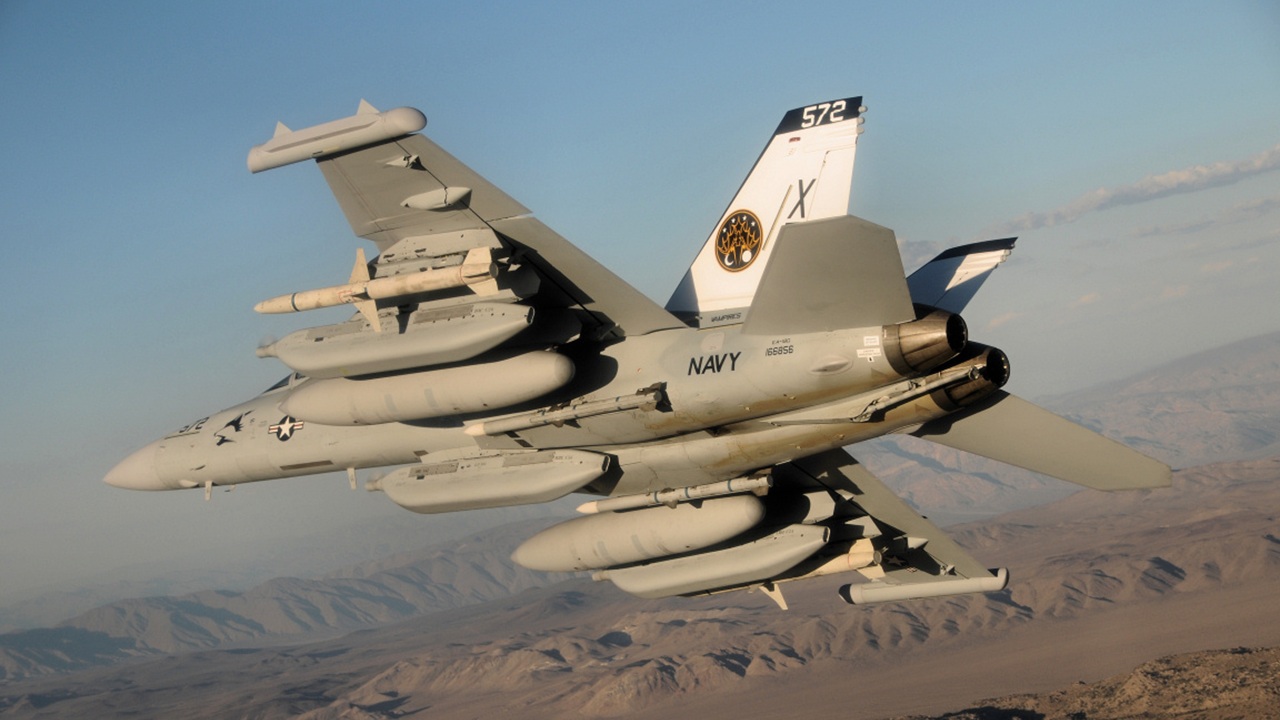
In the modern era of air warfare, specialized attack aircraft are needed to counter enemy air defenses—and the EA-18G Growler is the best plane in the world for this task.
The EA-18G Growler is the US Navy’s premier airborne electronic attack aircraft—and one of the most strategically important, if underappreciated, platforms in modern warfare. Derived from the two-seat F/A-18F Super Hornet, the EA-18G replaced the EA-6B Prowler, offering the Navy an updated electronic attack platform for an era in which air defense systems are dense, networked, and resilient. The EA-18G’s responsibilities are straightforward: to blind, confuse, disable, and dismantle enemy sensors and communications, clearing the way for strike fighters, bombers, and naval forces to dominate enemy airspace.
The EA-18G Growler’s Specifications
- Year Introduced: 2009
- Number Built: ≈170 (for US and Australia)
- Length: ≈60.3 ft (18.5 m)
- Wingspan: ≈44.9 ft (13.6 m)
- Weight (MTOW): ≈66,000 lb (29,900 kg)
- Engines: Two GE F414-GE-400 turbofans (~44,000 lbf total thrust)
- Top Speed: ≈1,190 mph (1,915 km/h) / Mach 1.8
- Range: ≈1,275 nmi ferry; ≈500+ nmi combat radius
- Service Ceiling: ≈50,000 ft (15,200 m)
- Armament: Typically two AIM-120 AMRAAM and two AIM-9X for self-defense; electronic-attack pods as primary “weapons”
- Electronic Systems: AN/ALQ-218 receiver suite; ALQ-99 tactical jamming pods; communications jammers; SIGINT sensors; advanced datalinks
- Crew: 2 (pilot + electronic warfare officer)
Understanding the EA-18G Growler’s Role
Introduced in 2009, the EA-18G incorporates the airframe, engines, and much of the avionics architecture of the Super Hornet, giving the EA-18G commonality with the rest of the carrier air wing. But where the Super Hornet carries bombs and missiles, the EA-18G carries jammers, sensors, and electronic surveillance gear.
The platform’s defining systems are the AN/ALQ-218 receiver suite, which detects, geolocates, and characterizes radar emitters, and the ALQ-99 tactical jamming pod, capable of suppressing enemy radar across multiple frequency bands. The EA-18G also incorporates high-powered communications jammers, satellite-interference tools, electronic deception systems, and advanced datalinks that allow the EA-18G to share threat data across the battlespace. In combination, these systems allow the EA-18G to degrade enemy situational awareness to the point where integrated air-defense networks lose cohesion. In modern combat against a near-peer adversary, the EA-18G is invaluable.
For propulsion, the EA-18G can reach speeds of up to Mach 1.8, but also retains impressive aerodynamic performance—even while carrying multiple external pods. When needed, the EA-18G can carry a handful of missiles for self-defense. But the platform’s primary weapons are of the electromagnetic, rather than kinetic, variety: jamming beams, interference patterns, and electronic standoff attacks that neutralize radar systems without ever dropping a bomb or firing a missile.
The US Navy Needs a Way to Counter Anti-Air Defenses
The Navy needs the EA-18G because modern air defense systems have become too sophisticated to allow for the unassisted strike aircraft to penetrate. The Cold War-era EA-6B, an analog platform, was no longer up to the task of matching evolved defensive threats. The EA-18G, meanwhile, was built specifically for countering networked radar arrays, passive detection systems, long-range surface-to-air missiles, and electronic counter-countermeasures. When integrated with other Navy platforms, like the Super Hornet, the F-35C, and the E-2D Hawkeye, the Navy has an integrated kill-chain, featuring electronic attack as the opening move.
Strategically, the EA-18G has reshaped how the Navy fights. The platform is central to suppressing and destroying enemy air defenses (SEAD/DEAD), escorting strike packages, protecting carrier groups, and enabling joint-force operations across the world. As the US “pivots” towards Asia, where a revisionist China is increasingly assertive in the Indo-Pacific, the EA-18G is one of the few platforms with the ability to reliably counter China’s sophisticated and expansive A2/AD network.
The EA-18G is expected to be the backbone of Navy electronic attack capabilities for the foreseeable future. The forthcoming Next Generation Jammer (NGJ), a try-band pod system that will replace the ALQ-99, should provide the EA-18G with more power, precision, and range—making the platform relevant into the 2040s, and perhaps beyond.
About the Author: Harrison Kass
Harrison Kass is a senior defense and national security writer at The National Interest. Kass is an attorney and former political candidate who joined the US Air Force as a pilot trainee before being medically discharged. He focuses on military strategy, aerospace, and global security affairs. He holds a JD from the University of Oregon and a master’s in Global Journalism and International Relations from NYU.
Image: Wikimedia Commons.