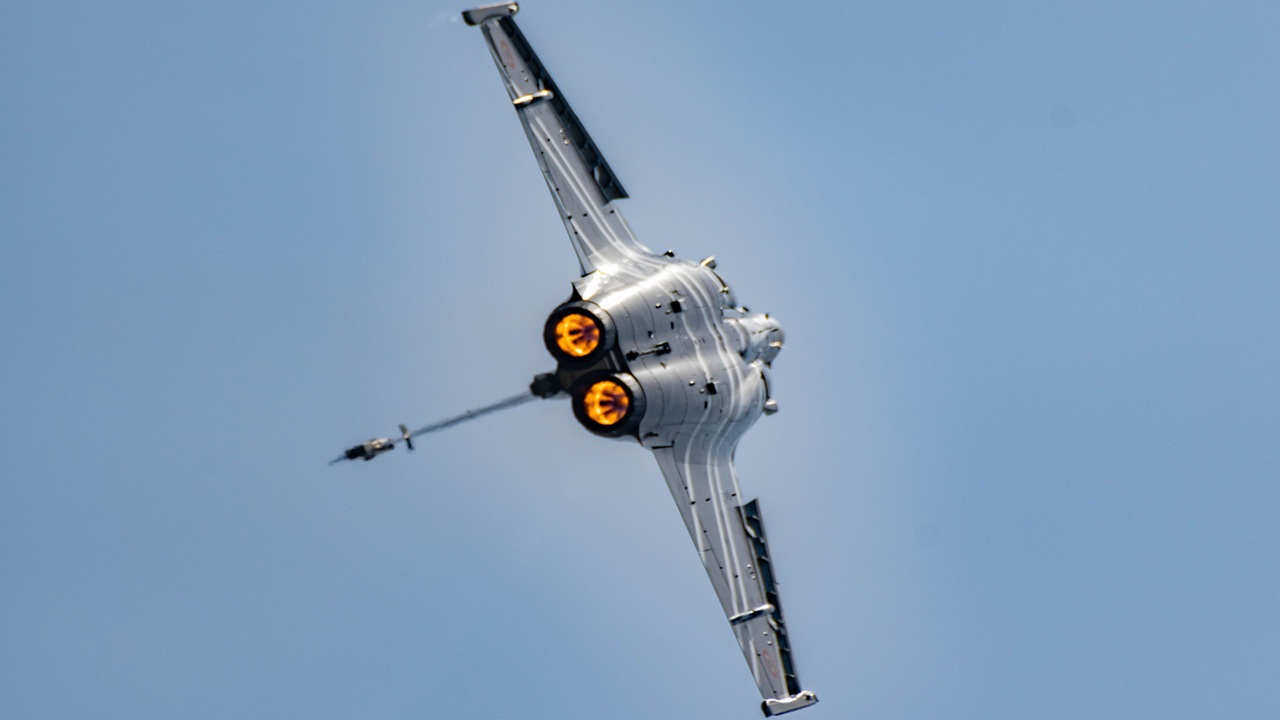
The Dassault Rafale is neatly tailored to France’s aerial doctrine—namely an ability to carry out missions independently, with limited logistical or ISR support.
The Dassault Rafale is often described as an “omnirole” fighter jet, but this is not quite correct. In truth, the Rafale was designed as a tremendous air-to-air fighter, with its other capabilities following on from there.
Designed to win control of the air independently, the Rafale was built to reflect the French emphasis on autonomy, an aircraft capable of sensor fusion without reliance on external assets. In air-to-air engagements, the Rafale balances beyond-visual-range (BVR) and within-visual-range (WVR) capabilities. The result is a versatile fighter optimized for dynamic fights.
The Dassault Rafale’s Specifications
- Year Introduced: 2001 (entered French Navy service; 2006 for French Air Force)
- Number Built: ~240+ delivered as of 2024 (production ongoing for export customers)
- Length: 50 ft 2 in (15.3 m)
- Wingspan: 35 ft 9 in (10.9 m)
- Weight (MTOW): ~54,000 lb (24,500 kg)
- Engines: Two Safran (formerly Smecna) M88-2 turbofans (17,000 lbf each with afterburner)
- Top Speed: ~1,190 mph (1,915 km/h) / Mach 1.8
- Range: ~1,000 nmi (1,150 mi, 1,850 km) combat radius; ~2,000 nmi (2,300 mi, 3,700 km) ferry range with drop tanks
- Service Ceiling: ~50,000 ft (15,240 m)
- Loadout: 14 hardpoints (13 on Rafale M naval variant); 9,500 kg (20,900 lb) total payload capacity
- Aircrew: 1 (Rafale C and M); 2 (Rafale B twin-seat variant)
What Makes the Rafale So Good at Air-to-Air Combat?
The Rafale features a delta wing and close-coupled canards, offering high lift and excellent instantaneous turn rate. The relaxed static stability is fly-by-wire controlled. And the strong thrust-to-weight ratio (courtesy of M88 engines) enables powerful acceleration. In sum, the Rafale is designed for sustained maneuvering and energy retention. Though not the fastest fighter, the Rafale is extremely agile, with aerodynamics that support high angle-of-attack control and nose authority. The airframe choices underpin both BVR positioning and WVR dominance.
The core BVR sensor is the RBE2 AESA radar, which provides long-range detection and multi-target tracking with low probability of intercept modes. Integrated with OSF infrared search and track (IRST), the Rafale can detect without emitting radar. The primary BVR weapon is the MBDA Meteor, which offers ramjet propulsion and a large no-escape zone. The Rafale’s BVR doctrine emphasizes first detection, first shoot, and cooperative engagement.
The Rafale benefits from the SPECTRA EW suite, which integrates radar warning, jamming, and threat geolocation. Providing 360-degree awareness, the SPECTRA can cue countermeasures and maneuvering, allowing the Rafale to survive contested BVR environments and reduce reliance on escort jamming. The fusion of radar, IR, and EW gives pilots a high-confidence tactical picture; the Rafale fights with information as much as missiles.
The Rafale also has excellent capability in WVR close-in encounters, thanks to its high agility and rapid nose pointing. The helmet-mounted display allows for off-foresight targeting. The primary WVR missile is the MICA IR, which offers high off-boresight angles and imaging infrared seeker. The Rafale’s control laws favor pilot confidence and aggressive maneuvering. The canards improve low-speed handling and post-merge control. In sum, the Rafale is designed to win if the fight collapses into a dogfight—an insurance policy to its BVR capabilities.
The Rafale Is Perfectly Tailored to France’s Air Doctrine
French doctrine assumes limited external ISR support, meaning that the Rafale must sense, decide, and act independently. The emphasis, then, is on autonomy and flexibility. BVR engagements are preferred—but WVR is fully embraced. Pilots are trained to transition seamlessly between regimes. The Rafale is not optimized however for pure stealth; instead, the aircraft is optimized for survivability through EW and agility.
Strategically, the Rafale offers high-end air-to-air capability without political dependence on the United States. That format appeals to mid-sized powers—particularly the states of the Persian Gulf, which have occasionally dealt with American hand-wringing in the past. The jet’s air-to-air design reflects European threat assessments and has been optimized for contested regional conflicts. The Rafale’s balance of BVR and WVR makes it resilient across scenarios; it can fight alone if needed.
In sum, the Rafale is not a specialist, but a balanced air superiority platform designed to kill at range or up-close. That design is no accident, but a reflection of comprehensive preparedness, no matter the nature of the fight.
About the Author: Harrison Kass
Harrison Kass is a senior defense and national security writer at The National Interest. Kass is an attorney and former political candidate who joined the US Air Force as a pilot trainee before being medically discharged. He focuses on military strategy, aerospace, and global security affairs. He holds a JD from the University of Oregon and a master’s in Global Journalism and International Relations from NYU.
Image: Shutterstock / Flavian Dessertine.