The easy answer is no, Ellen is not a saint. Ellen Organ, also known as Little Nellie of Holy God, has not been canonized by the Catholic Church. It does not appear that her canonization process has even been started, although she died more than a century ago.
Of course, one could argue that it is not necessary for the Church to canonize her. Nellie received Baptism immediately after her birth and died at the age of four. Would God exclude a baptized child who has not yet reached the age of reason from the heavenly kingdom? Perhaps the Church refrains from canonizing this child because it might encourage someone to question the state of all the other baptized children who died young, which, of course, no Catholic would want to do.
On the other hand, the process of canonization is more than a mere bureaucratic procedure. As one source describes it:
Canonization is the act by which the Supreme Pontiff declares in a definitive and solemn way that a Catholic Christian is actually in the glory of heaven, intercedes for us before the Lord and must be publicly venerated by the whole Church. The Holy Father proposes those canonized for the imitation—by a life of faith and charity toward God and neighbor—veneration, i.e., cult, and therefore for the invocation by prayer of the people of God with an act of public ecclesiastical cult.
Why would someone be considered a candidate for canonization? The two fundamental criteria are: 1) a reputation for martyrdom or heroic virtue, and 2) a reputation for the power of that person’s intercession. Since Ellen Organ did not die a martyr’s death, the two essential questions are: did she demonstrate heroic virtue, and has she developed a reputation as an intercessor from heaven?
Ellen was born in the village of Portlaw, Ireland, and was the youngest of four children. Her father was a soldier. He later stated he noticed that two-year-old Nellie had somehow picked up the habit of referring to the Lord as “Holy God.” Perhaps she heard her mother use that expression. Nellie’s mother was a pious woman, and the family prayed a daily Rosary.
Unfortunately, Nellie’s mother died of tuberculosis in January 1907. Although neighbors initially tried to help the family, Ellen’s father soon realized that he could not work and simultaneously care for his young children. The four Organ children were placed in Catholic boarding schools, and Nellie and her sister Mary arrived in a school run by Good Shepherd Sisters in May 1907.
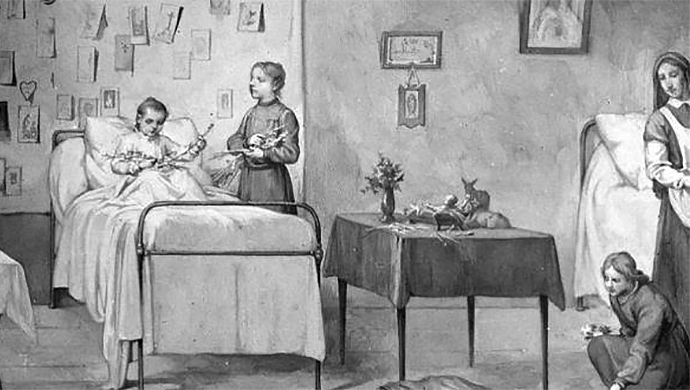
Nellie loved the school and loved the Sisters. She called each of them “Mother.” Granted, she spoke with the lisp of a child who was not yet four, and she occasionally showed the temper of a preschooler. But the sisters also noticed that she always apologized when she was corrected. And when a sister looked carefully at the child after one of those outbursts, she realized that Nellie had a crooked spine. Suddenly, Nellie’s occasional bad temper, off-balance walking, and discomfort when sitting for long periods made sense; the little girl was simply in a lot of pain.
A doctor also examined Nellie, and he diagnosed her with tuberculosis, sadly telling the Sisters that Nellie did not have long to live. To ensure that Nellie was kept comfortable, the superior of the convent moved Nellie to the infirmary. As Nellie’s discomfort increased, she was allowed to sleep in the same room with the convent nurse so that she could receive around-the-clock care.
As her health slowly declined during the remaining eight months of her life, Nellie experienced extreme thirst, a diseased jaw (due to the decay of her bones), difficulty in eating, fatigue, and constant pain. She suffered, but she didn’t complain. And she didn’t complain because she seemed to come to a mature understanding of the meaning of the Cross at the age of four.
When Nellie saw a painting of the Crucifixion, she asked (in simple words) why people hurt the Lord in that way. Although the Sister explained it gently, Nellie burst into tears and kept repeating, “Poor Holy God!” Her childlike sympathy toward Christ and His suffering helped Nellie accept her own increasing physical pain.
Nellie is perhaps the Church’s youngest visionary. While playing with her toys near a statue of the Infant of Prague, she began insisting that the statue danced for her. She somehow knew when her caregiver had or had not received Communion at Mass that morning. She sometimes asked adults to leave her room so she could speak with Holy God. When they asked what she talked to the Lord about, she replied, “Holy God says I muss not speak of dese tings.”
Although no one encouraged her or suggested it, Nellie began to beg for Confirmation, Confession, and the Eucharist, one Sacrament right after another. It was as if God opened her heart to Himself through her suffering and opened her mind to sacramental theology through the sisters and the atmosphere of her Catholic school.
The bishop himself came for her Confirmation. When the community’s priest asked Nellie to explain the Blessed Sacrament, she did not respond with a catechism response but with the simple (and typical) statement, “It is Holy God.” After edifying the entire school through her devout reception of First Holy Communion, Nellie asked to be carried to the chapel every Sunday except on a few occasions when she was too ill. Of course, she received the Anointing of the Sick before the end, leaving her only lacking the Sacraments of Matrimony and Holy Orders when she peacefully died at the age of four years, five months, and eight days.
Of course, these stories might sound like pious exaggeration on the part of a few adults who were grieving the loss of an adorable child. But people who care for young children every day tend to have a fairly realistic understanding of typical child behavior, and these examples were reported by multiple sources, not just one or two people.
In fact, Nellie’s bishop was so inspired by her that he told the pope about her remarkable acceptance of suffering, her devotion, and her love for God. Although Pope Saint Pius X lowered the age of reception of the Eucharist in 1910 to the age of discretion—down from age twelve to age seven—for many reasons, Nellie’s story is said to have had a significant impact on his decision. He even asked the Irish bishop for a relic of Nellie.
So why isn’t she Saint Nellie or at least Servant of God Nellie? She seems to be a model of heroic virtue, and there have been many reports of favors received since her death.
Perhaps that’s because Little Nellie has already achieved the miracle that Holy God wanted to be performed through her life. Her childlike love of Christ inspired a pope to open the doors of the tabernacle—the lock-up, as Nellie called it, a term for a prison cell that she had learned from growing up in a soldiers’ barracks—to children. What more would Little Nellie want than to know that millions of young children have received the Lord into their hearts, just like her, because of her love for Holy God?
Endnotes:
If you value the news and views Catholic World Report provides, please consider donating to support our efforts. Your contribution will help us continue to make CWR available to all readers worldwide for free, without a subscription. Thank you for your generosity!
Click here for more information on donating to CWR. Click here to sign up for our newsletter.