In a narrow sense, the function of a “tripwire” force is to deter conflict. In fact, it often escalates it.
The tensions between the Kingdom of Denmark and the United States over the fate of Greenland continue—and relations between the two NATO allies deteriorate, although President Donald Trump has recently vowed not to use military force to resolve the issue.
The Trump-Greenland Saga: Here’s Where We’re At
At the start of January, Trump made a series of loud proclamations about America’s interest in reclaiming the geostrategically vital region of Greenland, in the face of what he (rightly) assessed were Russian and Chinese threats to North America and Europe via the relatively undefended Arctic.
Denmark argues that this is irrelevant. In Copenhagen’s view, the president is breaking sacrosanct international norms and laws established after the end of World War II. If Greenland belongs to Denmark and the United States tries to strong-arm it into surrendering the island to America, the idea goes that this is no different than Russia strong-arming its way into Crimea or China Taiwan. The remainder of European NATO nations are committed to defending the “international order” against such aggression—though, to an increasing extent, that order seems to exist only in their own minds.
Trump has not given up on the idea of Greenland. However, as noted, the president made a surprising declaration at the World Economic Forum in Davos, Switzerland, in which he declared that US troops would not seize the island by force amid ongoing negotiations. Now a deal is reportedly in place, under which the United States would have greater freedom to operate in Greenland but would stop short of fully annexing the island. It remains to be seen if that deal will last.
What a “Tripwire” Force Is Meant to Do
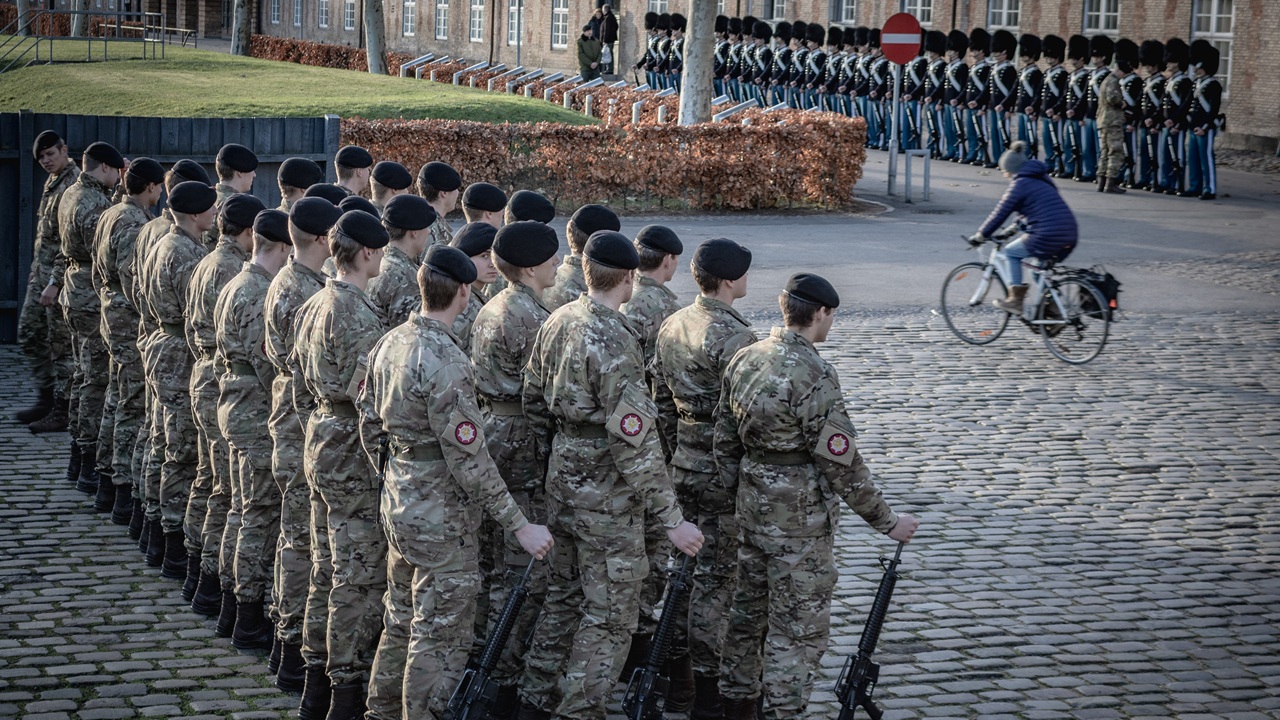
As Trump blustered about Greenland, the Danes did something rather cheeky. They initiated plans to rotate more than 1,000 of their troops through Greenland in the coming months. It is being referred to as a “tripwire” force aimed at deterring the United States from trying to lay claim to the island militarily.
Of course, the United States is no stranger to the notion of a tripwire force. In fact, US troops pioneered it. Over the past two decades, the United States has opened a string of small military bases in the territory of NATO allies in Eastern Europe—particularly the Baltic states of Estonia, Latvia, and Lithuania. A handful of US troops would be stationed in each nation, within a stone’s throw of the border with Russia. These troops would be far too few in number to realistically deter a Russian invasion of the Baltics. Yet in order to conquer the Baltics, Russia would realistically need to fight them on its way in.
The Kremlin’s plan for claiming the Baltics, if it came to that, would be to launch a lightning-fast invasion, roll them up in a handful of hours, and present the outcome to the western NATO allies as a fait accompli and deterring a wider war. But if Russian troops had killed American troops, the United States would be out for blood, and a wider war would become far more likely. In essence, the function of a tripwire force is to die—and therefore raise the political stakes.
As noted, this idea was pioneered in Eastern Europe, but it could be used in any conflict where a larger force sends a smaller one to the periphery as a deterrent force. Initial reports coming out of Greenland around mid-January, when the tensions between Washington and Copenhagen were at their apogee, indicated that more than 100 Danish elite forces were deployed to Greenland as part of Copenhagen’s “tripwire” force. These elite forces were allegedly deployed to Nuuk, with another 100 Danish troops stationed at Kangerlussuaq.
Specifically, personnel from Denmark’s 1st Brigade and the special forces (Jaegerkorpset) have been training for combat in extreme Arctic conditions since last year. They remain on the massive island, helping to shore up Denmark’s forces there. Meanwhile, the Danish Royal Navy deployed the frigate HDMS Peter Willemoes to strengthen Denmark’s overall strategic position around the island.
How Can NATO Deter Its Own Anchor?
This force is designed to ensure that, if US troops arrived on Greenland uninvited and wound up in a fight with its defenders, the entirety of NATO would be called upon to defend Danish sovereignty in Greenland. Of course, little thought has apparently been given to the fact that the United States is a member of NATO. In fact, it is the key member of NATO.
Denmark has issued live ammunition and shoot-to-kill orders to their small “tripwire” force deployed to Greenland. Under the rubric of preparing for the worst-case scenario, the Danish forces on Greenland are apparently intending to kill Americans, if the US ever decides to place boots on the ground.
Interestingly, a handful of other nations—including NATO allies Germany, Sweden, France, the Netherlands, and Norway—have also sent a few troops to the island. This move was intended to signal to Washington continued resolve and commitment to ensuring Danish sovereignty over the island (never mind the fact that the Danes have never once expressed any interest in the sovereignty of Greenland).
What it really showed, though, was how tenuous the NATO alliance truly is today.
After years of being mired in a losing proxy war with the Russians over the fate of Ukraine, the European powers didn’t hesitate about challenging the Americans militarily over Greenland. It indicates that NATO has been shredded by its constant conflict with Russia in Ukraine and the slightest disagreement with its primary partner, the United States, could send the alliance into a tailspin.
While the US military could have brushed the Danish force aside in Greenland, that’s beside the point. Europe’s approach—go for the guns first and try diplomacy later—is not the kind of action most nations take when dealing with their oldest and strongest ally. And the manner in which Denmark is deploying this force is telling. As a tripwire force, it almost begs for greater conflict. This is not how diplomatic disputes are resolved.
Geopolitics Always Wins Out in the End
Greenland, long taken for granted by Denmark, is no longer the sleepy, icy backwater it has been for decades. In fact, Greenland is becoming one of the most decisive pieces of real estate on Earth. Whoever controls Greenland controls access to the Greenland-Iceland-United Kingdom (GIUK) Gap—the critical maritime air corridor linking the North Atlantic to the Arctic. Whoever controls Greenland, then, will enjoy dominant positioning over emerging Arctic shipping routes, undersea cable networks, space-tracking infrastructure, missile-warning radars, and forward basing for long-range strike and missile defense.
Denmark has for decades both lacked the military capacity or the political will to seriously defend Greenland. It has usually deferred to the United States to underwrite Greenland’s security. Now, when the United States openly acknowledges the changing strategic environment and signals that Greenland must be brought more firmly inside America’s defensive perimeter, Denmark has gone apoplectic. But by deploying a paltry force to Greenland, Copenhagen has inadvertently admitted the central truth of Trump’s argument: Greenland’s security ultimately depends on the United States, whether the Danes like it or not.
This is the deeper sickness afflicting NATO today. European leaders want American protection. Yet they also resent American power. Europe relies on American money, intelligence, logistics, and firepower. But then Europe gets upset when Washington asserts strategic interests of its own.
For the time being, Europe can grandstand with a handful of special forces trundling around the tundra. When push comes to shove, though, if the Americans decide to get serious about Greenland, that tripwire force will be rendered ineffective quickly…and then the fundamental crisis within NATO will come to a head.
About the Author: Brandon J. Weichert
Brandon J. Weichert is a senior national security editor at The National Interest. Recently, Weichert became the host of The National Security Hour on America Outloud News and iHeartRadio, where he discusses national security policy every Wednesday at 8pm Eastern. Weichert hosts a companion book talk series on Rumble entitled “National Security Talk.” He is also a contributor at Popular Mechanics and has consulted regularly with various government institutions and private organizations on geopolitical issues. Weichert’s writings have appeared in multiple publications, including The Washington Times, National Review, The American Spectator, MSN, and the Asia Times. His books include Winning Space: How America Remains a Superpower, Biohacked: China’s Race to Control Life, and The Shadow War: Iran’s Quest for Supremacy. His newest book, A Disaster of Our Own Making: How the West Lost Ukraine is available for purchase wherever books are sold. He can be followed via Twitter @WeTheBrandon.
Image: Shutterstock / Carlos Cabral de Menezes.