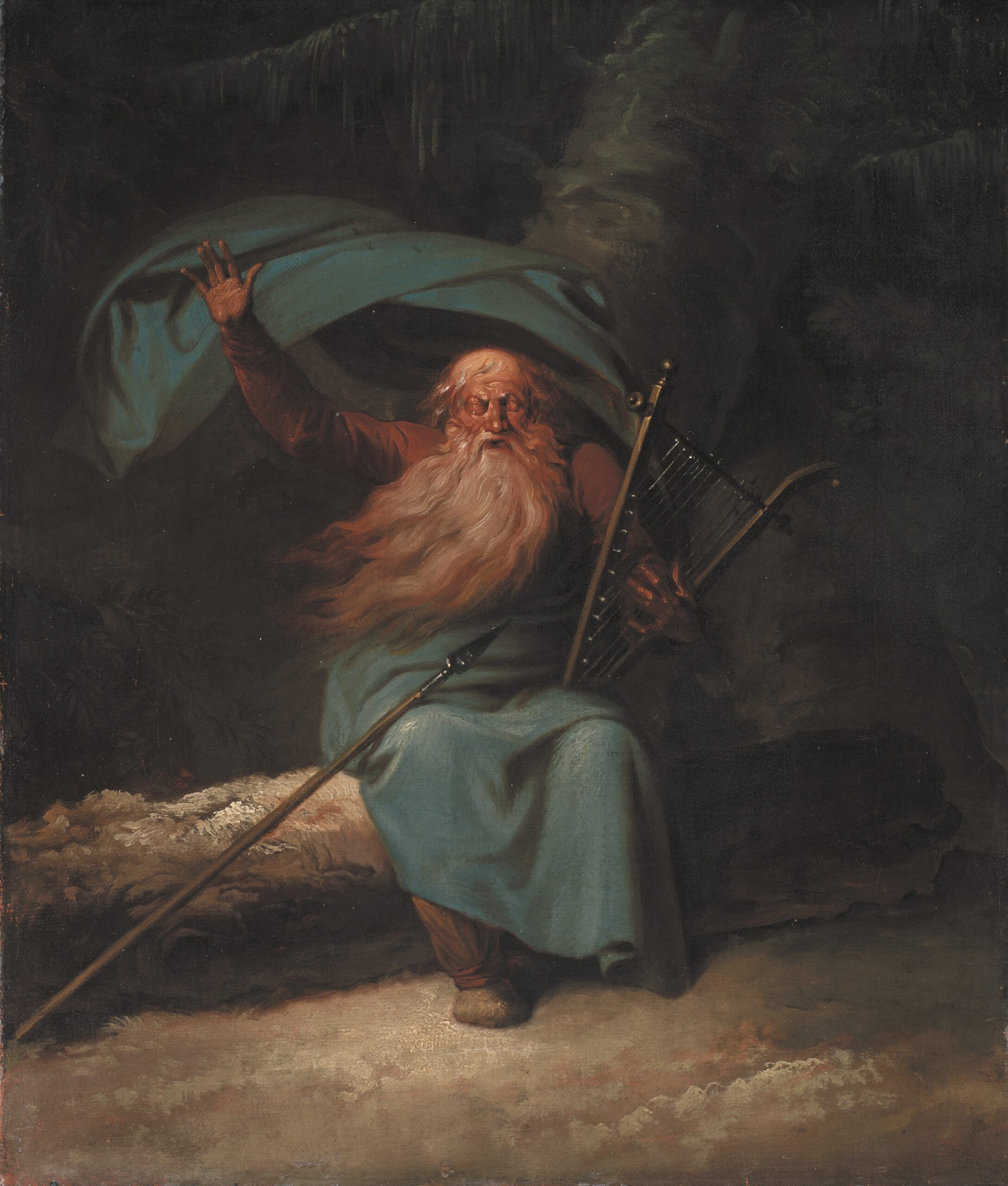
Towards the end of Goethe’s Sorrows of Young Werther (1774), the eponymous hero proclaims, “Ossian has overtaken Homer in my heart.” The sentiment is all the more striking coming from a character whose greatest solace had been going up into the hills and musing over the brilliant images of the Iliad and the Odyssey; this was written by a man who was as much a committed Hellenophile as a founding Romantic. How did Gaelic rhymes, composed by the Scottish poet James Macpherson (1736–96) under the moniker of Ossian, come to be so highly regarded throughout Europe as to merit comparison with the West’s foremost bard?
Natasha Sumner does not answer that question in her latest book, Heroes of the Gale: A History of Fionn and the Fianna. She does provide, however, an original and in-depth exploration of the origins of the Fenian tradition—the cycle of legends that deals with the hero Fionn mac Cumhaill and his men, the Fianna—and how it changed over time.
Sumner writes in her introduction, “Despite the Fianna’s widespread and enduring popularity, this book is the first full-length, comprehensive analysis of Fenian stories and songs and their place in society.” Sumner sets out to explore how these works were composed, why they were written, and what impact they had on society, all over the course of nearly two millennia.
A little introduction to Fionn is in order. Fair-haired Fionn was the son of the former leader of the Fianna, a group of heroes who protected Ireland from threats near and abroad. Fionn grew up in exile, where he became proficient as a hunter and warrior. After consuming the mythical salmon of knowledge, he only had to put his thumb in his mouth to know the future. Fionn eventually returned to the court of the king and earned his place as the leader of the Fianna. He had a son, Oisín (Macpherson’s Ossian), who was traditionally regarded as the author of the oldest Fenian poems.
Sumner begins by investigating the historicity of Fionn and the cultural context in which the first stories of the hero emerged. Today, most scholars believe that Fionn never actually existed. Sumner makes clear, however, that the Irish institution of the fían (plural: fianna) dates to before Ireland’s conversion to Christianity in the fifth century. The young aristocratic men who formed part of a fían (roving warrior band) were similar to Japanese ronin, ranging across petty kingdoms and acting with varying degrees of honor (theft, murder, and abductions were common), before coming into their lands and settling down at the age of majority.
The principal concern of Heroes of the Gale is to understand how changes in Celtic history and culture were reflected in the nature and production of Fenian stories. The earliest versions of these tales, passed down in a long oral tradition, were reflections of the cultural practices of pagan Ireland. With the coming of the monks and literacy, Fenian material became the stuff of literature, and the tales were mixed with Christian themes and characteristics.
Early-medieval Fenian stories reflected this conflict between Christian and pagan Ireland. The first written reference to the fían comes from none other than St. Patrick himself, who, according to at least one seventh-century account, resurrected a long-dead man who had been viciously killed by a fían. The story not only gives us our first glimpse of our subject but also makes clear the significance of the early Irish Christians as transcribers and chroniclers of traditions that may not have survived without their oftentimes hostile written accounts.
The Anglo-Norman invasion of Ireland (1169–77) again changed the nature of the Fenian cycle: the Fianna became the protectors of Ireland, the role for which they are now chiefly known. As England’s grip on the country grew tighter during the Tudor and Cromwellian periods, Fionn and his men became increasingly associated with resistance, resulting in the proliferation of Fenian material.
In the decades following Macpherson’s 1761 “discovery” of Ossian’s ancient Irish epic poem recounting the story of Fionn, the Fenian tradition reached the peak of its popularity in the British Isles, Europe, and even America. (Thomas Jefferson believed Ossian was “the greatest poet that has ever existed.”) At the same time, the Fianna stories served as cultural keystones in the creation and development of Irish nationalism. As Sumner notes, “Over the course of the latter half of the nineteenth century and the early twentieth century, the Fianna’s place within Irish popular culture thus evolved in conjunction with, and in support of, the ideological goals of the emerging independent Irish nation.” These stories were recast, purged of all their less savory aspects, and taught to the young to instill national pride. The tales also became rallying cries for the preservation of the Irish language. There was a huge rush in the nineteenth and twentieth centuries to collect the oral material that lived on—and still lives—in the rural, western parts of Ireland. Some Irish intellectuals even thought that the stories themselves formed the basis for a latent national literature.
Today, the Fenian tradition has been largely commercialized, whether through tourism or in the naming of businesses, sports teams, and buildings, both in Ireland and in diaspora communities. These phenomena attest to the enduring appeal of these millennia-old heroes, who show no signs of leaving the popular Irish imagination any time soon.