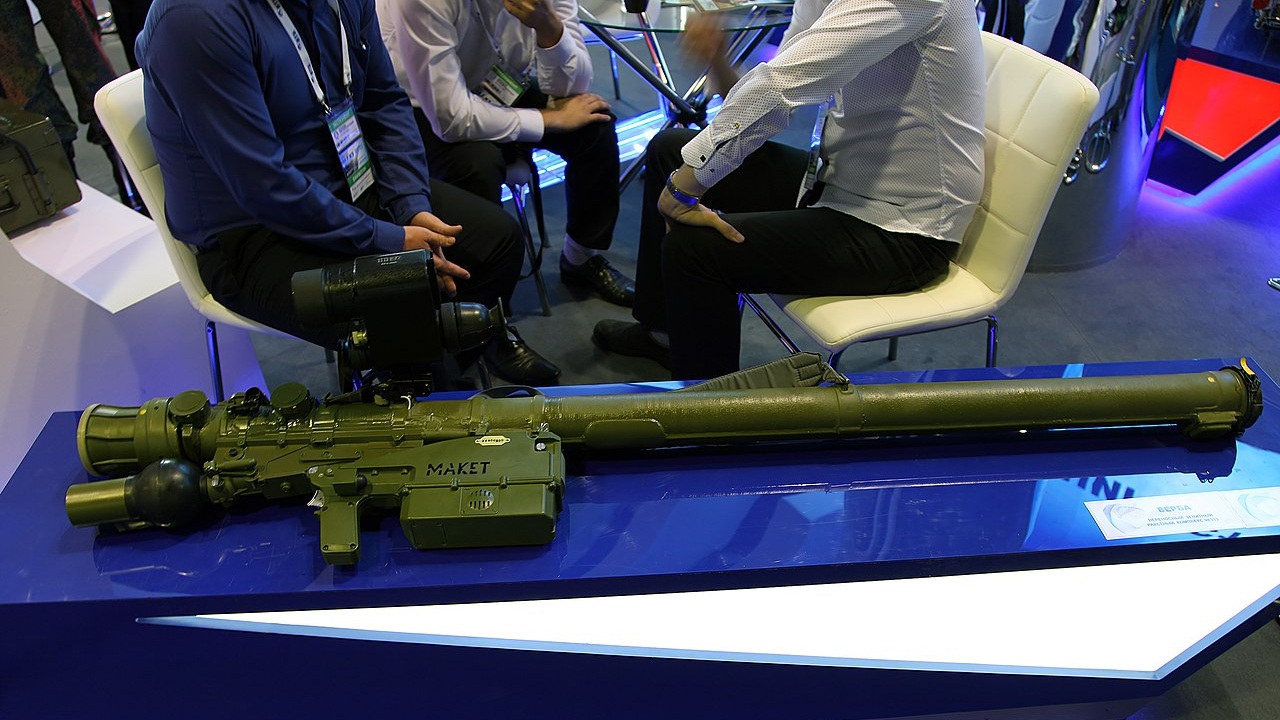
The 9K333 Verba MANPADS systems are designed to shoot down helicopters and low-level aircraft—and are unlikely to be of much use against the US Air Force.
It is doubtful that Iranian Supreme Leader Ali Khamenei has ever heard the music of Canadian folk artist Bruce Cockburn, who in the mid-1980s penned the song “If I Had a Rocket Launcher.” The tune, fittingly described as “the most violent song about peace ever written,” was inspired by conflicts in Latin America. Yet, as music critics have noted, it could easily be about ongoing wars around the world.
With the US military amassing its forces in the Middle East, Khamenei must certainly be thinking about what some rocket launchers or other man-portable air defense systems could mean for his nation.
However, the Islamic Republic’s supreme leader doesn’t need to sing out “If,” as it is now being reported that Tehran secretly signed a nearly $600 million contract with Russia that will see Iran acquire 500 9K333 Verba man-portable air defense systems (MANPADs), along with 2,500 9M336 missiles.
According to the Financial Times, the deal was concluded in December between the Russian state-owned arms exporter Rosoboronexport, a subsidiary of the Rostec military-industrial conglomerate, and the Moscow office of Iran’s Ministry of Defense and Armed Forces Logistics (MODAFL) with little fanfare.
The good news for the US forces preparing to strike Iran is that the deliveries, which are expected to be made in three tranches, won’t begin until sometime next year. Additional deliveries will then follow in 2028 and 2029.
The 9K333 Verba Puts Low-Altitude Aircraft in the Crosshairs
- Year Introduced: 2014
- Number Produced: ~1,000 (production ongoing)
- Length: 1.64 to 1.78 meters (about 5.4 to 5.8 feet)
- Weight: 17.25 kg (38.0 lb)
- Diameter: 72mm
- Target Acquisition: Three-channel optical seeker (ultraviolet, near-infrared, mid-infrared).
- Operational Range: 500 meters (1,640 ft) to 6,000 m (19,685 ft)
- Altitude Range: 10 m (32.8 ft) to 4,500 m (14,763.8 ft)
- Missile Speed: ~600 m/s (approx. 1,800 km/h or Mach 1.5)
- Target Speed: Up to 400 m/s (head-on) or 320 m/s (pursuit)
- Guidance/Fuse: Fire-and-forget; uses a laser proximity fuse for enhanced effectiveness against small targets
- Warhead: High-explosive fragmentation
- Reaction Time: 18–30 seconds
The Verba was developed to engage low-flying aircraft, helicopters, and unmanned aerial vehicles (UAVs), including loitering munitions. Each launcher costs around $47,000, with the ordnance costing around $200,000.
The 9K333 Verba was first employed in combat by the Russians in the Syrian Civil War. It is unclear how many were used or how effective the weapon has been.
Russia has not widely exported the Verba yet. In addition to the not-so-secret sale to the Islamic Republic, Armenia reportedly also bought an undisclosed number of MANPADs, but the status of that deal is unknown.
Russia and Iran Have Growing Military Ties
Russia retains its close ties with Tehran and has continued to supply the Middle Eastern nation with small arms and military hardware—in part due to the fact that both nations have been cut off from international financial networks via sanctions, forcing them to trade with one another.
Russo-Iranian bilateral trade has in recent years included the sale of combat aircraft. There are also reports this month that the Islamic Republic of Iran may have received at least the first Russian-made Mil Mi-28NE (NATO reporting name “Havoc”), an all-weather, day-night, tandem-attack anti-armor helicopter.
Tehran was also reported to operate multiple batteries of S-300PMU2 air defense systems. Still, such anti-aircraft platforms may have been targeted in last June’s Operation Midnight Hammer, which the US carried out to destroy the country’s nuclear program. The delivery of Verba MANPADs could enhance Iran’s air defense capabilities, though they are unlikely to pose a serious threat to American aircraft.
About the Author: Peter Suciu
Peter Suciu has contributed over 3,200 published pieces to more than four dozen magazines and websites over a 30-year career in journalism. He regularly writes about military hardware, firearms history, cybersecurity, politics, and international affairs. Peter is also a contributing writer for Forbes and Clearance Jobs. He is based in Michigan. You can follow him on Twitter: @PeterSuciu. You can email the author: [email protected].