The United States could use its surface fleet to help escort oil tankers through the strait—but its ships in the region are already under considerable strain.
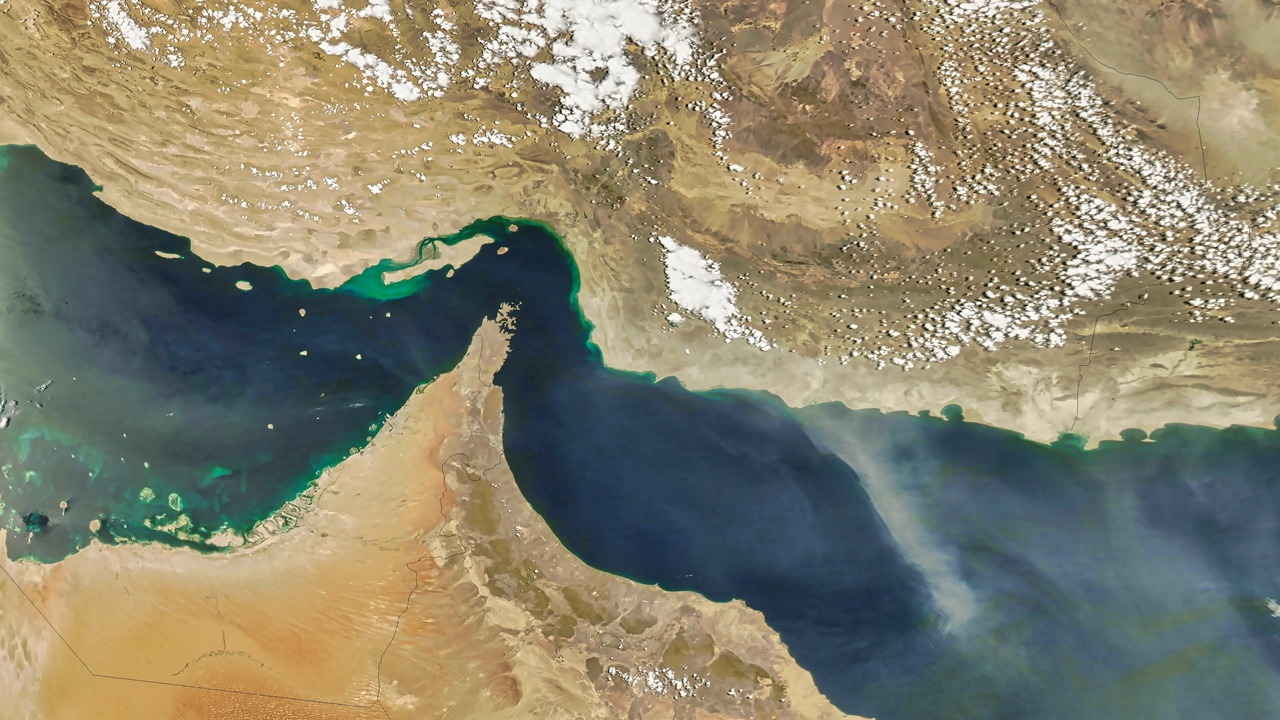
Iran has closed the Strait of Hormuz, probably the world’s single most important sea lane.
In response, the United States is considering sending the US Navy to act as an armed escort for oil and natural gas tankers, breaking through the Iranian blockade by force, President Donald Trump said. The goal is to reassure markets and cool energy prices that have spiked since Operation Epic Fury began on Saturday.
The Economic Consequences of Shutting Down the Strait of Hormuz
The Strait of Hormuz is one of the most important maritime lanes in the world because of the vast quantity of oil and liquefied natural gas that passes through it every day. The strait snakes between the north Omani and southern Iranian coasts. Approximately 20 million barrels of oil—about 20 percent of the global oil supply—sail through the strait every day.
Because of the interconnected global nature of oil markets, oil prices far beyond the Persian Gulf are certain to be affected by a prolonged closure of the strait. Even in the United States, which imports its oil mostly from Canada and Mexico, the economic consequences are likely to be painful—a point that Trump is no doubt aware of.
European and Asian nations are likely to be affected even more, given their direct trade ties to the Gulf. This is one reason that French President Emannuel Macron dispatched the Charles de Gaulle, France’s sole aircraft carrier and the flagship of the French Navy, to the Eastern Mediterranean, despite expressing a desire to remain outside the conflict. The French leader indicated a willingness to forge a task force to protect shipping in the Strait of Hormuz and the region.
“We stand alongside our friends and allies in the region for their security and territorial integrity. It is our responsibility. It is strictly defensive and aims to protect and restore peace as quickly as possible,” the French President added.
The US Navy Is Already Stretched Thin
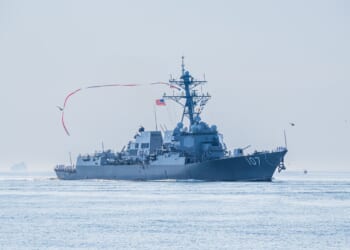
The possible escort duty mission will stretch the US Navy’s forces in the region.
In the days and weeks leading up to Operation Epic Fury, the Navy assembled an impressive strike force off the coast of Iran and in the region. There are currently two aircraft carriers, the USS Abraham Lincoln and the USS Gerald R. Ford, operating in the region with their escorts. The escort ships provide air defense, anti-ship, and anti-submarine warfare capabilities to the carrier strike group.
Also, the Navy almost certainly has guided-missile submarines in the region to support potential strikes with their Tomahawk arsenal or to sink Iranian warships. There was one such instance on Wednesday morning, when an unidentified fast-attack submarine sank the Iranian frigate IRIS Dena with a Mk 48 heavy torpedo in the Indian Ocean.
The USS Gerald R. Ford is operating from the east Mediterranean with three Arleigh-Burke-class guided-missile destroyers as part of its escort, the USS Winston S. Churchill, USS Bainbridge, USS Mahan, and three additional destroyers operating independently, the USS Roosevelt, USS Bulkeley, USS Thomas Hudner.
The USS Abraham Lincoln is operating from the Arabian Sea, also with three Arleigh-Burke-class missile-guided destroyers as part of its escort, the USS Frank E. Petersen, Jr., USS Spruance, and USS Michael Murphy, as well as an additional six independently deployed guided-missile destroyers, the USS McFaul, USS John Finn, USS Milius, USS Delbert D. Black, USS Pickney, and USS Mitscher.
In other words, the Navy has approximately 15 guided-missile destroyers in the region—each of which could, in principle, conduct escort duty to maritime vessels. But a good portion of these vessels are tasked with protecting the aircraft carriers, while the others are hitting targets in Iran with their Tomahawk missiles. But it is possible that in subsequent days, when air superiority over Iran will be complete, the independently-deployed Arleigh-Burke-class destroyers will not be needed for land-attack missions and could be spared for escort duty.
About the Author: Stavros Atlamazoglou
Stavros Atlamazoglouis a seasoned defense journalist specializing in special operationsand a Hellenic Army veteran (national service with the 575th Marine Battalion and Army HQ). He holds a BA from the Johns Hopkins University and an MA from the Johns Hopkins’ School of Advanced International Studies (SAIS). His work has been featured in Business Insider, Sandboxx, and SOFREP.