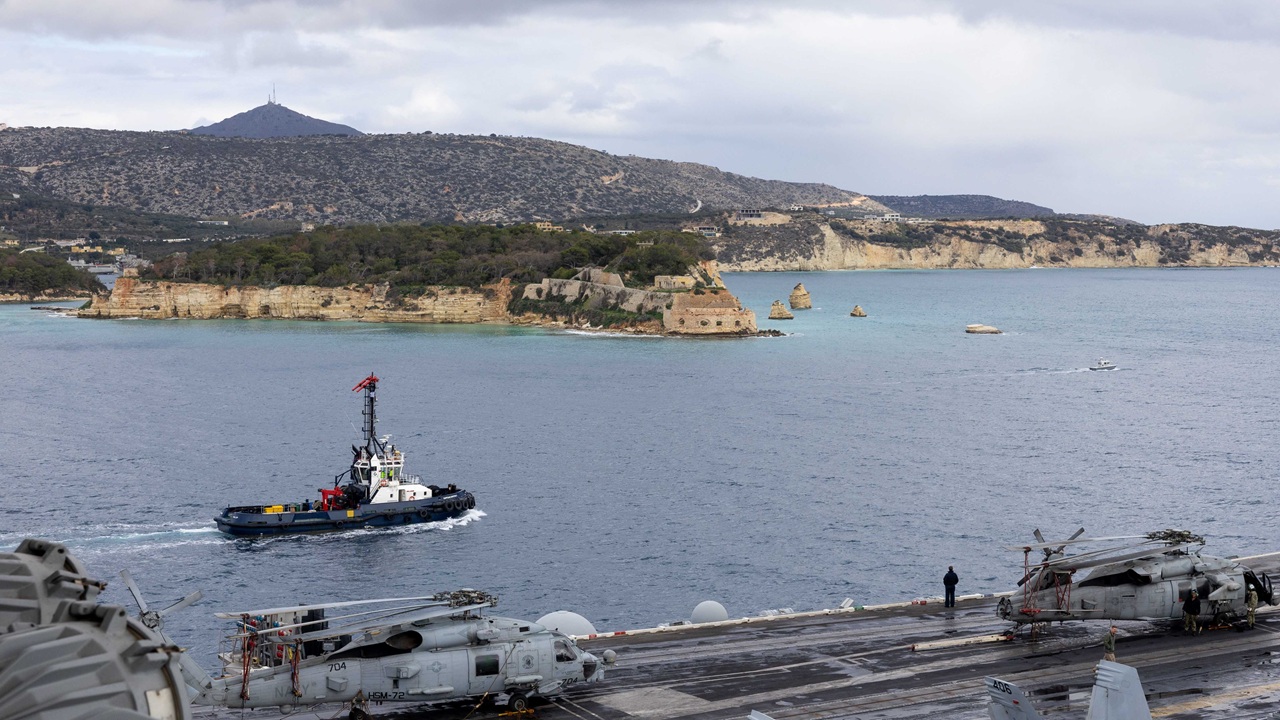
At least three men have been arrested over the past year for illicitly taking pictures of American warships at the Souda Naval Base on Crete.
As the clouds of war began to gather over Iran in January, Tehran took steps to prepare for the fight it had been preparing for nearly 50 years.
The Iranian intelligence services recruited spies to monitor the physical movements of US military assets in the region. Iranian handlers were specifically interested in the movements of the US Navy and Air Force in Crete, Greece.
Iran Is Trying to Spy on Souda Naval Base
Since January, the Greek National Intelligence Service and the Greek police have arrested several foreign nationals spying on US military movements at Souda Naval Base on the island of Crete.
Souda Naval Base is one of the most important US Navy bases in the world. Located in the south of Greece and the Eastern Mediterranean, Souda is one of the region’s largest natural ports, providing berthing, refueling, general supply handling, ammunition handling, minor maintenance, and ship repair to US Navy and NATO warships. It has the deepest harbor in the region and can host aircraft carriers.
Leading up to Operation Epic Fury, scores of fighter jets and support aircraft and several Navy surface combatants, submarines, and logistical vessels passed through Souda Naval Base en route to the Persian Gulf—making the base a prime target for Iranian intelligence-gathering.
The first Iranian spy was caught near the base in June 2025 amid the 12-Day War between Israel and Iran, on the eve of the United States intervention. A 26-year-old Azerbaijani with a Polish passport had taken some 5,000 photographs of Souda Naval Base and the movements of US Navy warships. He had been sending the material to an unknown recipient through specialized cryptographic software.
The second spy, a 36-year-old Georgian man, was arrested in February, shortly before the launch of Operation Epic Fury. The man was arrested by Greek law enforcement officers while attempting to leave the country. On his person, Greek authorities found photographs of US Navy and Air Force assets from Souda Naval Base.
A third spy was arrested on March 12. The 58-year-old Polish man followed the same modus operandi as his two predecessors; Greek law enforcement officers found binoculars, data storage devices, multiple SIM cards, a laptop, a tablet, as well as handwritten notes with his observations in his possession. A digital forensics investigation revealed photographs of the USS Gerald R. Ford aircraft carrier, a guided-missile submarine, F-22 Raptor stealth fighter jets, KC-135 Stratotankers, and Arleigh Burke-class guided-missile destroyers. The spy was transmitting the information to at least 10 unknown people.
Israel and America Are Winning the War for Intelligence
In 2026, human intelligence (HUMINT) operations of this nature are far less important than in decades past. In the 21st century, the global strategic landscape is largely transparent: access to commercial satellites is easy, X accounts monitor the movement of warships and combat aircraft with surprising precision, and maritime traffic websites map out naval traffic. With these resources in easy reach, using spies to snap pictures often amounts to a waste of resources.
As the Iran conflict continues, one thing is clear: the United and Israel have decisively defeated Iran in the war of intelligence. American and Israeli intelligence officers have managed to recruit assets to penetrate Tehran’s political, military, and intelligence establishment. As a result, the country’s head of state is dead and its senior leadership has been decimated. Iran’s attempts to gather intelligence on its enemies seem amateurish by comparison.
About the Author: Stavros Atlamazoglou
Stavros Atlamazoglou is a seasoned defense journalist specializing in special operations and a Hellenic Army veteran (national service with the 575th Marine Battalion and Army HQ). He holds a BA from the Johns Hopkins University and an MA from the Johns Hopkins’ School of Advanced International Studies (SAIS). His work has been featured in Business Insider, Sandboxx, and SOFREP.