India’s slow shift toward self-reliance in arms manufacturing is a major problem for Russia, already hamstrung by domestic consumption for Ukraine and competition abroad from China.
From 1991, following the dissolution of the Soviet Union, until the invasion of Ukraine in February 2022, Russia was the second largest arms seller in the world, behind only the United States. The war in Ukraine—which led Russia to devote most of its arms production to domestic use, and also prompted some of its customers to cut ties with it—contributed to Russia falling to third place in global arms sales, trading places with France.
Between 2020 and 2024, Russia’s arms exports decreased by 64 percent compared to the previous five-year period, according to data from the Stockholm International Peace Research Institute (SIPRI). Russia saw a 64 percent decline from 21 percent of the total global market from 2015 to just 6.8 percent by the end of 2025.
“Russia was the only top 10 supplier to see its arms exports fall (–64 per cent). Its share of global arms exports shrank from 21 per cent in 2016–20 to 6.8 per cent in 2021–25. Russia supplied major arms to 30 states and 1 non-state actor in 2021–25,” SIPRI’s report explained.
Moscow has been determined to regain its position. And the key to doing so will likely be to keep India, its premier importer, a happy and loyal customer. Even as New Delhi has continued to increase its military hardware production, India has remained the second-largest importer of arms globally, after Ukraine.
The Moscow-New Delhi Military Axis
The ties between Moscow and New Delhi regarding arms sales cannot be overstated. India accounted for 8.2 percent of global arms imports in the 2021–2025 period, with an astonishing 40 percent of this total coming from Russia.
“Nearly three quarters (74 per cent) of Russian arms exports went to three states in 2021–25: India (48 per cent), China (13 per cent) and Belarus (13 per cent),” SIPRI added.
According to Russian Ambassador to India Denis Alipov, India’s military is currently 60 to 70 percent equipped with Soviet- or Russian-made platforms.
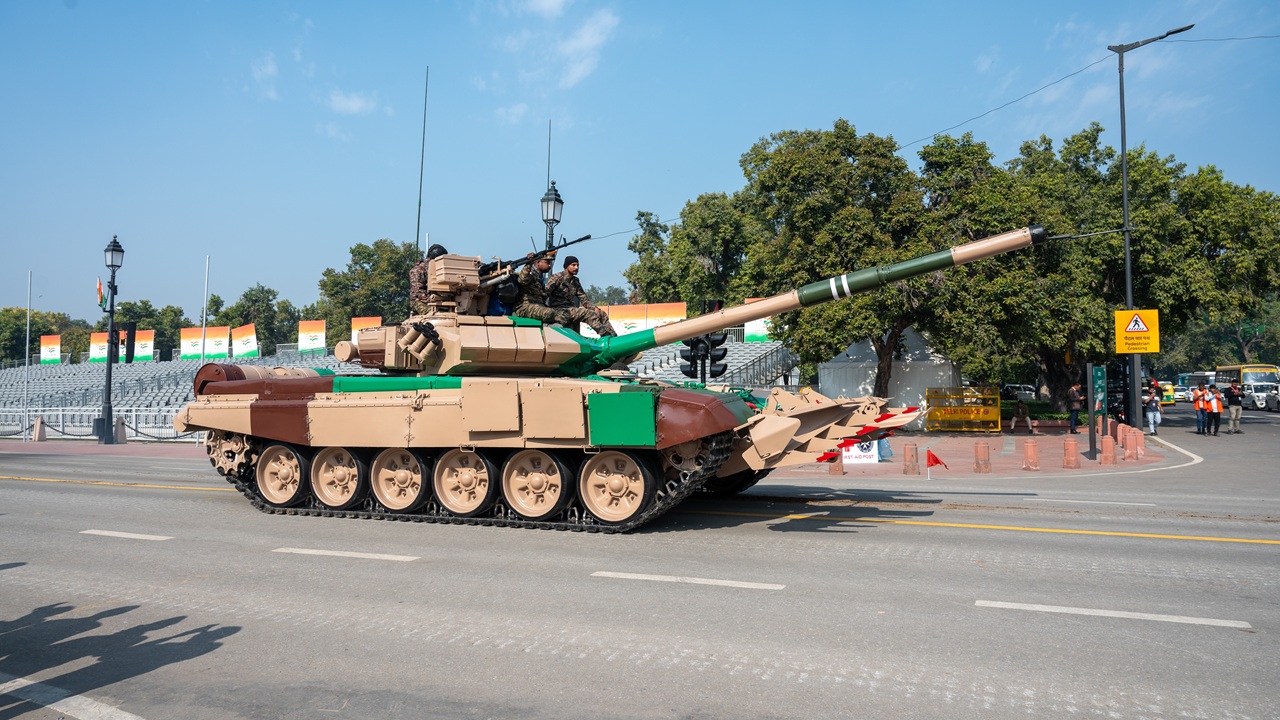
“Successful examples of Russia-India cooperation in the military-technical sphere include joint ventures for the production of BrahMos hypersonic cruise missiles (since 1998), the production of AK-203 assault rifles, and the licensed assembly of T-90 tanks, Su-30MKI fighters, and aircraft engines,” Russian state news agency TASS reported.
Despite pressure from Washington, New Delhi has adopted the Russian-made S-400 Triumf air-defense system and the Project 11356 frigate. The Indian Navy’s flagship, the INS Vikramaditya (R33), is the modified Kiev-class aircraft carrier that was sold to the Asian nation in 2004 and then refurbished in Russia.
India’s Defense Sector Is Gradually Becoming More Self-Reliant
However, Moscow may want to hedge its bets and find additional customers beyond India, as the trend line is against it. As SIPRI noted, India’s imports from Russia actually decreased marginally in the 2021–2025 period, relative to 2016–2020.
“The largest share of Indian arms imports came from Russia, at 40 per cent—a significantly smaller share than in 2016–20 (51 per cent) and almost half that in 2011–15 (70 per cent),” the think tank observed. “India is increasingly turning to Western suppliers.”
New Delhi has not committed to buying the Sukhoi Su-57 (NATO reporting “Felon”), the much-hyped fifth-generation stealth fighter, despite efforts from Rostec, Russia’s state-owned military and industrial conglomerate, and its export subsidiary Rosoboronexport. Even offerings of co-production and technology sharing have barely increased interest in the Su-57 from India.
Russia Is Losing Ground to China Around the World
Beyond India, another client state of Russia has decreased its arms purchases. SIPRI’s report found that Algeria, the only nation to purchase the Su-57, has cut its imports from Russia by 78 percent. At the same time, Morocco, its neighbor and regional rival, has increased its own purchases from the United States by 12 percent, becoming the largest arms importer in Africa.
Another major issue facing Russia is that China is increasing its domestic production of aircraft and other components. Beijing has relied on Moscow for aircraft engines for China’s advanced fighters, but China is learning quickly and will soon no longer need to import hardware.
That could spell trouble for the Kremlin well beyond East Asia. Russia’s value proposition for developing countries has long been that, although its aircraft are not quite as advanced as cutting-edge Western platforms, they are good enough to get the job done at a lower cost—and without supply chains contingent on political goodwill from the human rights-obsessed West. For many years, Russia has profited from that proposition. But China is increasingly competing with it around the world—particularly after the short India-Pakistan war in May 2025, in which Pakistan’s Chinese-built J-10 fighters performed better than expected against India’s Russian and European aircraft.
Finally, it may not be China that is gunning to overtake Russia in arms sales. As France is sitting comfortably in the number two spot, other European countries are increasing arms sales.
“Germany overtook China to become the fourth largest arms exporter in 2021–25, with 5.7 per cent of global arms exports. Almost a quarter of all German arms exports (24 per cent) went to Ukraine as aid (and another 17 per cent went to other European states),” SIPRI reported, adding, “Arms exports by Italy increased by 157 per cent, pushing it from the tenth largest exporter in 2016–20 to the sixth largest in 2021–25. Over half of Italy’s exports went to the Middle East (59 per cent), while 16 per cent went to Asia and Oceania and 13 per cent to Europe.”
Russia may hold on to the number three spot, but for how long is the question. One thing that would likely help its position would be to abandon its efforts to conquer Ukraine and seek peace—but this course of action seems unlikely, at least for now.
About the Author: Peter Suciu
Peter Suciu has contributed to dozens of newspapers, magazines and websites over a 30-year career in journalism. He regularly writes about military hardware, firearms history, cybersecurity, politics, and international affairs. Peter is also a contributing writer for Forbes and Clearance Jobs. He is based in Michigan. You can follow him on Twitter: @PeterSuciu. You can email the author: [email protected].