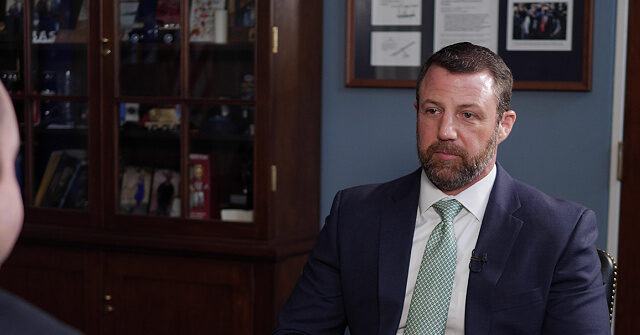
WASHINGTON — Sen. Markwayne Mullin (R-OK) told Breitbart News in a long-form exclusive on-camera interview in early February in his U.S. Senate office that the Chinese Communist Party (CCP) has had its plans for global domination through the Belt and Road Initiative disrupted by President Donald Trump.
The interview, which took place on Feb. 4 before Trump picked Mullin to succeed outgoing Secretary of Homeland Security Kristi Noem, is a big deep-dive into China’s expansionist vision and the efforts of the American government to counter those. Breitbart News had been planning to release the interview closer to Trump’s upcoming trip to China, where he is expected to meet with Chinese President Xi Jinping in early April, but since Trump shocked the world by selecting Mullin to lead the Department of Homeland Security (DHS) Breitbart News has decided to move the timeline of the publication of the interview up to now. It is a rare exclusive look into a major arena of national security by a prominent incoming member of the president’s Cabinet ahead of his Senate confirmation hearing before the Senate Committee on Homeland Security and Government Affairs (HGSAC), chaired by Sen. Rand Paul (R-KY).
The hearing was announced for next week on Monday. Usually, cabinet secretary candidates do not do interviews during their confirmation processes, and it is unlikely Mullin will do another one between now and when he is confirmed by the full U.S. Senate, which is expected later this month. But the strange timing of this pre-recorded interview on the threat of China, the president’s sudden appointment of Mullin, and the president’s trip to China upcoming later this spring creates a perfect storm that allows a unique situational window for Breitbart News readers and viewers into what the president’s new man in charge of Homeland Security thinks on China and the threats America’s greatest adversary presents to national security. It also represents an opportunity to see just how deeply Mullin has thought about and studied these issues of paramount importance, and how prepared he is for his new role in countering Chinese influence in particular.
“So let’s talk about the CCP first,” Mullin told Breitbart News when asked to explain the Belt and Road Initiative from the CCP. “The CCP, they look at themselves as a lasting government body of China. So we look at things as a four-year cycle when we have leadership. They have decided they’re going to have a 100-year plan, and this is underneath President Xi. They’re not a republic, they’re not a democracy. They’re a communist country that President Xi runs.”

(Matthew Perdie/Breitbart News)
Mullin points to former President Barack Obama’s failures to get the Trans-Pacific Partnership, or TPP, trade deal approved. That multilateral trade deal was highly unpopular in the United States and failed to make it through Congress — critics attacked it as “Obamatrade” — but the underlying point of it was meant to unite freer countries in the Indo-Pacific against China’s influence in the region. Since then, Trump has much more successfully, through other bilateral and multilateral frameworks, stepped up to counter China’s influence. Mullin also points to how former President Jimmy Carter flipped U.S. diplomatic recognition from Taiwan (or the Republic of China) to the Communist government on the mainland called the People’s Republic of China (PRC). The PRC, which the CCP controls, refuses to have formal diplomatic relations with any nation that maintains formal diplomatic relations with Taiwan.
Taiwan is now a democracy, but for decades after China’s civil war, it was a military dictatorship led by the old Chinese government that the communists on the mainland overthrew. They fell back to the island of Taiwan and held together the old “Republic of China.” The CCP has spent decades trying to force countries that still maintain formal ties with Taiwan — the Vatican and many Catholic, Latin American, and Caribbean nations among them — to flip diplomatic recognition as well. But more importantly than Taiwan or mainland China relations with various nations, the CCP has used the global landscape for the last several decades to build out a hegemony of influence that Mullin calls out directly in this interview — laying out how, like Trump has regularly pointed out, mistakes of several American presidents have helped fuel China’s rise.
“So this goes all the way back to the Pacific trade deal underneath Obama that didn’t go forward when it broke,” Mullin said. “You’re talking about the Trans Pacific Partnership — TPP. When it fell through, President Xi looked at it as an opportunity because they were waiting for a lot of partners out there. So they went, and they said, ‘well, why don’t we look at this as like this Silk Road?’ This goes back to ancient history of the Silk Road, where trade was moving in and out of China. It all started really with the interesting colors that they had, and the gunpowder, which a lot of people weren’t familiar with. The Silk Road continued to grow from there. And then they lost it when sea lanes opened up, when different trade opened up, and more isolated China became. Well, go back to Jimmy Carter, bringing them out of really the Dark Ages into the world trade. They had been stumbling trying to figure out how to get a foothold. They really got upset during the economic downturn with our housing bust in 2008. So they’re looking for an opportunity, and that opportunity started when we didn’t finish the trade partnership. So in ’13 they said, ‘let’s do a Belt and Road Initiative.’ So what is a Belt and Road Initiative? This is a 100-year plan. They said, ‘okay, since the United States changes policies every four to eight years, we need to have 100 years for stability and make all roads run through China.’”
Mullin said the CCP has been trying to have the Yen replace the U.S. Dollar as the world’s reserve currency and to pick off U.S. trade partners worldwide.
“They don’t like the idea that the dollar and not the yen, but the dollar is the currency,” Mullin said. “They didn’t like the idea that the trading partners wanted to trade with the United States more than they wanted to trade with China. They didn’t like the idea that 70 percent of their economy in 2013 was dependent on the U.S. economy. So when our economy turned, their economy turned. I was there in 2013. I met with them, and they were extremely upset.”
Mullin also added later in the interview that the Chinese are not “good Samaritans” and are trying to execute a “China first” worldview.
“They’re going to control the currency, they’re going to control the manufacturing, going to control your health care, and you’re going to be indebted to them, and you can’t have economic trade without going through China,” Mullin said. “So it’s a form of discipline that alone should scare people that they’re not interested in being good Samaritans. They’re interested in a China-first agenda. And that’s what the Belt and Road Initiative is: a China-first agenda.”
But beyond that, the broader theme of the Belt and Road Initiative, he said, was a historical reference designed to have trade routes that resembled the old historical Silk Road, but also the “belt,” which he said the CCP uses to enforce its will on the rest of the world by force.
“So this Belt and Road Initiative, if you understand it — what is the belt and what does the road represent? So, it’s not just simply a catchy name,” Mullin said. “It actually has meaning. Everything that China does, they usually target what they’re doing. So the road itself, meaning it’s a road that goes around the United States that has exit ramps and on ramps. And they want all those roads to go through China. They want health, so they have a Belt and Road Initiative for health care. They have a Belt and Road Initiative for AI or technology. They have a Belt and Road Initiative for manufacturing. They have a Belt and Road Initiative for ports, and for military, and for ship building. So they wanted it all to have to funnel in and out.”

(Matthew Perdie/Breitbart News)
Mullin continued, “What’s the belt represent? The belt is not just simply what people think — it’s to keep it tied together, which is true. So as they build it, they build a belt around it, and they do that by getting countries in debt to them. So they go to these poor countries in Africa or in Central and South America, and they offer them a tremendous amount of money — up to this point over $1.2 trillion — and they get them indebted to them. They offer to build them government buildings. They offer to build them a port. But when they do that, they don’t employ the people from the country. They then ship out their own constituents … And that’s part of their initiative. It’s called the Great Migration, the Belt and Road Initiative, the migration. … They put in their own people to build the infrastructure. And then when they can’t do it, they take it. So that’s the belt. But the belt also has a different meaning. The belt is a way of discipline. So if you go back to the history of the belt, of the original garment that you see, traditional garments from the Chinese where they had a belt around them. That belt was designed to do two things: to hold the garment together. That’s to hold the project, hold the road together. But it was also a form of discipline. So after a while, they use the belt to tighten up.”
To implement this agenda, Mullin said the Chinese Communists “go to strategic areas.” He pointed specifically to the Western Hemisphere as a place they have very aggressively targeted, an interesting point given Trump’s recent Shield of the Americas Summit. Trump specifically is putting Mullin’s predecessor, Noem, into a role of being special envoy to this effort. But it is worth noting that Trump has been very, very active in the Western Hemisphere — from the raid on Venezuela that saw the capture of Nicolas Maduro to his push to eliminate Chinese influence over the Panama Canal to his work on Cuba and more.
“First of all, let’s look at what they did in our hemisphere — the Panama Canal,” Mullin said. “Interestingly, we paid for that, right? Sure, and then we decided to give it to Panama. Well, Panama wanted some infrastructure done to it because [then-President Bill] Clinton turned it over to them in the 90s. They want some infrastructure to it. So they turned to Hong Kong at the time and said, ‘Listen, if you’ll invest in the entry points, both ends of the canal, we need ports set up. We need a place to build it, to extract the payments, set up the checkpoints, see what’s going through it for security purposes.’ China’s like, ‘Hey, we’ll do this.’ That was before the Belt and Road Initiative was actually in full swing. But they saw a strategic place because now they control that very strategic, important channel, not just for commerce for us but for our fleet, our Navy fleet, coming in and out of the Pacific moving to different areas. It cuts down almost two weeks of travel from having to go all the way down around South America.”
Mullin said the Chinese work on the Panama Canal intrigued them and got them interested in using ports worldwide to exact control. Since then, the CCP has been very active in building or taking over ports from around Asia, throughout the Middle East, and into Europe and elsewhere worldwide.
“That was their first port. Then they started looking at different waterways,” Mullin said. “Well, if they can get Panama, what about the Suez Canal? What about around the Horn of Africa? What about the different ports that have traffic moving in and out? So it’s not just about the port itself, but it’s about controlling the commerce and building to have areas set up for strategic purposes in the case of war — or in the case of economic war — to which they can close the ports real easy. If they control the ports to the country, they control the country because you can’t get things in and out. So what they’ll do is they’ll go into the country, and they’ll say, ‘Okay, listen, we’re going to first build your government buildings, but you got to use our hardware. So you got to use our technology — Huawei. You got to move. You got to use our 5G, what we consider 5G.’ It’s so laced with spyware that there’s nothing that can be done in and out of that building. I’ve traveled all over Africa. I’ve been in a lot of countries in Central and South America where Huawei is there.”
Mullin explained, “We don’t even take our phones off the plane — like, we shut them down before we land, shut them completely off, and put them in controlled bags so there’s no signal that can be brought out because of Huawei technology because they literally steal everything that the government is doing. Then they get indebted to them, and they say, ‘Well, why don’t we get a partnership? Instead of just us having their government building, why don’t we do a partnership with you, and a way for you to be able to pay it back? We’ll, we’ll build a port for you. We’ll take a percentage of it, you take a percentage of it, and the percentage that you have, we will use for debt. So we’re going to help you pay off your debt because we’re going to go into business for you.’ The problem is that it never makes money, and they do it on purpose.”
After that, Mullin said, the Chinese started taking over security apparatuses in various nations. But one place China has failed significantly, he said, is in dealing with Western concepts of freedom of speech and the news media — partially because, he argued, Chinese President Xi Jinping has complete control over the media in China, so he did not realize that in much of the rest of the world, a free press is a check on government control.
“Really what they’re doing is they’re slowly taking over the country, and they’re moving it from maybe a democratic country to a communist country. So that’s their whole play, at the same time, taking over strategic places. They do it slowly,” Mullin said. “What they don’t understand, and what China is getting better at understanding now, is the media they control. The message in China, no one receives any information through TV or through your phone that isn’t controlled and seen by Beijing, so they thought they control the same narrative in every country they go to. President Xi has never had to deal with media or communications that he didn’t control. So people have started catching wind of what they’re doing. As every country that you talked about. I haven’t met one country right now that says, ‘Oh, wow. This was a great idea, partnering with China.’”

(Matthew Perdie/Breitbart News)
China was making significant headway worldwide until Trump’s first term in the White House, getting Western nations like Greece and Italy to join its initiatives. But then COVID hit the world, and Mullin said that the Western world’s dependence on Chinese supply chains was thrust into the international spotlight. Trump, he added, was warning the world to steer clear of the CCP. But when now-former President Joe Biden came in, all this work to counter China worldwide was paused or halted — and it is Trump’s return that he said has accelerated it. Trump, he said, was not even playing chess with China directly — he said Trump knocked over the chessboard entirely and disrupted China’s plans.
“It [COVID] really woke people up to that — to the dependency that we had on China,” Mullin said. “But none of this would have taken place if President Trump wouldn’t have been in office. And what I mean by that is you didn’t see Italy, you didn’t see Peru, you didn’t see even what happened with India and Brazil recently, who said they weren’t going to participate in the BRICS, which is a supposed to be a contingency to NATO and the war games that they had that Brazil and India said, ‘No, we’re not participating.’ That wouldn’t happen without President Trump’s leadership. What I mean by that is, underneath Biden, people were concerned about what was happening in the U.S. You didn’t see a forward approach to the foreign policy. In ten years, we had let China basically get a hand in almost every single country in Central and South America with the exception of one. I won’t mention the name because they’ve been able to stay a little bit under the radar. But there was actually an internal river that China was charging a tax for because they controlled the port that the country that the river exited out of went into the ocean, that they controlled it. So they controlled ships going in and out, and it was to pay off the port. It was for the port infrastructure, which was forcing all the other countries that weren’t part of the Belt and Road Initiative to join. Because President Trump was able to jump in and say, ‘Wait a second, we’re not playing chess with you anymore. We’re tipping over the chessboard,’ it allowed these other countries to have a hand to go in and say, ‘We do agree. We need to diversify out of China. We need to move away from China. We can’t allow it.’ It all started with the PPE gear … When President Trump said, ‘We’re going to bring that manufacturing back in the United States. We’re going to bring the chips back in the United States. We’re going to quit being so dependent on China. We’re going to bring pharmaceuticals back to the United States.’ Remember, roughly 70 percent of all pharmaceuticals used to be made inside the United States. We make less than one percent now of antibiotics. That’s scary. Over 80 percent of the world’s antibiotics are made in China. That should scare the daylights out of people. Everybody noticed it, but they didn’t pay attention to it until COVID. So I think they overplayed their hand with COVID. China did, but President Trump, by stepping up and showing strong leadership, saying, ‘We’re going to change this,’ gave these countries a backbone to be able to start pulling away. That belt was getting tight on them, and people saw it.”
When it comes to Taiwan, Mullin argued in his interview with Breitbart News that the island nation is extremely important because of its semiconductor chip manufacturing. Mullin recounted some of the history again of former President Richard Nixon’s trip to China to try to help the U.S. win the Cold War against the now-defunct Soviet Union and then later Carter’s decision to flip diplomatic recognition from Taiwan to the CCP — and then of course now-former President Ronald Reagan’s Six Reassurances to Taiwan that stabilized the U.S.’s informal relations with the nation after Carter’s switch. But during all of this, Mullin said, historically, nobody was paying attention to the importance of chip manufacturing, which was building up in Taiwan. Taiwan’s chips are in basically every major modern device and are of critical importance to the survival of Western civilization.
“So go back to Jimmy Carter. The Jimmy Carter foreign policy towards China was actually President Nixon’s — so President Nixon had been put out to rest, which by the way I think President Nixon doesn’t get near as much credit for his foreign policy, but he’s also the creator of China because he came in the Cold War about beating Moscow,” Mullin said. “By trying to cut out and separate, he believed that China could be if they got economic ties to the United States, and we allowed to have trade with them that we could bring them — we could open our eyes — and we could bring them out of the Communist Party to which they were running. Remember, it was young. It was pretty young at that time. So Nixon was the one that went in there and actually negotiated the deal for Jimmy Carter, which like I said, gives us what we have today.”
Mullin continued, “When Taiwan separated, it was put in a situation with the United States because the United States was fighting the Cold War. They were fighting against the communist influence around, that Russia and China were trying to spread at the time. So we felt like we needed to start working with Taiwan. But it was a delicate dance because we were bringing them in at the same time we were trying to protect Taiwan. When Reagan came in, he started working on some of the trades with Taiwan, and then as things moved on, there was this small little industry that no one was paying attention to called chip manufacturing, and no one saw it being as important as it is right now. So Beijing looks at Taiwan not necessarily as ‘we need to unite the country.’ It’s the importance that they have. They want to control the chip manufacturing. Why is the chip manufacturing so important? The specific chip that they’re talking about, every iPhone is dependent on, almost every defense system we have is dependent on it, your vehicle that are driving today — since our vehicles are all electronic now except the motor that’s underneath the hood — all depends on the chip. Ninety percent of the chips are made in Taiwan. Ninety percent of the world chips are in Taiwan. That is a major importance to the Belt and Road Initiative since China is being outflanked right now by President Trump.”
Since Trump is outmaneuvering China’s Belt and Road Initiative, Mullin said that Latin America, Africa, and even European nations are flipping against China and siding again with the United States in a major geopolitical coup for the West.

(Matthew Perdie/Breitbart News)
“You’re having countries in Central America drop out,” Mullin said. “You’re having countries in South America drop out. You’re having countries in Africa that are starting to say, ‘You already bankrupted us. What else can you do to us? So get lost.’ You have countries in Europe, because of Italy’s boldness — which we were there talking to the leadership two weeks before they were going to make a public announcement. I was in Italy, we made a trip, I was over there in that region, and they said, ‘We’d like to talk to you.’ So we flew to Italy specifically to visit with them, and they told us what they were going to do. I could not believe I was hearing this come out of Italy. Italy is not always friendly to the United States, but I could not believe that they were saying this, and they were explaining it to me in depth. They haven’t released everything yet because it’s still classified, but it’s amazing what happened to teach them to do that. Now, Italy is telling other countries, ‘This is what happened, and now this is what’s going on.’ So they’re watching them go through, and so Taiwan has become important to China because they’re saying, ‘Since we’re losing this influence, this is in our backyard. We need this.’”
In addition to chip manufacturing, Taiwan’s geopolitical position as the first major island off the mainland of China — with major seaways through the South China Sea and the Taiwan Strait passing by either side — makes it of utmost importance.
“Talk about the shipping lane. So why is the shipping lane so important? It’s not about the stuff you buy at a Walmart,” Mullin said. “It’s not about the little trinkets that you buy, souvenirs. It’s about the stability of China’s economy. China has rare earth minerals. There’s no question they have the lead on rare earth minerals. What they don’t have is energy. They don’t have coal, they don’t have gas, and they don’t have crude oil. So they’re dependent on the rest of the world for those shipping lanes. So if you’re looking at trying to keep the shipping lanes open and their strategic point of China, Taiwan is the first island chain that is a jump into the United States. If they can control the first island chain, then they can start the first island on the island chain. Then they can start slowly, pick that up, and secure — in a time of war — secure that shipping lane in between, there in between the islands that can continue that flow of natural resources. It’s not lost on them. What lost Japan the war was our ability to isolate them, right? Because they were really similar to China. They didn’t have the natural resources they had stockpiled, and they had tried the best they could to be prepared for war, but they knew they couldn’t sustain a long war. They knew the longer the war went on, the more it was going to be devastating for them. China is looking at that same situation. They’re in the same boat except their neighbor, which they could possibly get some from, is a friend of theirs called Russia. But if Russia is in an all-out war, then their resources are going to be utilized for them and for their manufacturing because you can’t build anything without energy. It doesn’t exist. You can’t manufacture one single thing if you don’t have electricity, and then you can’t run something on just electricity either unless you have something powering that. So it’s still going to take fossil fuels. Those shipping lanes are what they’re trying to control with Taiwan as not the entire shipping lane, just because the Taiwan Strait or the South China Sea, it is just the beginning. It’s just the mouth. But they know that that’s a foothold that they need to start moving in for the Belt and Road Initiative.”
Again, this interview took place several weeks ago in early to mid-February, so it was recorded before the president’s recent decision to take military action against Iran. Nonetheless, Mullin detailed how actions Trump has taken to secure energy production worldwide, and the president’s use of energy as a geopolitical tool has helped the interests of the United States.
“I would say it’s turning for the first time in a decade, and so let’s look at what is the backbone of economy? We just mentioned that the backbone of economy is energy, right? Because they can’t produce anything without fossil fuels and that’s one thing that China doesn’t have,” Mullin said. “So I say that because if you read President Trump’s book — which President Trump’s a dear friend of mine, and if you read his book — the art of negotiation is that you always negotiate from a point of strength. So let’s look at what’s going on right now, why the president is now engaging with them fully, where he’s reaching out, saying, ‘Let’s have this meeting.’ So Beijing has been buying their oil on the black market, right? They’ve been buying it from Venezuela at a 30 percent discount. They’ve been buying it from Russia at a 30 percent discount. They’ve been buying it from Iran with a 30 percent discount. They’ve been using Venezuela as a staging point. They’ve been using Cuba as a staging point. So the first thing that President Trump did is he started putting pressure on Iran and on Venezuela at the same time. When they went in and they took Iran or took Venezuela, that took roughly 140,000 barrels of oil a day from China, where they can no longer buy it at 30 percent off — they can still go buy it on open market, but they’re not buying it at this significant discount.”

(Matthew Perdie/Breitbart News)
“The Yen is falsely over-inflated right now or under-inflated,” Mullin said, “and it hasn’t actually been fully tried on against the dollar because Beijing doesn’t get their real records out and they’re able to keep their products low and their inflation somewhat low because they’re able to control their energy costs because they’re buying all this stuff at a discount. Then you look at what happened, what’s going on in Iran, what happened in Iran with the uprising, and then the president systematically going after the ghost ships. Now, we knew these ghost ships were out there, roughly a fleet of 1,000 of them, but we haven’t actually attacked them. We haven’t actually used resources. We’ve known they’ve been out there for decades, but we haven’t actually paid attention to them. Now the president is disrupting those shipping lanes, which mind you, is very important to China. It’s taken over a million barrels a day from Beijing at a cheap price. Now, Beijing only has 90 days of supplies of the cheap oil. Now they’re down to roughly 25 days. There’s a reason why President Trump set this for April. Because in April, China will have to be buying this crude at a full price, at market price. At this point, they’re going to start noticing that they can’t continue to subsidize this manufacturing, they can’t continue to subsidize the countries that they had this partnership with, and they’re going to be not in a panic but they’re going to be almost in a point of, ‘Okay, we’re going to have to do something.’ Not going to strike a deal in April, but it’s going to the beginning of the squeeze come June. That squeeze is going to get real. By the end of the year after the midterms, that squeeze is going to be hurting, and that’s when I think you’ll probably see a strong deal if a deal is going to be struck. But what was Beijing wanting to do in 2027? They said by 2027, they want to be fully prepared to go into Taiwan. Because of this shift, this economic shift, this is going to set Beijing back, and Beijing feels like they have time, so they’re not going to force anything. They’re going to try to outmaneuver President Trump. But the world has woken up. President Trump has woken the world up to what Beijing was really doing, and it’s going to, even when President Trump leaves office, they’re not going to be able to regain the footing because President Trump isn’t even playing chess with him. President Trump has kicked over the chessboard, and he’s brought Beijing back to the table, and they know it.”
Mullin also detailed how Trump’s negotiation tactics worldwide also rely on “timing” as an important tool.
“The Art of the Deal also talks about timing. You got to know when the timing is right,” Mullin said. “So people weren’t excited about paying 25 percent tariffs, 18 percent tariffs, right? They weren’t excited about having to renegotiate their deal, but they had two options, right? They knew the tactics of China. China isn’t there to just partner with you. China has come there to take over your country. China is coming over to influence your country. They want to. They want to take over your economy, where they want you to be indebted. The United States doesn’t operate that way, and so when they had a little bit of a taste of it because of their dependency for the PPE gear and other medical supplies coming out of Beijing during COVID, the timing was right for the president. People were hungry. China overstretched themselves during Biden because they looked at Biden as being a very weak leader, and they thought the United States had lost their way. They didn’t think President Trump was going to win reelection. So they doubled down thinking, ‘If we get four more years with this administration, not Trump’s administration, but the Biden or the Harris administration,’ and I’m not trying to throw them under the bus, I’m just saying what they were doing politically. They thought that they would be able to complete their Belt and Road Initiative in 25 years instead of 100 years. But because they overleveraged themselves — they pushed too hard — and President Trump was able to strike when the iron was hot and said, ‘You’re going to come back to us, but we’re going to renegotiate this deal.’ What we didn’t really anticipate is Canada pushing the way that they have. I wouldn’t say we wouldn’t anticipate it. We just didn’t see the political change in Canada. We want to have a good relationship with Canada, but in President Trump, it was the one that started working on the Keystone pipeline, right? He wanted to finish Keystone pipeline, but China or Canada really surprised us in some of the antics that they were doing. Our economy has been tied together for quite some time, but they definitely had a better trade deal with us than we did with them. The president said, ‘We’re going to right this wrong.’ Canada’s doubled down with China. The president says, ‘Hey, better pay attention here. One, we’re not going to let China get a foothold on us. They’re not going to go up above us and get a strong foothold, but two, they’re going to ruin you.’ He said it very clear: ‘It’s going to run you.’ All they got to do is look around at the other countries just pulling away from China, and they don’t trust them. Go talk to Italy — they don’t trust them. Go talk to Brazil — they don’t trust them. Go talk to India — they don’t trust them. Go talk to France — they don’t trust them. Go talk to Greece. Go talk to any country you want to in Africa that they’ve got ties with, and so it’s kind of surprised us the reaction, but the rest of the world is going, ‘No, no. We want President Trump. We’d rather negotiate with him than President Xi, who is a communist leader, because we at least have stability with the United States. We know they’re not going to try to take over our country.’”
One place where Mullin might have some major influence in his new role at DHS is stopping China from investing in U.S. land and other businesses.
“Well, President Trump is well aware of the influence of China,” Mullin said, adding that “China is so entwined in our financial sector right now that we’re having to peel away the onions.”
“What I mean by that is it isn’t the CCP and Chinese Communist Party that’s buying up land,” Mullin continued. “It’s not the CCP that’s going in and buying up companies, strategic manufacturing companies, investing in them. They’re investment firms that the CCP may provide the seed money from, but it wasn’t from the CCP. It was from a billionaire from China that has ties to the Communist Party, but they’re using a cousin of a cousin of a cousin of a cousin.”
He mentioned several investigations into Chinese influence operations by a number of agencies, including the U.S. Secret Service, and how Trump is combating this for the first time in generations.

(Matthew Perdie/Breitbart News)
“He’s put the might and the force of the United States to start looking at this,” Mullin said. “The first thing we started doing is we started looking at critical infrastructures. What is being bought and sold around critical infrastructures, and who that really is — who is actually investing in these companies, which is why the president has went out and is making trade deals specifically with countries that we can trust, that had investments in China and wanting them to come to the United States. The president has made it very clear on strategic points, like Panama, like equipment being used for lifts and cranes that are being used in our ports, especially electronic, non-manned ones, electric vehicles, technology companies that’s coming in, technology products coming in and out, our transformers that were so dependent on China for so long.”
Mullin also mentioned in this interview the need to protect the skies, particularly in space, and how Trump, in his first term, rolled out Space Force. “The second thing we got to protect is what’s in the sky,” Mullin said. “So the president came out in his first term, and he created the Space Force. Everybody laughed at him. You remember the Democrats laugh at him saying, ‘Oh, this is just a Trump thing.’ No, he recognized the threat. Because technology was moving so fast that he didn’t even know Starlink was going to be as successful as it is today. But he saw the future because he’s a business guy, and he knew that we’re going to have to invest in there. Because who controls the space, the same person who controls the seas — the space is the new seas. God forbid, we have another world war, that fight is not going to be happening in the skies that we can see, but in the skies in space.”