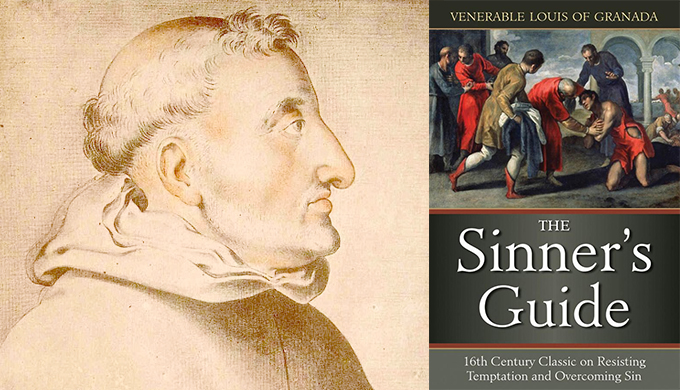
Five hundred years ago this year, a twenty-one-year-old Spaniard made his religious profession as a member of the Order of Preachers, the Dominicans. That man, now called Venerable Louis of Granada, though little known now, was once described as “the writer of the Spanish empire.”
Indeed, Fray Louis died in 1588, the same year as the disastrous Spanish Armada’s defeat at the hands of Protestant England. A new edition of one of his most famous books, The Sinner’s Guide, a translation published in 1883 (and enjoying the imprimatur of a then-Boston Archbishop), presents an opportunity to reconsider this oft-overlooked theological master.
One of the greatest spiritual writers of the sixteenth century
Born in destitution, Louis’s courage and intelligence attracted the attention of the Count de Tendilla, Mayor of the Alhambra, who placed Louis under his patronage. After an excellent education, Louis received the habit of a Friar Preacher in 1524. In 1534, he offered to serve as a missionary to Mexico, but his superior commanded him to cancel his trip. Five years later, in 1539, he wrote a small tract on the method of prayer for a student who had asked him for advice. In contrast with the style of Renaissance humanists, the requested product was surprisingly straightforward. It was eventually transformed into a work that would make Fray Louis’ name: The Book of Prayer and Meditation.
By the late 1540s, Fray Louis was in wide demand as a preacher and spiritual director, even among European royalty. Around 1552, Queen Catherine of Portugal, sister of the Holy Roman Emperor Charles V, selected him as her confessor and advisor. He spent most of the remainder of his life in Portugal. He was regularly called upon to help resolve problems among the royalty, though he viewed such participation in worldly affairs as a distraction and even a cross.
Fray Louis was a man of incredible humility. He turned down Queen Catherine’s offer of the archbishopric of Braga, which would have made him Primate of all Portugal. Likewise he refused the honors of the cardinalate, offered to him by Pope Sixtus V. “Fray Louis could have lived in the palace, but since childhood he was espoused of poverty and he disdained the delights and comforts of the world,” write Fr. Alvaro Huerga, O.P. “He dressed in such poverty that he wore the same hat for forty years and his black cappa was worn and patched with twelve years of use.” He would rise at four in the morning and spend two hours at prayer, followed by the daily celebration of the Mass at a time when priests were not accustomed to celebrating Mass every day.
His works enjoyed remarkable popularity among some of the greatest saints of the sixteenth century. Teresa of Ávila called Louis “a man given to the world by God for the great and universal good of souls,” and claimed that his The Sinner’s Guide converted a million souls. St. Charles Borromeo, also a contemporary, wrote:
Of all those who up to our time have written on spiritual matters… it can be stated that no one has written books either in greater number or of greater selection and profit than Fray Louis of Granada. … In fact I do not know if in matters of this type there is today a man more beneficial to the Church than he is.
St. Rose of Lima adored his books and is said to have always had them at hand, particularly The Book of Prayer and Meditation. St. Vincent de Paul and St. Louise de Marillac were also devotees.
In 35 years of writing, Fray Louis authored 49 works of spiritual theology, apologetics, hagiography, sacred oratory, and translations. Four are considered masterpieces of spiritual theology: The Book of Prayer and Meditation, The Sinner’s Guide, Memorial of the Christian Life, and Introduction to the Creed. St. Francis de Sales declared that Memorial of the Christian Life included all that could be said or that one could wish to say about the topic. Though his books are difficult to find now, they have been translated into 25 different languages and gone through hundreds of editions. The Japanese version of The Sinner’s Guide is considered having sustained the faith of Japanese Catholics during two centuries of violent persecution.
One of the reasons for Fray Louis’ popularity was his ability to wed common sense to passionate orthodoxy. Fr. Huerga explains: “Fray Louis’ writings are neither dry nor difficult; they breathe fire and life, touching the heart of the reader and motivating him to seek God’s will as the only source of true happiness.” Indeed, his writing was so clear he was accused of “writing for the wives of carpenters,” and his zeal so apostolic that he was criticized for wanting “to make all Christians perfect,” as if that is not exactly what Jesus exhorted us to be (c.f. Matt 5:48). Thus was Fray Louis described as both a “theologian of the people” and “the Spanish Cicero.” His Spanish biographer Nicolás Antonio declared: “Our nation has never had a greater or more useful man, and perhaps it will never again have one to equal Louis of Granada.”
Recovering Fray Louis’ renown
Given such praise, it is a marvel that his books are so little known today, with far more Catholics familiar with the writings of such Catholic Reformation saints as St. Teresa of Ávila or St. Francis de Sales. The Sinner’s Guide offers an excellent introduction to the Spanish Dominican’s continued spiritual relevance. The text is loosely divided into several sections: eleven motives for practicing virtue and twelve privileges of virtue, a discussion of various reasons people neglect virtue, remedies against such sins as pride, covetousness, lust, envy or gluttony; and an extended exploration of man’s duty to himself, his neighbor, and to God.
One of the most arresting qualities of Fray Louis’ writing is the remarkable diversity of sources he uses to teach Catholic doctrine. The Sinner’s Guide effortlessly moves between Holy Scripture, classical sources such as Aristotle and Seneca, church fathers such as St. Augustine and Gregory the Great, and medieval scholastics such as St. Thomas Aquinas and St. Bernard. In a chapter discussing the terrible power of lust, Fray Louis shifts from the biblical story of David’s wicked son Amnon, who lusted after his sister Tamar, to Dido, Queen of Carthage, as described in Virgil’s Aeneid. “Can there be a more terrible slavery?” he asks. “We call a man a captive who is placed in prison and bound with chains, but his bondage does not equal that of a man whose soul is the slave of an inordinate affection.”
Fray Louis’ writings often evince a poetic piety. In a discussion of the Incarnation and Atonement, we read:
What mortal tongue can explain this ineffable mystery? Yet it is equally impossible for me to speak or to be silent. Silence seems ingratitude, and to speak seems rashness. Wherefore, I prostrate myself at Thy feet, O my God, beseeching Thee to supply for my insufficiency…
Elsewhere, he demonstrates that characteristic ability to describe complex religious realities—such as the incredible mercy of a holy, infinite God willing to descend to sinful and finite man—in the most accessible terms. “Can we think of two beings more widely separated than God and the sinner?” Fr. Louis asks. “Yet where will we find two beings more closely united?”
And his words are capable of bringing remarkable comfort to the Christian struggling with the question of whether a seemingly distant God actually loves him among so many others. “Think not, O man, that thy debt is less because God suffered for all men as well as for thee. Each of His creatures was as present to His divine mind as if He died for him alone.”
I easily could go on for many pages. The truth is that Venerable Louis seems just as capable a guide to Christian spirituality as St. Francis de Sales in his Introduction to the Devout Life or St. Alphonsus Liguori in Uniformity with God’s Will. I encourage you to take the advice of some of the most popular saints of the sixteenth and seventeenth centuries, and learn from the wisdom and piety of this overlooked Spanish spiritual director.
If you value the news and views Catholic World Report provides, please consider donating to support our efforts. Your contribution will help us continue to make CWR available to all readers worldwide for free, without a subscription. Thank you for your generosity!
Click here for more information on donating to CWR. Click here to sign up for our newsletter.