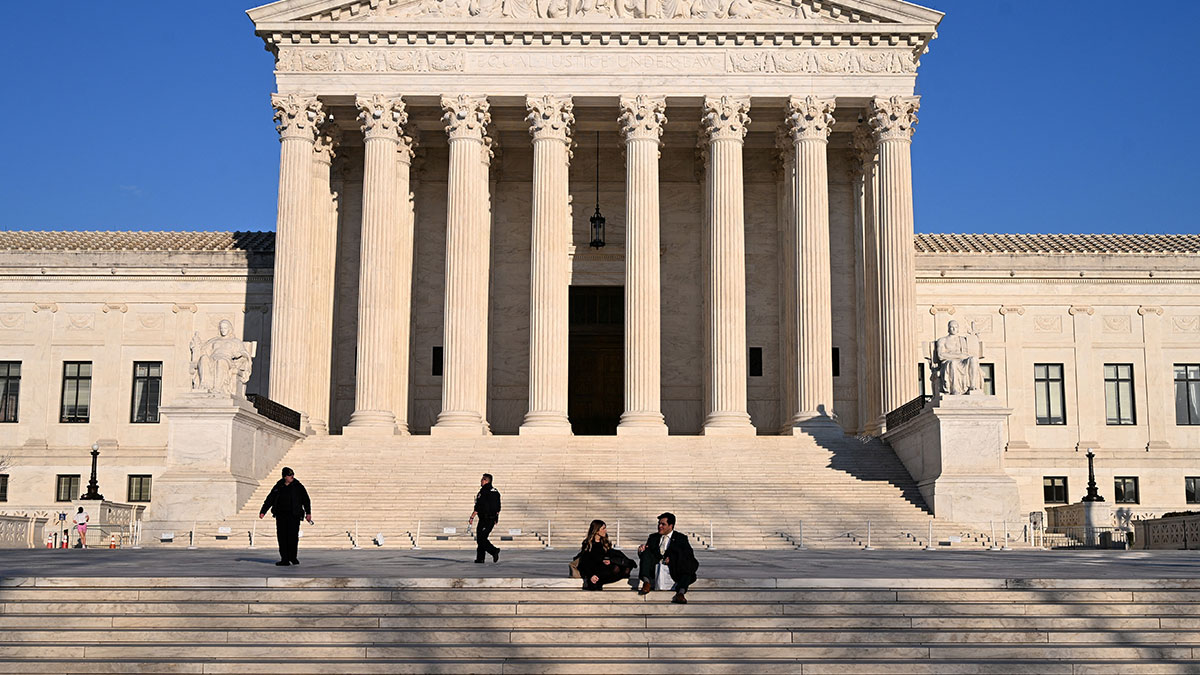
The Supreme Court’s Tuesday decision in Mirabelli v. Bonta marks a turning point in the fight over whether public schools may socially transition gender-dysphoric children without informing their parents. In lifting the Ninth Circuit’s stay of a district court injunction against California’s parental-exclusion policies, the Court has signaled that parents are more than just bystanders in the upbringing of their own children.
At issue were California policies that prohibit public schools from informing parents if their child adopts a new gender identity at school, unless the child consents to his or her parents being told. The state instructed teachers to use new names and pronouns and to withhold information about those changes from parents, even upon the parents’ request. Both parents and teachers challenged these rules as violations of the First Amendment’s Free Exercise Clause and the Fourteenth Amendment’s protection of parental rights.
Finally, a reason to check your email.
Sign up for our free newsletter today.
The Court’s unsigned opinion concluded that the parents are likely to succeed on the merits, meaning their constitutional claims are presumptively valid. California’s policies, it explained, trigger strict scrutiny—the highest standard of judicial review—because they “substantially interfere with the rights of parents to guide the religious development of their children.” The parents in this case hold religious beliefs about sex and gender. By facilitating social transition at school while cutting out parents, the state’s policy imposes “the kind of burden on religious exercise that Yoder [Wisconsin v. Yoder, an important precedent] found unacceptable.”
The Court was equally clear about the constitutional significance of parental rights. Citing Pierce v. Society of Sisters and Meyer v. Nebraska, the opinion reaffirmed that parents possess a longstanding right “to direct the upbringing and education of children under their control.”
That right includes participation in consequential decisions affecting a child’s mental health. Gender dysphoria, the Court noted, “is a condition that has an important bearing on a child’s mental health,” and California’s policy “facilitates a degree of gender transitioning during school hours,” while concealing that fact from parents. Such a regime likely violates the Constitution.
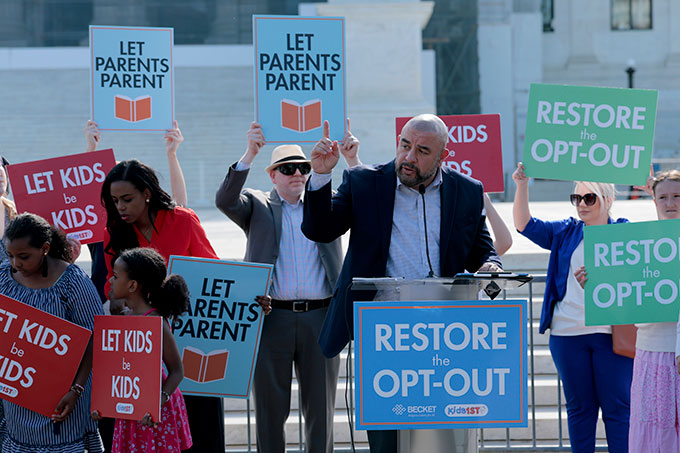
Importantly, the Court rejected the Ninth Circuit’s cramped reading of last year’s decision in Mahmoud v. Taylor, which held that public schools burden parents’ religious exercise when they require children to participate in instruction involving gender-identity materials without opt-outs. The lower court had dismissed Mahmoud as a “narrow decision.” The Supreme Court disagreed, explaining that California’s policies “likely will not survive the strict scrutiny that is required.”
Justice Amy Coney Barrett’s concurrence, joined by Chief Justice John Roberts and Justice Brett Kavanaugh, underscored that this case involves nothing novel. The parents “are likely to succeed on the merits under a straightforward application” of established precedent. Barrett also dismantled the dissent’s suggestion that Dobbs v. Jackson Women’s Health Organization (the case that overturned Roe v. Wade) undermined parental-rights doctrine. Dobbs rejected the freewheeling expansion of unenumerated rights untethered from history and tradition. It did not call into question deeply rooted precedents, like Pierce and Meyer, that protect parental authority in education and childrearing.
Justice Elena Kagan’s dissent, joined by Justice Ketanji Brown Jackson—Justice Sonia Sotomayor also dissented but didn’t join Kagan’s opinion—criticized the Court for acting on its so-called emergency docket, claiming that the majority “already knows what it thinks.” But interim relief requires courts to assess the likelihood of success. As Barrett noted, when the balance of equities strongly favors one side and constitutional rights are at stake, granting relief is hardly radical.
Though it’s an abbreviated ruling at the interim-relief stage, the broader significance of Mirabelli is profound: we may in retrospect call this moment Mirabelli dictu. Across the country, school districts have adopted policies that treat parents as obstacles rather than partners in education. Some educators insist that concealing a child’s gender transition is necessary for the child’s safety. But the Constitution doesn’t permit the state to displace parents’ moral and medical authority based on ideological disagreement.
The Manhattan Institute has been at the forefront of this debate. We’ve filed amicus briefs in cases challenging similar parental-exclusion policies nationwide, including Foote v. Ludlow School Committee and Littlejohn v. Leon County School Board—both now the subject of certiorari petitions before the Supreme Court. In those cases, as in Mirabelli, parents allege that schools socially transitioned their children without notice or consent.
The tide is turning, the constitutional questions are converging, and the Court appears increasingly prepared to provide clarity.
Top Photo by Alex WROBLEWSKI / AFP via Getty Images
City Journal is a publication of the Manhattan Institute for Policy Research (MI), a leading free-market think tank. Are you interested in supporting the magazine? As a 501(c)(3) nonprofit, donations in support of MI and City Journal are fully tax-deductible as provided by law (EIN #13-2912529).
Source link