In Iran, Victory Is Non-Negotiable
The real stakes of the confrontation with Tehran are the survival of Western primacy and the defeat of the China-Russia axis.
As the American media remains fixated on the price of gas, inflationary pressures affecting the upcoming midterm elections, and President Trump’s ratings in the latest polls, a far more consequential contest is afoot in the Persian Gulf and around the world. While electoral economics dominate the US airwaves and social media, America’s escalating conflict with the Islamic Republic of Iran is a historic trial of whether the “free world,” including North America, Europe, Israel, Japan, South Korea, and Australia, can defend its vital interests against a determined authoritarian axis. With the demise of Ayatollah Ali Khamenei, his de facto successor and security supremo, Ali Larijani, and many other top terror bosses, the United States and Israel are addressing a threat that imperiled the West and the Middle East for almost five decades.
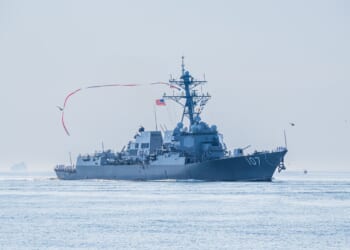
America’s NATO allies issue stern warnings but do not send naval vessels to escort tankers in the Strait of Hormuz. On the one hand, it is understandable after Trump’s threats against Greenland, a territory belonging to Denmark, a NATO ally and an EU member. On the other hand, a huge gap in LNG prices at the Henry Hub in Louisiana and in Europe—700 percent—demonstrates that our NATO allies should be more interested in opening the Gulf to tanker traffic than they are.
The China-Russia-Iran Axis Threat
In every generation, the West has faced a defining adversary. In the 20th century, it was the Nazis and the Soviet communists. Today, that opponent is the powerful, authoritarian, resource-rich Beijing-Moscow axis and its allies. The combat is kinetic and asymmetric, including cognitive warfare. In the Middle East, a key axis ally is the Shia totalitarian theocratic dictatorship in Tehran.
For decades, Iran, Russia, and China agitated for the eviction of the United States from the oil-rich Persian Gulf, while providing the weapons, technology, training, and diplomatic cover needed to build Iran’s “Ring of Fire” proxy network, including Hamas in Gaza, Hezbollah in Lebanon and Syria, and the Houthis in Yemen. They run terrorist agents and cells in Europe and the United States, often operating through criminal gangs and drug trafficking networks in the Middle East, Latin America, and Europe. Whether it was missiles for the Houthis to disrupt global shipping or guns for the brutal killers of Hezbollah and Hamas, Tehran’s budget for terror was effectively subsidized by Chinese oil purchases.
The Iran War Is Not a War of Choice, but a War of Necessity
To win, the West must recognize that whether the chant of “Death to Israel, Death to America!” is screamed in the Shia holy city of Qom, written on a black or green jihadi banner by a proxy in Gaza, or part of a loyalty oath taken by an operative in Europe or the United States, the target remains the same: the liberal international order.
The war with Iran is, therefore, not a “war of choice.” It is a war of necessity. Neutralizing Tehran’s capabilities, at minimum—or achieving the long-overdue regime change that the tens of thousands of Iranians have sacrificed their lives for, if possible—will disarm the primary pro-Chinese and pro-Russian power in the Middle East, which continues to demand the withdrawal of US military bases while attacking US allies like Saudi Arabia, the UAE, and Bahrain.
By bringing Iran to heel, alongside the Maduro regime in Venezuela, the United States can effectively regulate the flow of energy fueling China’s industrial machine. Establishing American dominance in the Gulf for the coming decades isn’t just about oil; it is about ensuring that the world’s most critical energy and trade arteries are secured by powers that protect the West and the global economy.
Notably, this conflict is an opportunity to put the specter of the “forever wars” behind us, where it belongs. Following the protracted, unsuccessful wars in Iraq and Afghanistan, many feared the West was in terminal retreat. A successful campaign against 47 years of Iranian aggression and nuclear ambitions would prove that a US-led coalition can fight to win.
Indeed, political disagreement is a hallmark of our democracy. However, there is a fine line between dissent and empowering our enemies. Those actively rooting for a US defeat are aiding and abetting a murderous, misogynistic theocracy allied with autocrats in the Kremlin and the CCP’s Zhongnanhai.
Today, Ukraine is the battlefront in Europe; Iran is the battlefront in the Middle East. But the most difficult terrain remains the “cognitive war” being fought in our own media and halls of learning. This front is characterized by orchestrated, paid-for, coordinated “protests” and aggressive social media campaigns where “influencers,” amplified by foreign bot networks, parrot the talking points of the IRGC, the CCP, and the Kremlin, seeking to demoralize the American public and delegitimize the West.
This is a war of ideas as much as it is one of missiles. To contain and eventually defeat the China-Russia axis, the West must regain its strategic confidence, defend its integrity, and protect its sanity—in Ukraine and in Iran. The price of gas may be high, but the price of failure would be historic.
About the Author: Ariel Cohen
Dr. Ariel Cohen is a nonresident senior fellow at the Atlantic Council. He is also a founding principal of International Market Analysis (www.IMAStrategy.com), a boutique global political risk consultancy. He is a recognized authority on international security and energy policy, and a leading expert in Russia, Eurasia, and the Middle East.
The post In Iran, Victory Is Non-Negotiable appeared first on The National Interest.