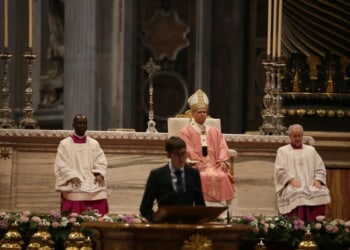
In a strong call for peace in Cameroon’s English-speaking regions, which have been devastated by ten years of violence, the Apostolic Nuncio to Cameroon and Equatorial Guinea, Archbishop José Avelino Bettencourt, has challenged Christians in the region to renounce violence.
Quoting Pope Leo’s message for the World Day of Peace, he challenged the congregation directly: “If you as a Christian, if you as a Catholic, do not accept to renounce violence, are you a Christian?”
The pope’s representative was speaking on Sunday, January 11, at the close of the 49th annual Seminar of Cameroon Bishops, which took place in the town of Kumba, considered the epicenter of the separatist crisis in Cameroon.
Horrifying losses
That conflict grew out of peaceful public demonstrations by lawyers and teachers in the English-speaking regions over the use of French in Anglo-Saxon schools and courts. The government, however, took a hardline approach, triggering violent confrontations. A separatist movement then emerged, demanding independence for the two English-speaking regions.
The result has been a horrifying human and economic loss. At least 6500 people were killed, 80% of schools were shuttered, more than 600,000 children found themselves out of school; 40% of health facilities became non-functional in some districts, and over a million people were forced to flee their homes. Over 70,000 of them have fled across the border into neighboring Nigeria.
Economists have estimated that the conflict has led to 3.3% percentage points of annual per capita growth lost, compounding year after year into an ever-widening prosperity gap.
Efforts towards peace have yielded mitigated results, including a 2019 Major National Dialogue. The Apostolic Nuncio insisted that the true source of lasting peace rests with Christ and without resort to arms.
“The peace of the risen Christ is unarmed because his was an unarmed struggle in the midst of concrete historical, political and social circumstances,” said Archbishop Bettencourt. “God’s goodness is disarming. Perhaps this is why God became man and came to us as a child, helpless in an unwanted place. “
Mgr. Agapitus Nfon of the Kumba Diocese noted that the prayers of the bishops were helping to return the area to peace.
His colleague, Mgr. Joseph-Marie Ndi-Okalla, of Mbalmayo, confirmed the gradual return to peace, saying in an interview with local Catholic newspaper L’Effort Camerounais that life was returning to normal in the region.
“For so many years, we have been following the situation in the North West and South West regions with great discomfort, both as pastors and citizens, “the cleric said.
“What we see today in Kumba is encouraging. Life is returning to normal. The town is becoming more and more dynamic-from the social, economic and ecclesial perspectives. I was personally struck by one fact. I was praying at the cemetery, on the anniversary of the death of my mother, and I saw children happily going to school. This simple account is a powerful signal. It shows that confidence is being born again, and that the future is being constructed with the youth. These signs presage hope for the Church and the nation.”
Roots and post-election violence
However, in comments to CWR, leading Cameroonian priest and author Father Humphrey Tatah Mbuy said being fixated on an end to violence misses the whole point of a sustainable peace.
“We all want the killings to stop,” the priest said. “But if we must make sure that peace is sustainable, there must be a sense of justice. You can’t have peace without justice. The two are inseparable. This means we must address the root causes of the crisis.”
The bishops also addressed the aftermath of the October 12th presidential election, which was marked by pockets of violence, as the opposition protested the victory of long-ruling leader Paul Biya.
Mr.Biya, 92, has been ruling Cameroon for the past 43 years, and he will be nearly 100 years old when his eighth term concludes in 2032.
His victory sparked nationwide indignation, with opposition leader Issa Tchiroma Bakary also claiming victory.
In their final release at the end of the seminar, the bishops urged dialogue as the only path to achieving lasting peace.
“In the wake of a post–election climate marked by insecurity, uncertainty, and fear experienced by a large part of the population, the President of the NECC called for sincere dialogue to achieve lasting peace, and invited the relevant authorities to address the issues of the high cost of living, injustice and endemic corruption,” stated the release.
Communion and collegiality
“The past year was truly a year of communion and collegiality for the Church in Cameroon,” Archbishop Bettencourt stated, highlighting the unified voice of the bishops in their pastoral letters. He noted that this unity links the Cameroonian Church directly to Christ and the bishop of Rome.
“We prayed together in times of sadness, such as when Pope Francis passed away last April, or when a brother bishop, a relative, a father or a mother died,” the Nuncio said.
“We prayed together in moments of joy and celebration too, such as during our national pilgrimage to Marienbourg last April, during the visit of the Secretary for Relations with States, Mr Paul Richard Gallagher…Communion and collegiality are at the heart of our vocation and mission in Jesus Christ.”
The cleric urged the Christian community and all Cameroonians “to look beyond blood ties or ethnicity, beyond associations that accept only those who are similar and reject those who are different.”
“Do you listen to the Pope? Do you listen to your church?” he quizzed.
“Pope Leo’s message directly challenges us, our common vocation in the church where we follow the one Christ, the one faith, the one church, the one mission. Our collegial presence, all the bishops here in Kumba, is a witness to the communion and collegiality that has always distinguished our church in Cameroon,” Archbishop Bettencourt said.
Bishop Agapitus Nfon of Kumba, reflecting on the same theme, spoke about the Magi’s journey to find the Christ child. He drew a parallel between their mission and that of the modern bishop.
“The primary mission of the bishop is to bring the people closer to God,” Bishop Nfon proclaimed. “In accomplishing this mission, the bishops must guide men and women on the path of faith, hope, and charity. At this moment, the bishops must be men of courage.”
He explained that this courage is not aggressive but is the courage “to remain unwavering in truth” in the face of a “dominant thought” that can be intolerant of faith. He urged the laity to support their bishops with prayer.
“We need your prayers and your help that the Lord may grant us the courage, the humility, the faith to help us shine like stars guiding you.”
Both speakers addressed the Church’s presence with the suffering. Archbishop Bettencourt referenced Pope Leo XIV’s exhortation to love the poor, calling on the Church to become “stars of hope for the poor, the prisoners, the displaced and the refugees.” Bishop Nfon, in his reflection on the Epiphany, noted that Christ is a king who “embraces poverty and identifies himself with the marginalized and the suffering.”
The seminar also served as a moment to look ahead. Archbishop Bettencourt announced that 2026 will mark the 60th anniversary of diplomatic relations between the Holy See and Cameroon, which he called “a true sign of communion and collegiality in the evangelical mission.”
If you value the news and views Catholic World Report provides, please consider donating to support our efforts. Your contribution will help us continue to make CWR available to all readers worldwide for free, without a subscription. Thank you for your generosity!
Click here for more information on donating to CWR. Click here to sign up for our newsletter.