Last month, activists packed the Chicago Teachers Union Center for the annual conference of the National Alliance Against Racist & Political Repression (NAARPR). Attendees gathered to discuss fighting ICE and confronting the Trump administration.
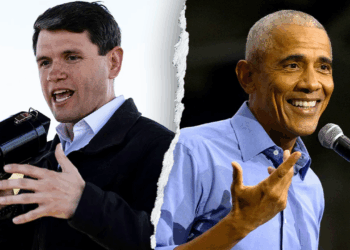
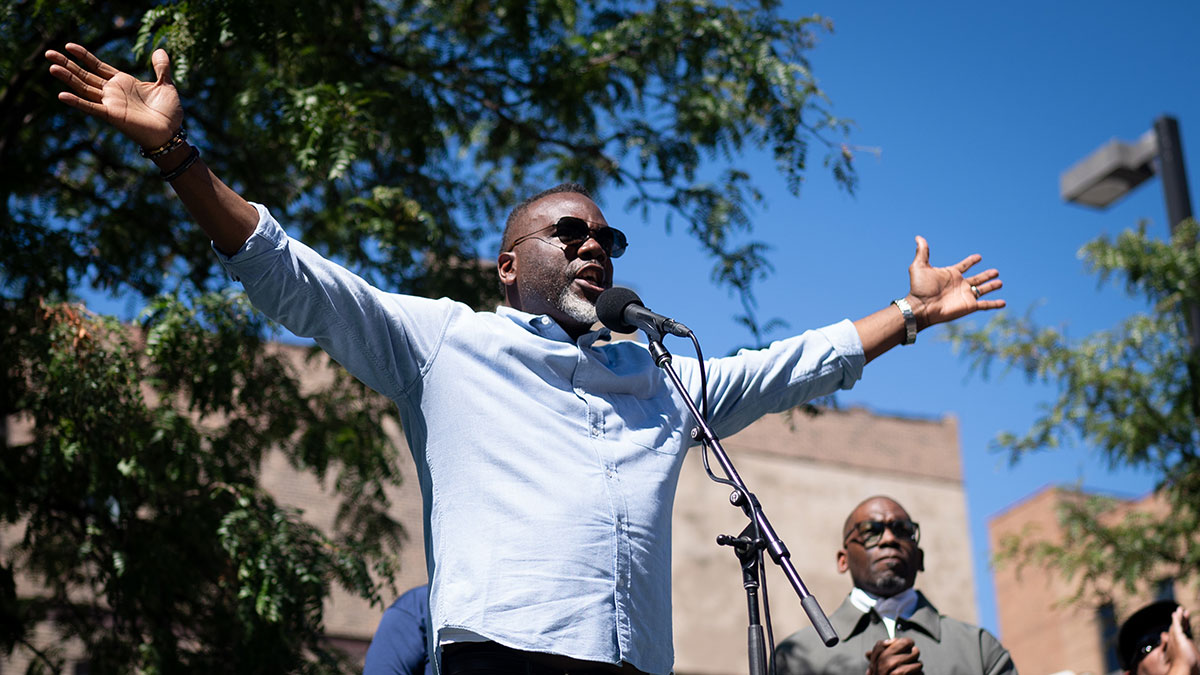
Despite NAARPR’s relative obscurity—it was founded in 1973 to agitate for the release of Angela Davis and has since become a catch-all activist organization—the group’s conference featured several high-profile speakers, including Chicago mayor Brandon Johnson, who claimed to have inherited a “white supremacist system.” The event was hosted by the Chicago Teachers Union, one of Johnson’s most aggressive backers.
Finally, a reason to check your email.
Sign up for our free newsletter today.
Johnson’s appearance, along with that of several Chicago aldermen, raises questions about the unpopular Chicago leader’s tolerance for extremism. Neither Johnson nor the aldermen responded to a request for comment for this article.
Characteristically for such an event, the conference began with a disruption. As Johnson, a Democratic Socialists of America (DSA) member, took the stage, protesters rushed forward with posters demanding “justice,” briefly halting the event.
Once order was restored, Johnson began by “fully admit[ting] that I have inherited a white supremacist system.” He suggested that education, health care, public housing, and policing were part of that system, and proposed raising taxes on “the ultra-rich and our large corporations” as the solution.
Chicago alderman Byron Sigcho-Lopez ratcheted up the rhetoric. “Here in Chicago, we give these Nazis the treatment they deserve,” the DSA member intoned, later identifying the Heritage Foundation’s Project 2025 as a “Nazi project.” Sigcho-Lopez argued that it was “time to fight capitalism, not with black capitalism or brown capitalism, but with socialism and not being apologetic about it.”
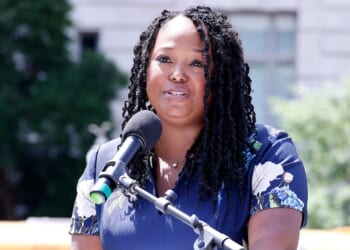
Another speaker was Alderwoman Jeanette Taylor, who offered a wave of profanity. “I don’t know where they get that American s**t from,” she began. “I’m from the continent of Africa. . . . I ain’t from f***ing here.” A DSA member herself, Taylor noted that while bad knees keep her out of fights, “If you know anything about Chicago, we’re all for a good a**-whooping.”
A third alderman, DSA member Anthony Quezada, outlined a far-left agenda. “The task before us,” he yelled, “is clear: protect our immigrant neighbors, build radical democracy, and organize a national people’s movement strong enough to abolish ICE, abolish the billionaire class, and defeat this billionaire-backed fascist agenda.”
Quezada is the chief sponsor of a referendum on community power over policing. The measure, scheduled for a vote in 2027, would transform the city’s Community Commission for Public Safety and Accountability from a largely advisory body into one with real authority over the Chicago Police Department’s budget and policies.
The radicalism continued throughout the weekend. Andan Bonifacio of BAYAN USA, a far-left Filipino group, celebrated armed conflict. “In the Philippine countryside where the fascism is the worst,” he said, “they’re not just fighting back toe-to-toe, but gun-to-gun against the fascist military.” Like the Palestinian resistance, Bonifacio insisted, “We will win our struggle for land and liberation to cut off the tentacles of U.S. imperialism in our homeland.”
Other speakers highlighted their direct action closer to home. Juleea Berthelot, a university student and vice president of Students for a Democratic Society, bragged about blocking the formation of a Turning Point USA chapter on campus and “de-arresting” protesters at a recent demonstration. Freedom Road Socialist Organization’s Syd Loving boasted of creating a “hostile work environment . . . for ICE, DHS, and the alphabet soup.” And Chicago Teachers Union organizer Kobi Guillory noted that “When we talk about fighting back, we’re not talking metaphorically . . . we’re talking about actually shutting s**t down.”
On the conference’s final day, NAARPR voted on a set of pending resolutions. Of the seven new resolutions that the group passed, two endorsed armed resistance. The first of those committed the organization to “support[ing] the Unified Palestinian Resistance and its self-defense campaign against over 100 years of white European settler colonization.” The second—related to “New Africa,” a proposed black-majority state carved from the American Southeast—committed NAARPR to the position that denying “the national oppression of New Africa” constitutes “a failure to support the politics of armed resistance to imperialist domination.” Both resolutions passed overwhelmingly.
NAARPR may not be a household name, but its chapters are embedded in cities across America. Communities and political leaders should shun this rhetoric. Chicago’s leadership, unfortunately, has embraced it.
Photo by Audrey Richardson/Getty Images
City Journal is a publication of the Manhattan Institute for Policy Research (MI), a leading free-market think tank. Are you interested in supporting the magazine? As a 501(c)(3) nonprofit, donations in support of MI and City Journal are fully tax-deductible as provided by law (EIN #13-2912529).
Source link