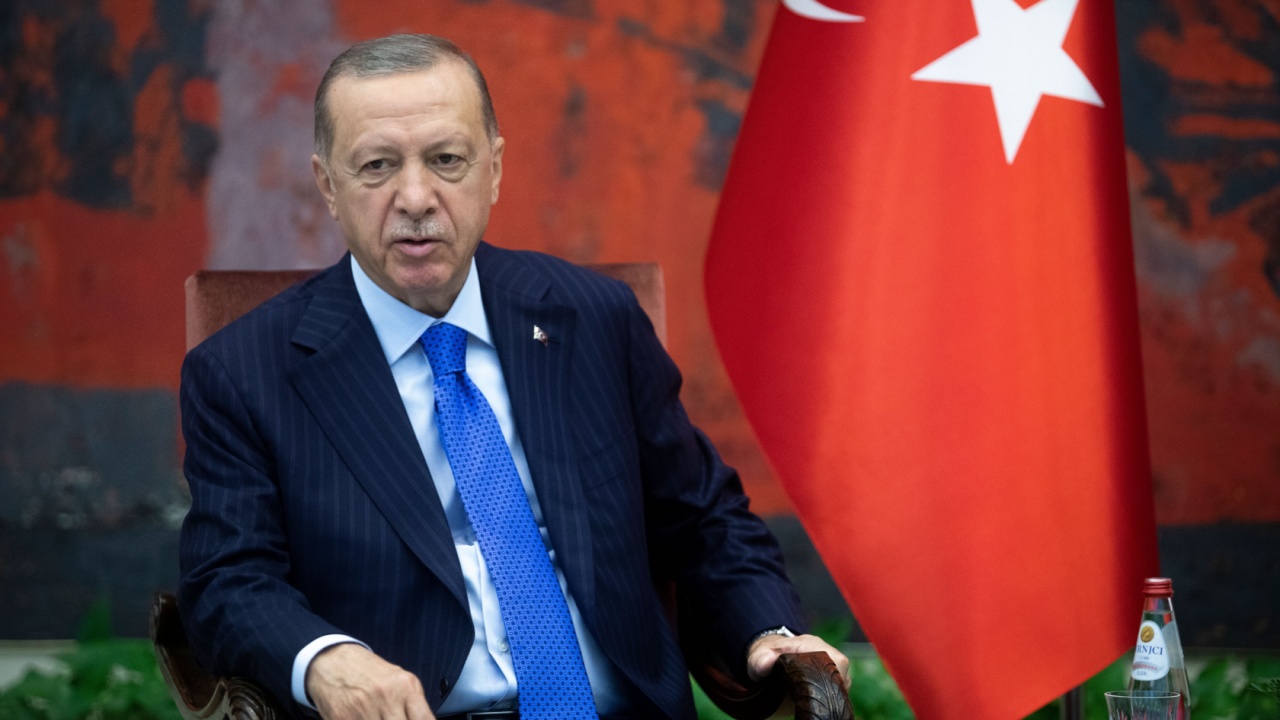
The government of Recep Tayyip Erdogan has provided an unexpected sanctions evasion lifeline for Nicolas Maduro’s Venezuela.
Turkish president Recep Tayyip Erdogan is well known for keeping up appearances with interesting counterparts. He has maintained cordial ties with the likes of Russian president Vladimir Putin, Chinese president Xi Jinping, and Iranian supreme leader Ali Khamenei—leaders who prop up Nicolas Maduro’s criminal regime in Venezuela.
Since 2016, Turkish relations with Venezuela have rapidly become a pillar of support for the Caracas government. Initially founded on a semblance of solidarity between Erdogan and Maduro, commercial ties skyrocketed in 2018, reaching over $1.1 billion in trade volume, compared to less than $200 million in 2017. The outlook is even more ambitious—in 2023, representatives of the Turkey Exporters Assembly expressed a goal of raising annual trade volumes to $5 billion “in the medium term.”
At first glance, Turkey seems like an obvious outlier when lined up next to Maduro’s other advocates abroad. Next to Russia, Iran, China, and Cuba, Turkey—as a NATO member and an erstwhile democracy—raises eyebrows as a member of Maduro’s “fabulous five.” This begs the question: why is Turkey so committed to investing in the Maduro government?
Turkey’s strategic vision on Venezuela is one in service of Erdogan’s quest for a Turkish great power. While much of Ankara’s geopolitical reach remains focused on the Middle East and Africa as of late, Venezuela serves as a foothold for expanding Turkish influence into the Western Hemisphere. In his oft-expressed disdain for world powers such as the United States, Russia, and China, Erdogan seeks to exploit similar sentiments in the international community and to fill a surrogate role. Erdogan is far more important to Maduro than vice versa. As the Venezuelan regime grows increasingly isolated by global sanctions, appalling human rights abuses, and repeated policy failures, partner states have become lifelines.
Accordingly, the nexus of Turkey-Venezuela relations is steeped in transnational crime and sanctions evasion. Beneath a visible dislike for the United States and for democracy at large, Turkey offers Maduro the profits of activities that harm civilians in Venezuela and abroad. These activities range from sanctions-busting gold exports that shore up Venezuela’s depleted foreign currency reserves to providing Venezuelan narcotraffickers with a transit hub for cocaine.
Turkey and Venezuela: United Against the West
Erdogan’s calculus in backing Venezuela is that he can shore up a place for Turkey in Latin America, a region largely beyond Ankara’s power-projection limits. Of course, there is a sense of affinity—Erdogan’s distaste for the Western world and for his own democratic obligations matches well with the Maduro regime.
Turkey-Venezuela ties were rather muted until just under a decade ago. In the aftermath of the 2016 Turkish coup plot, Maduro became one of the first world leaders to declare support for Erdogan. According to Venezuela’s then-Foreign Minister Jorge Arreaza, the move set in motion what he deemed the new “peak” of bilateral relations. Maduro would, only a few months later, reference Erdogan’s post-coup crackdown to threaten dissidents with violence should the Venezuelan people attempt to contest his rule.
Three years later, well into the Ankara-Caracas trade boom and a frenzy of state visits, Erdogan returned the favor. In early 2019, the Turkish president condemned US and international recognition of Venezuelan opposition leader Juan Guaido as the state’s rightful leader. While Maduro unleashed his secret police and armed socialist gangs (the colectivos) on civilian protestors, Erdogan urged him to “stand tall … Turkey stands with you.”
What stands out from this shared mentality is both leaders’ proclivity for anti-American sentiment. Long before US president Donald Trump authorized CIA covert action in Venezuela, Maduro decried American support for Guaido and anti-government protestors as a “coup.” In the same spirit, the Turkish president condemned the US position as “imperialist” and an affront to Maduro’s Venezuelan “democracy.” Erdogan previously accused the United States of backing the July 2016 coup attempt in Turkey.
That is not to say that Erdogan is always brazen in his support for Maduro. In 2024, following a third-term Maduro victory in unfree and unfair elections, Erdogan gave the Venezuelan leader a traditional phone call but avoided explicit congratulations. Amid deepening global outrage over Caracas’s continued governance abuses and failures, the Turkish president recognizes the risks of public applause for Maduro and has accordingly resolved to tread more lightly.
Gas, Gold, and Graft: How Turkey Keeps the Maduro Regime Alive
Erdogan’s public support is helpful for Maduro, who faces an ever-deepening legitimacy crisis at home. Yet the less-visible means, ranging from legally gray to explicitly criminal, of Turkish support are the real crux of the Turkey-Venezuela relationship and of the Maduro regime’s survival.
One key method by which Erdogan’s patronage has allowed the Maduro government to survive is through investment projects intended to prop up the failed Venezuelan economy. Overall, these projects target three major sectors: gas, petrochemicals, and mining. In January 2024, Turkish and Venezuelan officials discussed plans for Turkish companies to operate and invest in the latter’s oil and gas fields. Several months later, in June, Maduro signed agreements with Turkish delegates on a roadmap for a “full production chain” in natural gas, including a Turkish-funded fertilizer plant worth $750 million.
Given that Venezuela’s oil industry is at the heart of sanctions designed to stop Maduro from funding his human rights abuses, Turkish desires to build out that industry are clearly suspect. For example, Venezuela’s state-owned petrochemical company Pequiven, the entity responsible for dealing with investment projects such as the fertilizer plant, falls under sanctions issued in Executive Order 13884. As recently as this September, sanctions blocked Colombian state energy company Ecopetrol from purchasing Pequiven’s fertilizer subsidiary, Monomeros. In this sense, Turkish investment in Venezuela’s oil and gas enterprises constitutes a subversion of international efforts to prevent Maduro from profiting and keeping his failed regime in power.
The crown jewel of the June 2024 agreement, however, was a deal on Turkish investments in state gold mining projects in southern Venezuela’s “Orinoco Mining Arc.” Ankara’s involvement in the gold mining business in southern Venezuela dates to at least 2018, when it formed a joint mining venture known as Mibiturven with the Caracas government. Mibiturven, formed by sanctioned Venezuelan and Turkish entities, promptly obtained a 20-year mining lease in southern Venezuela and began importing heavy machinery and processing chemicals in 2019, indicating that their operations are live.
Turkish funds enabling Venezuelan mining projects in the Mining Arc ostensibly combat illegal mining operations that have devastated local communities and protected areas. It is a major public relations victory for Maduro, who frequently exhorts environmental protection. Under the presumed logic, international funding to build up a state presence in the south can only help the rule of law. Nevertheless, reports have found that Maduro’s government allows illicit mining operations to continue. Under the president’s auspices, Venezuela’s military frequently takes kickbacks and bribes from the illegal mines in exchange for arranging gold exports, and Maduro himself has promised local political officials gold mines to buy their loyalty.
All the while, atrocious violence against civilians continues with government knowledge and tacit approval. Human Rights Watch found in 2020 that mine operators—many of them state-sanctioned armed groups—punished destitute workers with amputations and gruesome murders. An influx of Turkish capital to expand these operations with no conditions only magnifies the Caracas government’s corrupt dealings and expands its capacity for brutality against civilians in the “blood gold” business.
This appears to be only the beginning of the Maduro regime’s plan to profit illegally from gold extraction and exports. Further down the line, Turkey plays a much more important role. Ankara imported almost $900 million in gold from Venezuela in 2018, with Caracas claiming that the Venezuelan Central Bank had shifted its refining operations to Turkey. Yet the lack of re-export to Venezuela indicated that Maduro had no intention of keeping the reserves—Turkish entities bought up the refined gold and transferred funds to a Venezuelan offshore account. The operation was, rather, a nearly billion-dollar bid to sell gold abroad and raise funds needed to keep the regime from entirely falling apart, all while operating under international sanctions. Turkey’s role as the refiner and buyer of Venezuelan gold was critical to the scheme.
The Turkish Connection to Venezuela’s Criminal Empire
Erdogan’s vital role in Maduro’s illicit gold trade is not simply a means for Caracas to shore up cash against its floundering economy. Turkey is an indispensable link in the Maduro regime’s activities on an international scale, far surpassing the damage of sanctions-busting. These activities range from inflating food import costs for malnourished Venezuelans through the gold trade to facilitating the transit and distribution of Venezuelan cocaine.
The crux of perhaps the most criminal and corrupt part of the Turkey-Venezuela gold operation between 2018 and 2020 was businessman and chief Maduro fixer Alex Saab. Saab controlled Mulberry Proje Yatirim, a Turkish company, which itself shared its phone and fax numbers and coordinated with the Turkish firm responsible for Mibiturven. Accordingly, Saab masterminded much of the discreet and illicit sale of Venezuelan gold in Turkey to bypass US sanctions.
Saab’s company then purchased supplies for Venezuela in Turkey and marked up food prices for Venezuelans through the state’s food subsidy program, known as CLAP. These artificially high prices allowed Saab to launder excess profits for its own benefit and that of other wealthy Maduro loyalists. Amid Maduro’s Turkish-enabled profiteering, much of Venezuela starved. Caritas Internationalis, the Catholic Church’s humanitarian aid network, found in 2017 that 54 percent of Venezuelan children suffered from malnutrition.
The degree to which Turkey is Maduro’s lifeline in gold smuggling and kleptocracy is perhaps matched by the country’s importance in Venezuela’s global drug trafficking scheme. The Maduro regime is deeply involved in the cocaine trade, which relies on senior Venezuelan military officers for protection and distribution. The US Treasury Department even sanctioned Maduro’s former Vice President and erstwhile confidant, Tareck El Aissami, as a Specially Designated Narcotics Trafficker in 2017.
Turkey remains a superhighway and distribution hub for Latin American cocaine. A 44-percent spike in cocaine seizures in Turkey from 2021 to 2022 did not correlate with any domestic consumption changes, indicating that Turkey was not a drug consumer base but rather a transit link. In particular, the port of Mersin on Turkey’s southern coast featured most frequently in Turkish drug busts of Latin American cocaine. At the same time, raids also uncovered processing operations in several Turkish provinces.
The question of the Turkish government’s role in Venezuela’s narcotrafficking came to a head in 2021, surrounding the claims of an exiled Turkish kingpin and former government ally. Crime lord Sedat Peker implicated the son of former Prime Minister Binali Yildirim in opening up a cocaine transit operation between Venezuela and Turkey in 2020–2021, after US DEA operations constricted prior operations out of Colombia. Although Yildirim denied the allegations, he confirmed that his son traveled to Venezuela in late 2020, supposedly to deliver medical supplies amid the COVID-19 pandemic.
It is unclear whether Peker’s claims are true, making it difficult to deduce whether Erdogan’s government is actively involved in narcotrafficking with Venezuela. Yet as Ankara’s ties with Venezuela have consolidated over the past decade, Turkey’s place in the global drug trafficking map has solidified. Therefore, Turkish alignment with Maduro and complicity in ensuring the Maduro regime’s survival via the global black market indicates a high risk of Erdogan’s government at least passively aiding Venezuelan narcotrafficking.
The costs associated with Erdogan’s willingness to abet Caracas’s activities are multidimensional, but Venezuelan civilians suffer first and foremost. Propping up Maduro against total downfall perpetuates his state-sanctioned misery, be it at the hands of crooked mining operations, the colectivos, or disastrous economic policies. Assisting the Venezuelan government’s corruption schemes has lined the pockets of Maduro’s cadre while impoverished civilians go hungry.
All the while, abetting the sanctions-busting process harms the global rule of law and rewards malign governance beyond Venezuela’s borders by cheapening sanctions regimes. By altering the stakes-costs logic of sanctions, bad actors worldwide are emboldened to subvert compliance and avoid policy changes requisite for relief.
It is too soon to determine whether the Erdogan regime is itself complicit in a drug trade that fuels crime and fatal overdoses worldwide. Yet the damage done both in Venezuela and abroad by his support for Maduro has already been plenty.
About the Authors: Sinan Ciddi and William Doran
Sinan Ciddi is a senior fellow on Turkey at the Foundation for Defense of Democracies (FDD) in Washington, DC. Sinan has over two decades of research experience focused on Turkish domestic politics and foreign policy, with bylines in Foreign Policy, Foreign Affairs, Politico, Newsweek, The National Interest, and 19FortyFive. He frequently provides commentary on various media outlets, including BBC, CNN International, DW News, France 24, the Greek Current Podcast, and CBS’s John Batchelor Show. Sinan is also an associate professor of national security studies at Marine Corps University and an adjunct professor at Georgetown University’s School of Foreign Service.
William Doran is a student at Georgetown University Walsh School of Foreign Service and a research intern at the Turkey Program at the Foundation for the Defense of Democracies.
Image: Sasa Dzampic Photography / Shutterstock.com.