To secure the US power grid, FERC must provide strong financial incentives to accelerate deployment of proven protection technologies.
The Center for Security Policy and the Secure the Grid Coalition filed a formal Complaint with the Federal Energy Regulatory Commission (FERC), docketed as EL26-49-000, this month. This is not another bureaucratic footnote. It is a direct challenge to the electric utility industry’s dangerous complacency—and a lifeline for the continuity of American society itself.
The complaint asks FERC to do one simple, urgent thing: order the North American Electric Reliability Corporation (NERC) to assess and protect America’s bulk power system against ground-induced currents (GICs) to the international scientific standard of 85 volts per kilometer (V/km). And crucially, it requests that FERC authorize full cost recovery through utility rate structures so that utilities—and therefore NERC—have every financial incentive to act instead of fighting to preserve the unprotected status quo.
Why now? Because the threats are real, imminent, and already costing us billions, while the industry’s self-written “protection” standard is pitifully inadequate, unscientific, and exists solely because NERC’s utility-company members voted to avoid the small added costs of protection. [Learn more by viewing the Secure the Grid Coalition’s video explainer below.]
The Threat: Invisible Currents That Can Black Out the US
Solar activity generates geomagnetic disturbances (GMDs) that induce low-frequency, quasi-DC currents in the Earth’s crust called ground-induced currents (GICs). These GICs enter the power grid through transformer neutral-to-ground connection, the path of least resistance, and flow across thousands of miles of high-voltage lines. The result? Half-cycle saturation of massive power transformers, creating massive harmonic distortion, reactive power consumption spikes, hot-spot heating, and eventually, continental-scale catastrophic failure.
The E3 component of a high-altitude electromagnetic pulse (HEMP) from a nuclear detonation in the exo-atmosphere does exactly the same thing—without a surface-leveling nuclear-sized blast or thermal impact reaching the ground. One weapon, detonated high enough, can bathe the continental United States in GICs powerful enough to destroy the grid in minutes.
We already see the damage in unexceptional, routine solar weather. Credible studies peg the annual economic toll from GIC-induced harmonics and equipment stress at approximately $10 billion a year. That is not theory; it is money leaving Americans’ pockets right now.
Worse, the damage is cumulative. Transformers do not always fail immediately. The 1989 Hydro-Quebec storm caused a blackout in Canada and, within 25 months, permanent failures in transformers at 12 US nuclear power stations. A 2003 solar event one-fiftieth the size of the 1921 “Railroad Storm” still destroyed 12 transformers in South Africa over months. Imagine that on a nationwide scale, from a 1-in-100-year storm like the 1859 “Carrington Event.”
The Industry GIC Protection Standard: Exceedingly Low, Unscientific, and Self-Serving
NERC’s only mandatory GIC protection standard (TPL-007-4 – Transmission System Planned Performance for Geomagnetic Disturbance Events) sets a “benchmark” geomagnetic disturbance event of just 8 V/km at 60° geomagnetic latitude (northern Quebec) and scales it down dramatically southward. Washington, DC, at roughly 49° latitude, is “protected” against a mere ~2 V/km. Southern states? 0.8 V/km.
This is illogical when compared to the real threats from solar weather and nuclear EMP, as depicted in the image below:
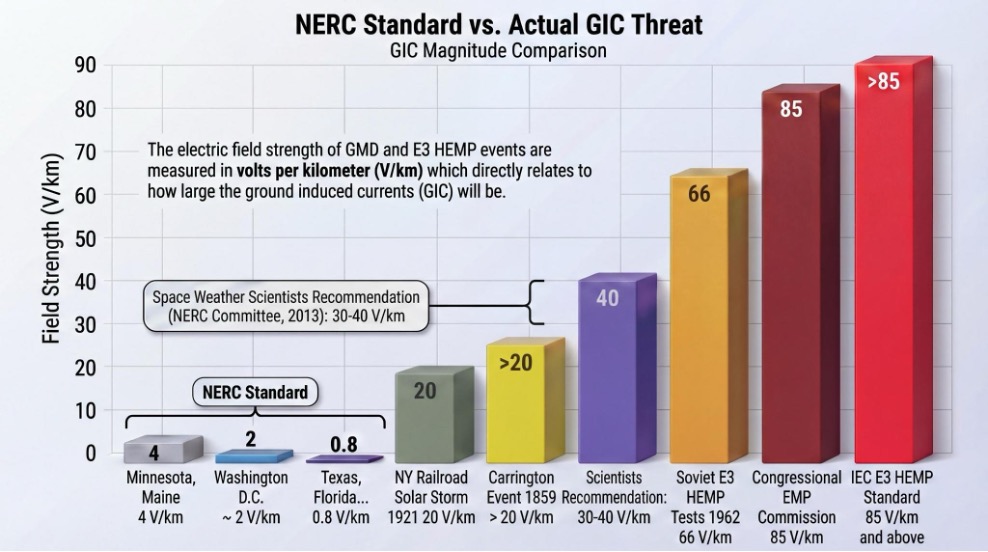
Even more nonsensical, this benchmark was not derived from North American storm data. It ignored the 1921 Railroad Storm (measured at 19–20 V/km), the 1989 event (peaks of 21.66 V/km in Maine, 19.02 V/km in Virginia), the Soviet HEMP tests over Kazakhstan in 1962 that achieved 66 V/km at the exact geomagnetic latitude of Washington, DC, and it ignores the International Electrotechnical Commission’s updated 2025 standard of 85 V/km for E3 HEMP protection.
Why such a low bar? Because NERC is a “self-regulating” body whose members are the very utilities that would have to pay for real protection. They voted on a standard that minimizes their expense. That is not science. That is regulatory capture dressed up as “reliability planning.”
The Nuclear Regulatory Commission (NRC) bought this flawed standard hook, line, and sinker. As explained in a recent report by the Center for Security Policy, in May 2025, NRC denied a 14-year-old petition for long-term spent-fuel-pool cooling—explicitly assuming the grid would never suffer a prolonged GIC-induced blackout. That decision disregarded Air Force Electromagnetic Defense Task Force warnings, a Government Accountability Office (GAO) report on growing spent-fuel inventories, and basic physics. It puts every American downwind of a nuclear plant at risk of a Fukushima-style disaster from the inevitable.
The Solution: Blocking Devices That Are Proven, Affordable, and Already in Use by Our Chief Adversary
There is no mystery here. Capacitive neutral-blocking devices—exemplified by the commercially available, live-grid-validated SolidGround system—simply attach to transformer neutrals and automatically block GICs while maintaining AC grounding. They have been installed and field-tested for over a decade by US utilities, including the Tennessee Valley Authority (TVA), the Western Area Power Administration (WAPA), and ATC. They work. They are not custom-engineered; they are “one size fits all” and can be mass-produced on assembly lines.
The one-time cost to protect America’s roughly 6,000 most vulnerable high-voltage transformers? According to Scott McBride of Idaho National Laboratory, approximately $4 billion. In return, we eliminate the $10 billion annual hemorrhage and permanently harden the grid against both solar superstorms and E3 HEMP.
Our chief strategic adversary understands this perfectly. China has reverse-engineered the SolidGround technology, infringing on patent protections, and has begun producing counterfeits. As the Center for Security Policy recently warned the US Department of Energy, there are indications that the Chinese are widely deploying these devices throughout their own grid. Beijing is ensuring its infrastructure survives the very events that would collapse ours. While American utilities hide behind a defective protection standard, our most dangerous adversary is prepared for reality.
The Complaint before FERC explicitly recognizes that utilities will not act without financial incentives. By authorizing cost recovery through rates, FERC can turn this national-security imperative into good business. Utilities recover their investment, ratepayers gain resilience, and the industry’s reflexive combativeness evaporates because protection becomes affordable and even profitable, given the extended lifespan of their equipment once protected against routine solar weather.
Protecting the Grid Is About Civilizational Continuity
The Trump administration’s “Speed to Power” initiative to expand generation is vital—but it rests on a foundation of sand if the grid itself remains unprotected. Every data center powering AI, every hospital, every military base, every household depends on transformers that can be ruined by currents we already know how to stop.
Formal comments on this FERC Complaint (Docket EL26-49-000) are due by March 30, 2026. History suggests the industry will flood the docket with myths about “operating procedures,” “resilient transformers,” and “prohibitively expensive” solutions. Past performance by FERC is not encouraging: the revolving-door relationship between regulators and the deep-pocketed utilities they oversee has repeatedly prioritized industry convenience over public safety.
But this time things might be different. FERC is comprised of a new set of commissioners, where none have served more than about a year and nine months, and the two most recent have served less than five months. Additionally, the complaint and petition in EL26-49-000 gives FERC the clearest possible path to do the right thing: order assessment to the 85 V/km standard, authorize cost recovery, and mandate deployment of proven blocking technology. The technology works. The math works. Our adversaries are already using it.
The only question left is whether FERC will choose science, security, and the American people—or continue to rubber-stamp an industry standard that guarantees that a future large solar storm or HEMP attack will leave us in the dark for years.
About the Authors: Lt.Col. Tommy Waller, Douglas Ellsworth, and CSM Michael Mabee
Lt. Col. Tommy Waller is the president & CEO of the nonprofit Center for Security Policy. Waller retired from the US Marine Corps after two decades of service in both active duty and the reserves as an Infantry and Expeditionary Ground Reconnaissance officer with deployments to Afghanistan, Iraq, Africa, and South America, and with cross-assigned service to the US Air Force’s Electromagnetic Defense Task Force (EDTF). His formal education includes numerous military schools and colleges, a BA in International Relations from Tulane University, and executive education from the Wharton School. In addition to running the Center for Security Policy, he also manages the nationwide bipartisan Secure the Grid Coalition.
Douglas Ellsworth is a senior fellow at the Center for Security Policy and serves as the co-director of the Center-sponsored Secure the Grid (STG) Coalition—an ad hoc group of policy, energy, and national security experts, legislators, and industry insiders who are dedicated to strengthening the resilience of America’s electrical grid. Through the support of the Center for Security Policy, the STG Coalition aims to raise awareness about the national security threat of grid vulnerability and encourage the steps needed to neutralize it. The STG Coalition brings a wide variety of expertise in cybersecurity, physical security, public policy and expressly serves the public interest.
Command Sergeant Major Michael Mabee (US Army Ret.) retired from the federal government in 2026 with 45 years to the day under oath to defend the Constitution. He is the author of The Civil Defense Book: Emergency Preparedness for a Rural or Suburban Community and has conducted public interest research on the security of the electric grid because of the absolutely vital role of this infrastructure in undergirding the very survival of our country. Michael has been featured on 60 Minutes, quoted by The Wall Street Journal, The Washington Post, CNN, Newsweek, and many other media outlets and publications on grid security. Michael has intervened and submitted testimony in over 200 federal dockets on electric grid security issues. He has participated in federal rulemaking related to grid security and has written the leading reference empowering communities to prepare for and survive a long-term power outage. He continues to write and speak about emergency preparedness for a long-term blackout.