There is nothing more painful than loneliness. When a student misbehaves in a classroom, he is seated next to the teacher or sent to the principal’s office. When a child makes poor decisions at home, she is sent to her room. When a prisoner in jail commits the most heinous crimes, he is sent to solitary confinement. And in Dante’s Inferno, the ninth circle of hell is composed of those who have so isolated themselves from God and His people that they are trapped in the frozen lake of Cocytus where they can remain alone with themselves for eternity.
Sin divides us from God and others. Our pride is to blame; we often think we know better than God, who seems to be absent from our lives more than present to us. We wait for His favor, but darkness comes instead. So, we try to make our own light, a personal flame, that blazes its own trail in the terrain of our souls. We succumb to our passions—lust, greed, anger…whatever fills our egos.
The only problem with this passionate fire is that it is uncontrollable. It burns us from the inside, clouding our vision of the true Light with smoke so black it makes even daylight seem like night. What’s left after these sins take control of our lives is total isolation from God.
Mary, being perfect and sinless, could not experience separation from God through sin like you and I do. Our Lord, however, wanted her to experience isolation from Him in another way:
Each year his parents went to Jerusalem for the feast of Passover, and when he was twelve years old, they went up according to festival custom.
After they had completed its days, as they were returning, the boy Jesus remained behind in Jerusalem, but his parents did not know it.
Thinking that he was in the caravan, they journeyed for a day and looked for him among their relatives and acquaintances, but not finding him, they returned to Jerusalem to look for him.
After three days they found him in the temple, sitting in the midst of the teachers, listening to them and asking them questions, and all who heard him were astounded at his understanding and his answers.
When his parents saw him, they were astonished, and his mother said to him, “Son, why have you done this to us? Your father and I have been looking for you with great anxiety.”
And he said to them, “Why were you looking for me? Did you not know that I must be in my Father’s house?”
But they did not understand what he said to them.
He went down with them and came to Nazareth, and was obedient to them; and his mother kept all these things in her heart.
And Jesus advanced [in] wisdom and age and favor before God and man.
(Lk. 2:41-52)
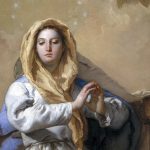
Place yourself in the heart of Mary at the moment she realizes that her Son was missing. Feel her shock. Ponder her frustration. Experience her worry. Hear the frightened tone in her voice as she looks to her acquaintances from the caravan and asks “Have you seen Jesus? Where is my Son?”
Mary’s stress rises until she finds her Son in the temple. Her anxiety erupts in a question: Why have you done this to us? Even after Jesus answers her, she remains confused by His actions. She keeps the experience in her Immaculate Heart and returns to “normal” with her obedient Son in tow.
The difference between the poor souls in Dante’s ninth circle and the Virgin Mary is what they willed toward God: the suffering souls were frozen in Lake Cocytus because they chose to shield themselves from God’s light; Mary, on the other hand, did not choose to lose Jesus—on the contrary, when He was absent, she searched for Him everywhere.
Our crosses place a shadow upon our souls when we are lonely. We, like Mary, ask Jesus, “Why have you done this to us?” Christ Himself interrogated the Father the same way when crucified, crying out, “My God, my God, why have you forsaken me?” (Mt. 27:46). Though God never abandons us, He does sometimes fall asleep in our boats while a storm rages around us. He feels absent. We feel scared and alone. Our reaction to being placed in this crucible dictates toward which eternity we long for. If we despair, Lake Cocytus awaits us. If we have faith, Our Lady will find us.
The word “church,” in Greek ecclesia, means many things—some translations define it as a “gathering” or “assembly.” Others render it “the people of God” or “the faithful.” All the definitions of Church share a singular thread, though, which is community—other people. We are one body in Christ, and, while we suffer our crosses individually, all our pain is united to His one sacrifice once and for all.
“[Therefore,] we rejoice in our sufferings, knowing that suffering produces endurance, and endurance produces character, and character produces hope, and hope does not disappoint us, because God’s love has been poured into our hearts through the Holy Spirit which has been given to us”…this spiritual tempering of man in the midst of trials and tribulations, which is the particular vocation of those who share in Christ’s sufferings. (Salvifici Doloris, 23)
Who are those who share in the vocation of Christ’s sufferings? Family, friends, and the Church. The scourge of loneliness is defeated by the joy of our connection to the saints, the cloud of witnesses that surrounds us.
Our crosses produce two pathways in life: we can cut ourselves from the body entirely, trust in our sinful passions, and suffer without the ones we love and without the aid of sanctifying grace. Or, we can choose to sustain our sorrow with the hope that our faith will guide us into eternal happiness with the unity of God and His saints.
The choice is yours.
“Man cannot fully find himself except through a sincere gift of himself.” (Gaudium et Spes, 24)
Editor’s Note: This article is part of a new CE series, Finding Joy in Our Crosses: The Paradox of Christian Happiness. This series comes from a collection of Lenten reflections by Catholic Exchange writer, TJ Burdick. To access the complete collection, visit TJ’s Substack at tjburdick.substack.com. No subscription necessary.
Photo by Samuel Austin on Unsplash