After successfully expanding US influence in Azerbaijan and Armenia, the Trump administration should set its sights on Georgia.
Vice President JD Vance’s historic visit to the South Caucasus ended in controversy. Vance deleted a post on X that showed him paying respects at the Armenian Genocide Memorial in Yerevan, along with second lady Usha Vance. That made headlines and brought on accusations of “genocide denial.”
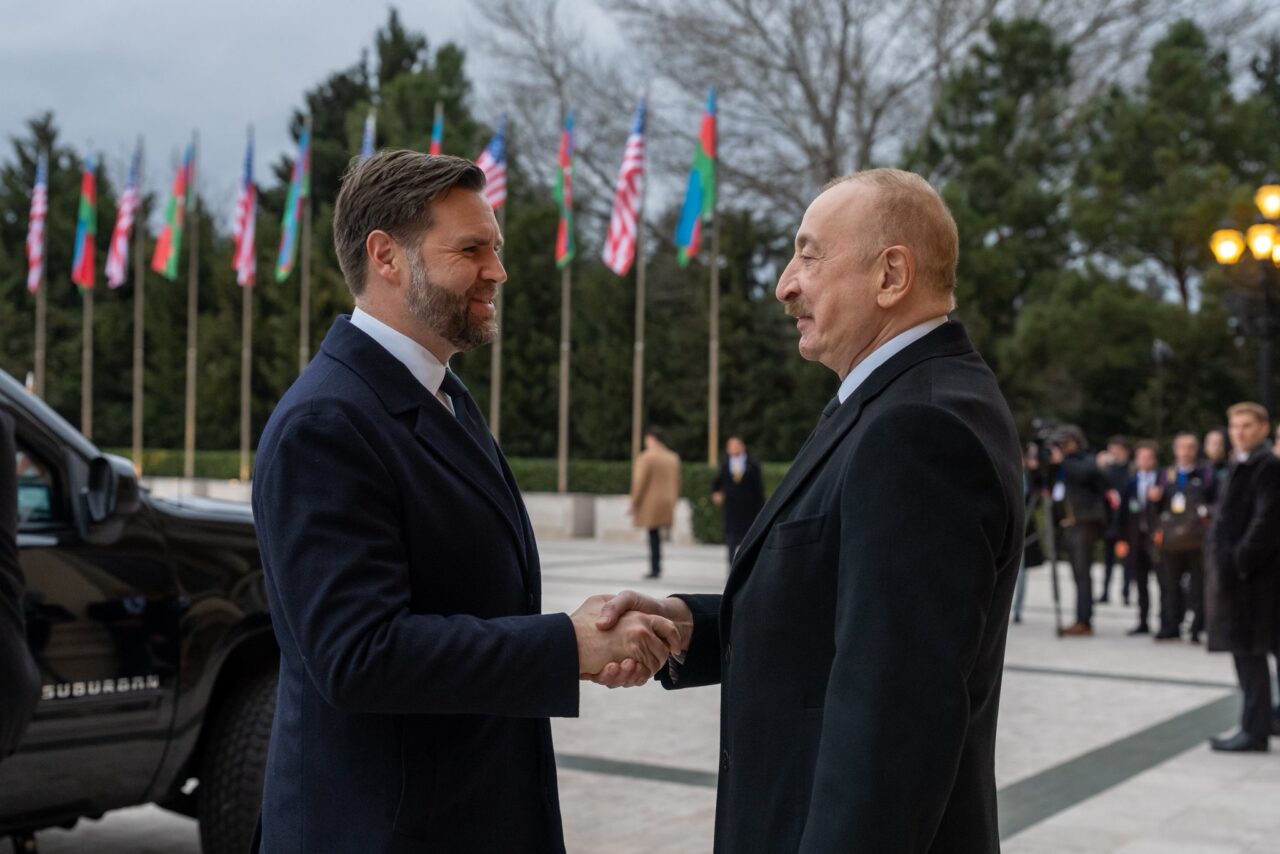
But focusing on the deleted post misses the point entirely. Vance is the first vice president and most senior US official to visit Armenia, and his trip forms an integral part of the Trump administration’s concerted effort to cement US influence and box out Russia in a region where Moscow was long the dominant player.
Above all, Vance sought to build on last August’s White House summit, where Armenia and Azerbaijan signed a peace agreement aimed at ending nearly 40 years of conflict.
Vance focused on fulfilling some of the bilateral trade deals promised to Armenian prime minister Nikol Pashinyan and Azerbaijani president Ilham Aliyev, which incentivized both to opt for peace last year. Their pact includes the creation of the Trump Route for International Peace and Prosperity (TRIPP)—a 27-mile rail and road project connecting Azerbaijan to its enclave of Nakhichevan through Armenia. TRIPP’s purpose is to provide a trade route between Central Asia and Europe that bypasses Russia and Iran.
On February 9, Vance and Pashinyan signed a civilian nuclear cooperation agreement that includes $5 billion to replace Armenia’s Soviet nuclear power infrastructure and $4 billion in fuel and maintenance contracts. The agreement undercut a last-ditch cooperation offer by Russia’s state-owned nuclear concern Rosatom.
A day earlier, Russian foreign minister Sergey Lavrov warned Armenian parliament speaker Alen Simonyan of the “risks of rapprochement with the West to the detriment of cooperation with traditional allies.”
The following day, Vance visited Aliyev and signed a strategic partnership agreement encompassing economic and security cooperation. The deal includes defense sales, cooperation in artificial intelligence, energy security, and counterterrorism efforts.
In all, it was a successful trip to the region, but incomplete. For a good reason. Vance refused to dignify Georgia, the region’s third nation, with a visit. The country has been considered the South Caucasus’ Black Sea gateway and the traditional backbone of east–west transit. Now, it is drifting closer to Russia and China, cracking down on pro-democracy protesters, and making open US engagement politically uncomfortable. The clearest sign of this shift is the development of Anaklia Deep Sea Port.
The facility is intended to anchor Georgia’s role in the Black Sea as a critical node in the Middle Corridor trade route between Asia and Europe. In 2016, the Georgian government awarded the project to the Georgian-US-European-led Anaklia Development Consortium.
But in 2020, the Georgian government, led by the pro-Russian Georgian Dream party, terminated that contract. Instead, in May 2024, it selected a Chinese-Singaporean consortium centered on China Communications Construction Company for a 49 percent stake. That gives a key US adversary an enormous stake in a crucial piece of infrastructure.
China’s commercial footprint in Georgia increasingly overlaps with firms linked to Beijing’s security ecosystem—such as the state’s use of Dahua surveillance cameras, Huawei telecom networks, and Nuctech security scanners. Meanwhile, Russia retains leverage through political, intelligence, and coercive influence operations, as well as threats of military intervention.
In all, the administration is getting it right in the South Caucasus, making the most of relations with Armenia and Azerbaijan. But President Donald Trump ignores Georgia at America’s risk. Washington doesn’t need to “bless” Georgia’s ruling party or grant it a high-level state visit to protect US interests, but it should keep targeted pressure on Tbilisi to reverse democratic backsliding. It is also important to expand support for civil society and media so that Georgia doesn’t become a durable platform for Russian and Chinese leverage on the Black Sea.
With Georgia, a blend of incentive and threat is warranted. The incentive would be the prospect of American investment, encouraged by the Trump administration. The threat would be a clear sign of US determination to impose sanctions on Georgian Dream’s leadership and its enablers unless they hold new, transparent, internationally-monitored parliamentary elections and end the persecution of journalists and political opponents, making fair elections impossible.
There is plenty of work left to do in the South Caucasus. The Armenia-Azerbaijan peace deal is still only a framework, and TRIPP will succeed or fail based on its implementation. Russia is maneuvering to stay relevant, pitching itself to Armenia as a better nuclear energy partner than the United States. Absent a new US approach to Georgia, the country will only deepen its partnership with America’s adversaries.
The next steps for the administration should be to bolster TRIPP with credible security and financing while approaching Tbilisi with the right mix of carrots and sticks to draw it out of Beijing and Moscow’s orbit.
About the Authors: Keti Korkiya and Dmitriy Shapiro
Keti Korkiya is a research analyst in the Russia Program at the Foundation for Defense of Democracies (FDD). Prior to joining FDD, Keti was a postgraduate fellow at the Center on National Security at Georgetown University Law Center, where she contributed to the Cumulative Civilian Harm Project. She holds an LLM in National Security Law from Georgetown University, an LLM in International Law from the Georgian Institute of Public Affairs, and an LLB from the University of Essex.
Dmitriy Shapiro is a research analyst and editor at FDD. His previous experience includes 11 years in journalism, most recently serving as the DC correspondent for the Jewish News Syndicate (JNS.org), where he covered a wide range of stories with a focus on politics. He has covered the US-Israel relationship, the Iran nuclear deal, antisemitism, and nearly all federal departments.