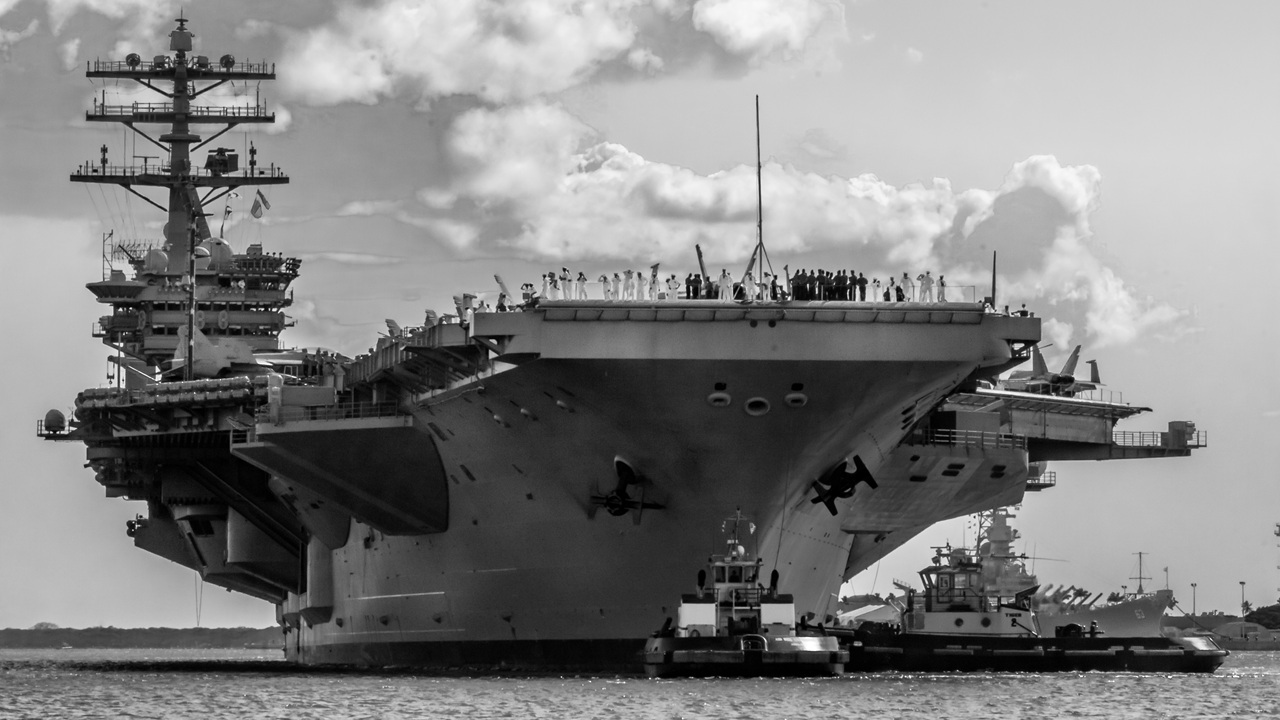
The US Navy cooperated extensively with Hollywood filmmakers for the 1980 film The Final Countdown—to the extent that nearly the entire movie was made aboard the supercarrier.
Just about everyone knows of Top Gun. The 1986 film, starring Tom Cruise as Pete “Maverick” Mitchell, was a pop culture phenomenon, the highest grossing film of its release year. For those who loved the film, the sun-soaked USS Enterprise, the world’s first nuclear-powered aircraft carrier from which Maverick and “Iceman” (Val Kilmer) launch their F-14 Tomcats, is iconic. But for more intensive film buffs and aviation nerds, there is another movie—lesser known but offering even better access to naval carrier operations than even Top Gun.
That film is The Final Countdown, released in 1980, and starring Kirk Douglas, Martin Sheen, and above all, the USS Nimitz.
When the Nimitz Got Its Close-Up
The Final Countdown is a science-fiction film in which the USS Nimitz—then the largest and most sophisticated aircraft carrier in the US Navy fleet—is inexplicably sucked through a time vortex roughly 40 years into the past, arriving at Pearl Harbor in early December 1941. The astonished crew is then confronted with the moral dilemma of whether to attempt to save the US Navy fleet from the impending Japanese attack—but in doing so to alter the future in an unpredictable way—or to stand by and watch the attack take place without intervening.
The movie itself was filmed almost exclusively aboard the USS Nimitz—marking one of the first times a modern warship was featured so extensively in cinema. Critically, gaining such unfettered access was never guaranteed. The film needed the Navy’s full cooperation, which producer Peter Douglas (son of lead actor Kirk Douglas) spent years working to secure. Approval was finally granted when Commander Emory Brown, then-skipper of the “Jolly Rogers” (VF-84) squadron, championed the film.
The Navy, and the Department of Defense, believed that the film could serve as a powerful recruitment tool, agreeing to full support on the condition that naval consultant William Micklos would oversee operations to ensure safety and mission readiness. With Micklos overseeing production, the film crew proceeded to create what, at times, feels more like a carrier operations documentary than a feature film.
Many of The Final Countdown’s Aviation Sequences Are Real
Principal photography took place in 1979, over two five-week periods. Most exterior shots were shot on the Nimitz while at sea off the Florida Keys and at Naval Air Station Key West. Some interior scenes and additional filming occurred at Naval Station Norfolk. The Nimitz even had a stunt double: the USS Kitty Hawk (CV-63), a smaller carrier, stood in during the Nimitz’ final arrival scenes at Pearl Harbor because the Nimitz was an Atlantic fleet ship at the time. But otherwise, the Nimitz is unquestionably the star of the show.
Navy personnel were featured heavily in the final film. A total of 48 real-life sailors from the Nimitz received screen credits for their roles as extras, background artists, or minor actors—with several sailors given even speaking lines. Notably, some sailors in the film can be seen with beards, a grooming standard that the Navy briefly permitted in the late 1970s before once again curtailing.
For aviation enthusiasts, The Final Countdown offers an embarrassment of riches—seemingly unfettered access to carrier operations. The film has extensive footage of Carrier Air Wing 8 in operation, including F-14A Tomcats, A-6E and KA-6D Intruders, A-7E Corsair II fighters, E-2C Hawkeye surveillance aircraft, S-3A Vikings, and EA-6B Prowlers. Essentially, the film serves as a time capsule—perhaps fitting, given the premise—for late Cold War naval aviation.
As expected, filming carrier operations so intimately was challenging for both crew and aircraft. In one notable scene, an F-14A flew quite low, pulling up just 100 feet above the water. In another—an unscripted scene that the camera crew happened to catch and feature in the final edit—an A-7 Corsair makes an emergency landing into a nylon barricade. And more than once, jet exhausts blew camera operators off the runway.
But the effort was worthwhile. Today, The Final Countdown stands as must-watch cinema for anyone interested in naval aviation or carrier operations. It’s not Top Gun, of course; there is no Kenny Loggins or volleyball or Kelly McGillis, and the film led to neither the pop-culture impact nor the recruitment boost for the US Navy that Top Gun did. But The Final Countdown offers greater insights into life aboard an aircraft carrier at the end of the Cold War.
About the Author: Harrison Kass
Harrison Kass is a senior defense and national security writer at The National Interest. Kass is an attorney and former political candidate who joined the US Air Force as a pilot trainee before being medically discharged. He focuses on military strategy, aerospace, and global security affairs. He holds a JD from the University of Oregon and a master’s in Global Journalism and International Relations from NYU.