
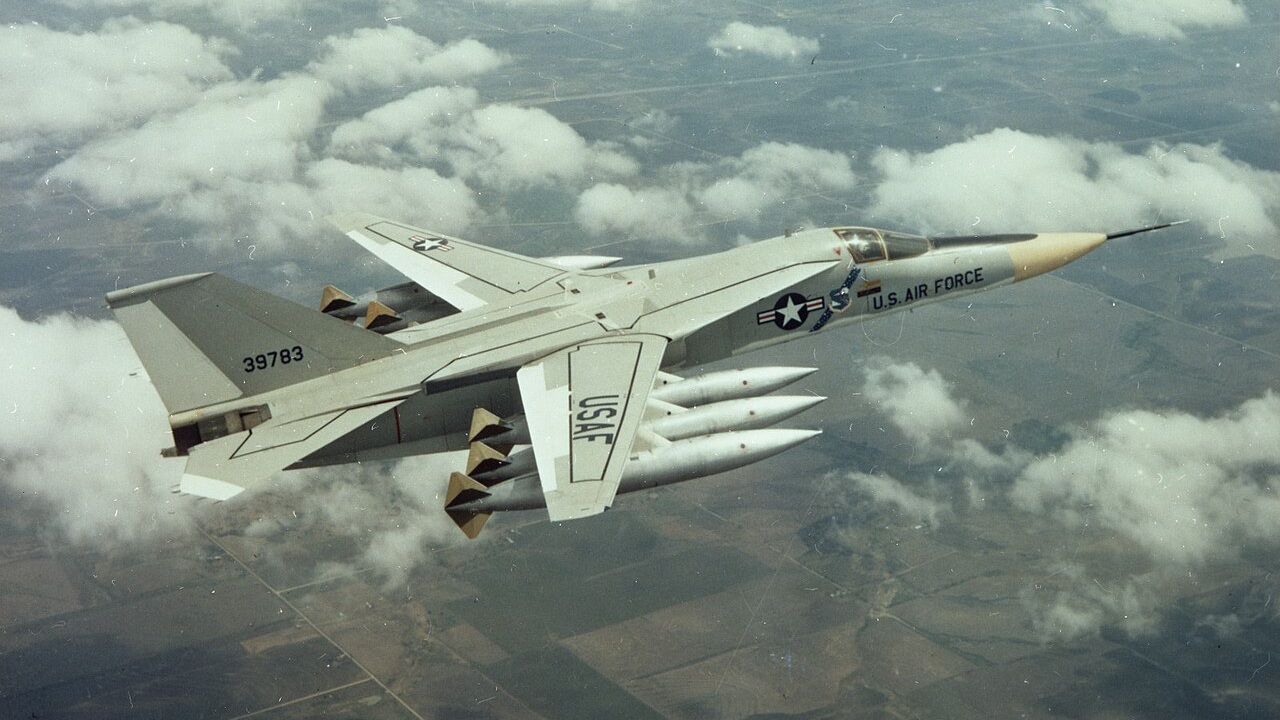
The F-111 Aardvark pioneered a variety of new technological innovations for the US Air Force—and proved that they could be combined to make an excellent strike aircraft.
The F-111 Aardvark—so named for its distinctively long nose—first flew in the 1960s, introducing a slew of technologies that are still relevant today. One of the most technologically ambitious aircraft of the Cold War, the F-111 combined speed, range, payload, and avionics in a way no previous aircraft had ever attempted. The end result was one of the world’s first true multirole aircraft—a platform that could do a little bit of everything, performing admirably as a fighter, bomber, striker, and interceptor.
The F-111 Aardvark’s Specifications
- Year Introduced: 1967
- Number Built: 563 (all variants)
- Length: 73.5 ft (22.4 m)
- Wingspan:
- 63 ft (19.2 m) swept forward
- 32 ft (9.75 m) swept back
- Height: 17 ft (5.2 m)
- Weight (MTOW): ≈100,000 lb (45,360 kg)
- Engines: Two Pratt & Whitney TF30-P-100 turbofans (~25,000 lbf each with afterburner)
- Top Speed: ≈1,650 mph (≈Mach 2.5)
- Range: ≈3,000 miles (4,800 km)
- Service Ceiling: ≈60,000 ft
- Loadout: Up to 31,500 lb (14,288 kg) of bombs, guided munitions, and nuclear weapons; internal weapons bay + external pylons
- Aircrew: 2 (pilot, weapons systems officer)
The F-111 Revolutionized How Air Battles Were Fought
The F-111 is a remarkable platform, years ahead of its time, for having introduced several technologies that were then unheard of, but have since become commonplace. They include:
- Variable geometry wings: The F-111 was among the first aircraft with wings that could extend for low-speed lift or retract for a supersonic dash—enabling both short takeoff and landing and high-speed penetration. Later models to incorporate variable geometry wings were the Panavia Tornado, Su-24 Fencer, MiG-23 Flogger, B-1B Lancer, and—probably most famouosly—the F-14 Tomcat of Top Gun fame.
- Afterburning turbofan engines: The F-111 featured the Pratt & Whitney TF30, the world’s first production afterburning turbofan, which granted the F-111 long-range efficiency and high-speed thrust. The class of engine would become standard for advanced fighters.
- Terrain-following radar (TFR): Terrain-following radar, then revolutionary but now standard, allows for hands-off automatic low-level flight at high speeds. With TFR, the F-111 could fly 200 to 500 feet above terrain in poor weather, at day or night. This ability revolutionized strike tactics, allowing the F-111 to fly under radar coverage in an era before modern stealth features existed. TFR systems can now be found on the F-15E Strike Eagle, B-1B Lancer, and Su-24 Fencer.
- Integrated avionics and digital navigation: The F-111 was the first combat aircraft with fully integrated nav/attack systems, which enabled precision delivery of ordnance at night and in all-weather conditions. The Aardvark’s systems were a direct ancestor to the computerized avionics found in today’s cutting-edge fighters.
- Internal weapons bay and external carriage: The F-111 could carry nuclear weapons, guided bombs, cluster munitions, and later laser-guided bombs—in an internal weapon bay or on external pylons. When paired with large internal fuel stores, this ability gave the F-111 intercontinental-range strike capability.
The F-111 Aardvark Was America’s First “Strike Aircraft”
The F-111 gave the US Air Force a penetrating strike capability in the era before stealth existed. This forced adversaries to rethink air-defense concepts and provided the US a credible non-nuclear deep-strike option, thereby strengthening deterrence against the Soviet Union and other major adversaries. The aircraft filled a niche between tactical aircraft and heavy strategic bombers, offering layered deterrence throughout the height of the Cold War.
In combat, the F-111 was used to perform missions that other aircraft could not. In Vietnam, for example, the F-111 proved survivable against early SAM systems, performing low-level penetration over long ranges, in all weather conditions. During Operation El Dorado Canyon, in 1986, F-111s flew nonstop from England to Libya and back—demonstrating the range and precision deep strike abilities that the aircraft was designed for.
The F-111 was far ahead of its time, performing multi-role missions at a time when aircraft were still highly specialized. It had deep strike precision before GPS-guided munitions existed; it had low-level penetrating abilities, at night, before night-vision pods existed; and it integrated sensors, avionics, and weapons in a way that wouldn’t be rivaled until the 1980s. The Aardvark was, essentially, a glimpse at the future.
About the Author: Harrison Kass
Harrison Kass is a senior defense and national security writer at The National Interest. Kass is an attorney and former political candidate who joined the US Air Force as a pilot trainee before being medically discharged. He focuses on military strategy, aerospace, and global security affairs. He holds a JD from the University of Oregon and a master’s in Global Journalism and International Relations from NYU.
Image: Wikimedia Commons.

















.jpg)