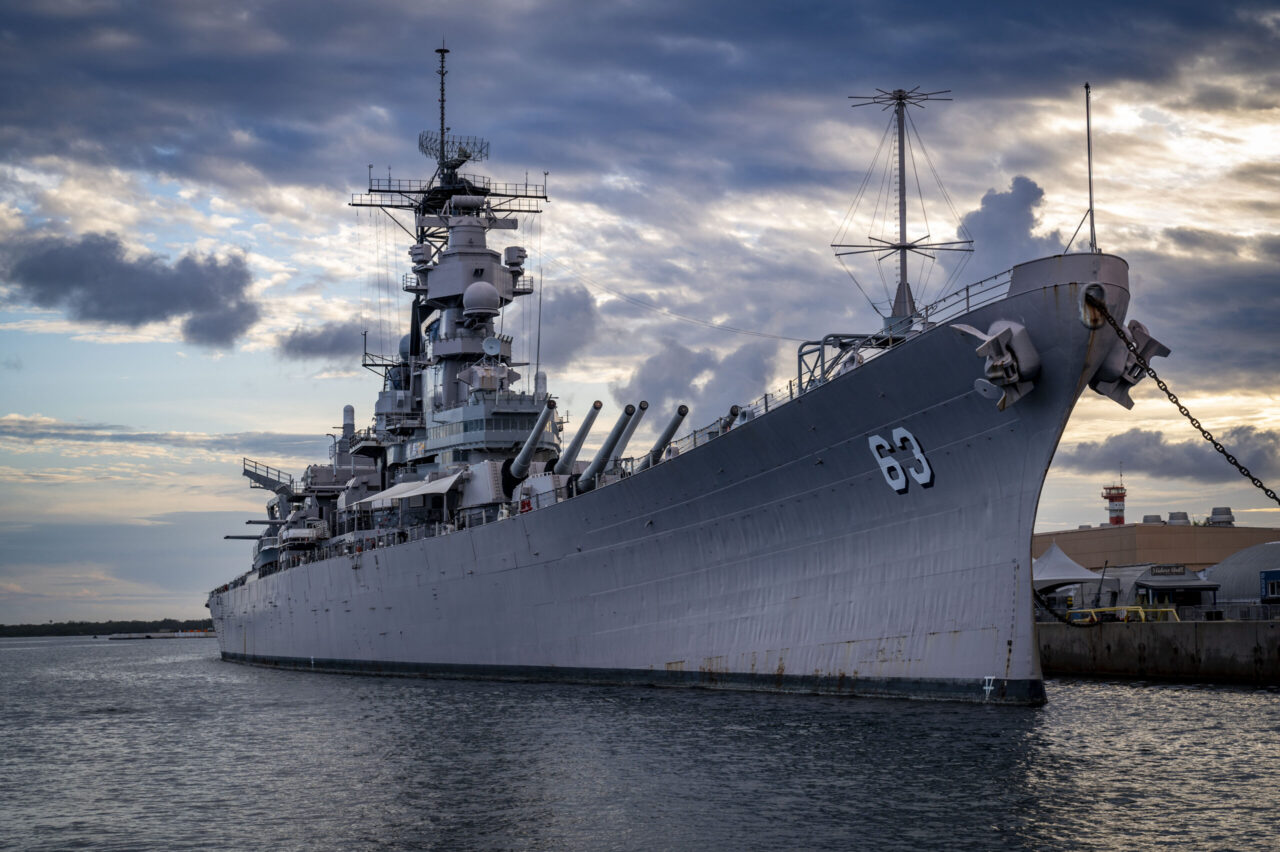
The advent of advanced anti-ship missiles, naval aviation, and even unmanned aerial systems ensured that the battleship remained obsolete—until now.
After decades, the battleship is back.
This week. President Donald Trump and the US Navy’s leadership announced the Trump-class battleship as part of the Golden Fleet initiative. Envisioned as a large capital warship capable of carrying rail guns and scores of advanced missiles, the Trump-class battleship promises to challenge current naval doctrine. Battleships, after all, have been obsolete for nearly 80 years.
Leading up to World War I, battleships were the kings of the waves. Indeed, a battleship arms race between Great Britain and Germany contributed to the outbreak of the Great War. The race to commission as many Dreadnought-type battleships as possible strained relations between the two European powers and contributed to the catastrophic events of World War I. The United Kingdom won the race, and the Royal Navy prevailed on the seas during the conflict. Even though there was only one major sea clash during the war, the Battle of Jutland in 1916, where the British lost more ships and men but won a strategic victory over the German High Seas Fleet, battleships served as the major naval unit of the war.
Little changed during the interwar period. The great powers of the time even recognized the importance of the battleship in naval warfare by signing the Washington Treaty in 1922, which limited the tonnage of new battleships to 35,000 tons. Although nations abandoned the Treaty in the years before World War II, the international agreement halted battleship development and production for about a decade.
When World War II broke out, the battleship was still the main surface combatant on the battlefield. Navies calculated their power based on how many battleships they could put out to sea. However, the battleship’s reign came to a quick close in the opening years of the conflict. And its end came from the air. In several actions throughout the world, the airplane, often launched from an aircraft carrier, showed why the battleship could not be what it was.
For example, on December 10, 1941, three days after the attack on Pearl Harbor, Japanese aircraft sank the HMS Prince of Wales battleship and HMS Repulse battlecruiser in a single action. Navies, especially in the Pacific theater of operations, became increasingly reliant on aircraft carriers to wage offensive operations. The end of the battleship era came in an epic battle between the Japanese Yamato, one of the largest battleships ever built, and hundreds of US aircraft on April 7, 1945.
Following the end of World War II, navies decommissioned battleships en masse. The US Navy retained some battleships in its active roster, but for secondary roles. Some were even brought back to service during the Gulf War in 1991 and outfitted with cruise missiles. But the advent of advanced anti-ship missiles, naval aviation, and even unmanned aerial systems ensured that the battleship remained obsolete. Battleships were too large and expensive, and brought little to the battlefield because their guns could not reach far enough.
That is, until now. The Trump-class promises to bring the battleship back to life. Whether that is a viable decision, however, remains to be seen on the future battlefield.
About the Author: Stavros Atlamazoglou
Stavros Atlamazoglou is a seasoned defense journalist specializing in special operations and a Hellenic Army veteran (national service with the 575th Marine Battalion and Army HQ). He holds a BA from the Johns Hopkins University and an MA from the Johns Hopkins’ School of Advanced International Studies (SAIS). His work has been featured in Business Insider, Sandboxx, and SOFREP.
Image: DVIDS.