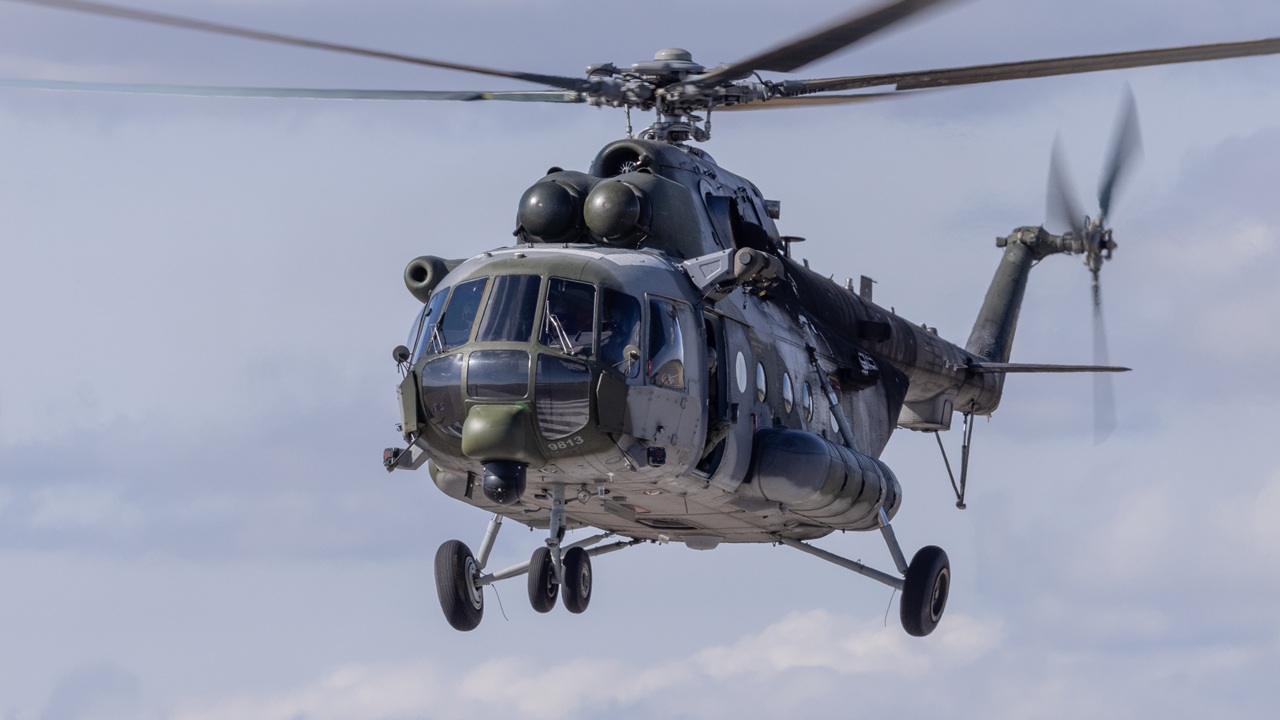
The Mi-8 is far more cost-competitive than Western counterparts, and focuses on redundancy and ease of use rather than exacting performance standards.
The Soviet Union’s Mi-8/Mi-17 helicopter is the most famous helicopter of the Cold War—the rough symbolic helicopter equivalent of the AK-47. The original Mi-8 model was eventually modernized and exported as the Mi-17, which became ubiquitous in Eastern Bloc and non-aligned countries. Rugged, cheap, and endlessly adaptable, the Mi-8/17 is still flying around the world, even today.
The Mi-8/Mi-17 Helicopter’s Specifications
- Year Introduced: 1967 (Mi-8) / 1975 (Mi-17)
- Number Built: 12,000+ (family total)
- Length: ~82.7 ft (25.2 m)
- Rotor Diameter: ~69.9 ft (21.3 m)
- Weight (MTOW): ~28,660 lb (13,000 kg)
- Engines: Two Klimov TV2-117 / TV3-117 turboshafts
- Top Speed: ~155 mph (250 km/h)
- Combat Range: ~290 mi (465 km)
- Service Ceiling: ~14,800 ft (4,500 m)
- Payload: ~8,800 lb (4,000 kg) internal
- External Sling Load: ~9,920 lb (4,500 kg)
- Capacity: 24 troops or 12–16 stretchers
- Aircrew: 3
The Mi-8 Was the Soviet Army’s Workhorse
After making its first flight in the early 1960s, the Mi-8/17 entered mass production. Designed by the Mil Design Bureau, the helicopter was built for utility, with an emphasis on simplicity, redundancy, and field repairability. This design philosophy struck a stark contrast with Western helicopters, which were optimized for performance and avionics.
The Mi-8/17 featured a twin-engine layout for safety and lift. The clamshell rear doors and side doors allowed for rapid loading/unloading, and the efficient transportation of troops, cargo, stretchers, and even external sling loads. The Mi-8/17 was not fast or stealthy; it didn’t need to be. Instead, its most valuable feature was its remarkable ability to handle abuse.
Accordingly, the Mi-8/17 became a staple of the Cold War, with widespread use across the Warsaw Pact and Soviet client states. Various Soviet-aligned nations used the helicopter for troop transportation, resupply, medevac, and command-and-control. In effect, the Mi-8/17 became a visual shorthand for Soviet presence worldwide, at the time a signifier of the “evil empire.”
Perhaps the Mi-8/17’s defining moment was the Soviet invasion of Afghanistan, where the helicopter served as the backbone of Soviet air mobility from 1979 to 1989. Operating in high altitude, extreme heat, and rugged terrain, the Mi-8/17 absorbed extreme punishment and kept going. While the helicopter was vulnerable to MANPADS attacks from the mujahideen on the ground, it proved indispensable.
How the Mi-17 Improved on the Mi-8
The Mi-17 was an evolution of the Mi-8, an export-focused upgrade featuring more powerful engines and improved hot-and-high performance. The new helicopter had better reliability and payload, and was adopted by Eastern Europe, the Middle East, Africa, and Asia. Ironically, the Mi-17 was widely used by NATO forces via contractors after 2001.
The platform proved one of the most-produced helicopters in history; it’s still flying in military service, UN missions, civilian transport, and disaster relief. The reason for longevity? A massive spare-parts ecosystem, low operating costs, and because pilots and mechanics around the world are so familiar with the system.
Strategically, the Mi-8/17 served as a symbol of Soviet (and later Russian) military power, encapsulating the nation’s philosophy of reliable quantity over perfection and utility over prestige. The helicopter showed how mass production of “good enough” platforms can outperform exceptional systems produced on more limited scales—at least in the aggregate. The Mi-8/17 served as a quiet counterpoint to the Western obsession with having the best tech.
It wasn’t flashy or cutting-edge. But its continued relevance underscores the enduring value of ruggedness and resiliency. Much of the world doesn’t need cutting-edge technology, just machines that show up when needed and can be repaired easily when they eventually fail.
About the Author: Harrison Kass
Harrison Kass is a senior defense and national security writer at The National Interest. Kass is an attorney and former political candidate who joined the US Air Force as a pilot trainee before being medically discharged. He focuses on military strategy, aerospace, and global security affairs. He holds a JD from the University of Oregon and a master’s in Global Journalism and International Relations from NYU.
Image: Shutterstock / Fotogenix.