The groundbreaking “Have Blue” design, which ultimately became the F-117 Nighthawk, relied heavily on research conducted by Soviet physicist Pyotr Ufimtsev.
The F-117 Nighthawk was the world’s first operational stealth aircraft—marking a radical watershed in aviation whereby an aircraft could achieve survivability through invisibility, rather than speed or maneuverability. Born from defense giant Lockheed’s ultra-secret Have Blue program, the F-117 remained classified until 1988—five years after becoming operational in 1983.
The F-117 Nighthawk’s Specifications
- Year Introduced: 1983
- Number Built: 64 (59 operational F-117A + 5 prototypes)
- Length: 65 ft 11 in (20.1 m)
- Wingspan: 43 ft 4 in (13.2 m)
- Weight (MTOW): ~52,500 lb (23,800 kg)
- Engines: Two GE F404-F1D2 turbofans (10,600 lbf each, no afterburner)
- Top Speed: ~620 mph / 1,000 km/h (~Mach 0.92)
- Range: ~930 mi (1,500 km) combat radius; ~1,600+ mi (2,575 km) with refueling
- Service Ceiling: ~45,000 ft (13,700 m)
- Loadout: Two internal bays; typically 2× 2,000 lb laser-guided bombs or JDAM
- Aircrew: 1
The F-117 Nighthawk’s Cold War Origins
In the 1970s, Soviet radar and missile technology was becoming increasingly sophisticated and increasingly lethal. The US Air Force, seeking a way to destroy high-value targets deep within Soviet territory, began investing in stealth technology. DARPA initiated a program to explore extreme radar-evading shapes and eventually Lockheed’s Skunk Works won a contract to craft what would become the F-117.
The key enabler for the program was a mathematical breakthrough—ironically from Soviet physicist Pyotr Ufimtsev’s work on how electromagnetic waves scatter off surfaces. While studying the properties of radar waves, Lockheed engineers discovered Ufimtsev’s equations—which, in an astonishing oversight, had not been classified by the USSR, likely because their strategic importance was not obvious at the time. The American engineers used Ufimtsev’s work to design an aircraft angled to deflect radar waves away from receivers. The Have Blue design process was one of the first to use computers to calculate the ideal shape of the aircraft; the computer’s lack of processing power meant that it was not powerful enough to compute the optimal design for curves, giving its proposed aircraft a distinctive design of flat panels stitched together into one unsightly blob.
The Have Blue program devised two prototypes. Both were eventually lost in separate accidents, but they proved that stealth performance could work in practice. Throughout the process, the program was ultra-secret, compartmentalized even within the Pentagon for its ramifications to Cold War strategy.
How the F-117 Revolutionized Air Warfare
The F-117 was an evolved version of the Have Blue prototype, scaled into an operational strike aircraft. The first flight was conducted in 1981, while initial operating capability was achieved in 1983. The entire program was run out of the Tonopah Test Range in Nevada (where the F-117 is still being flown today, despite being retired years ago), under extreme secrecy. Pilots used cover stories and only flew the aircraft at night.
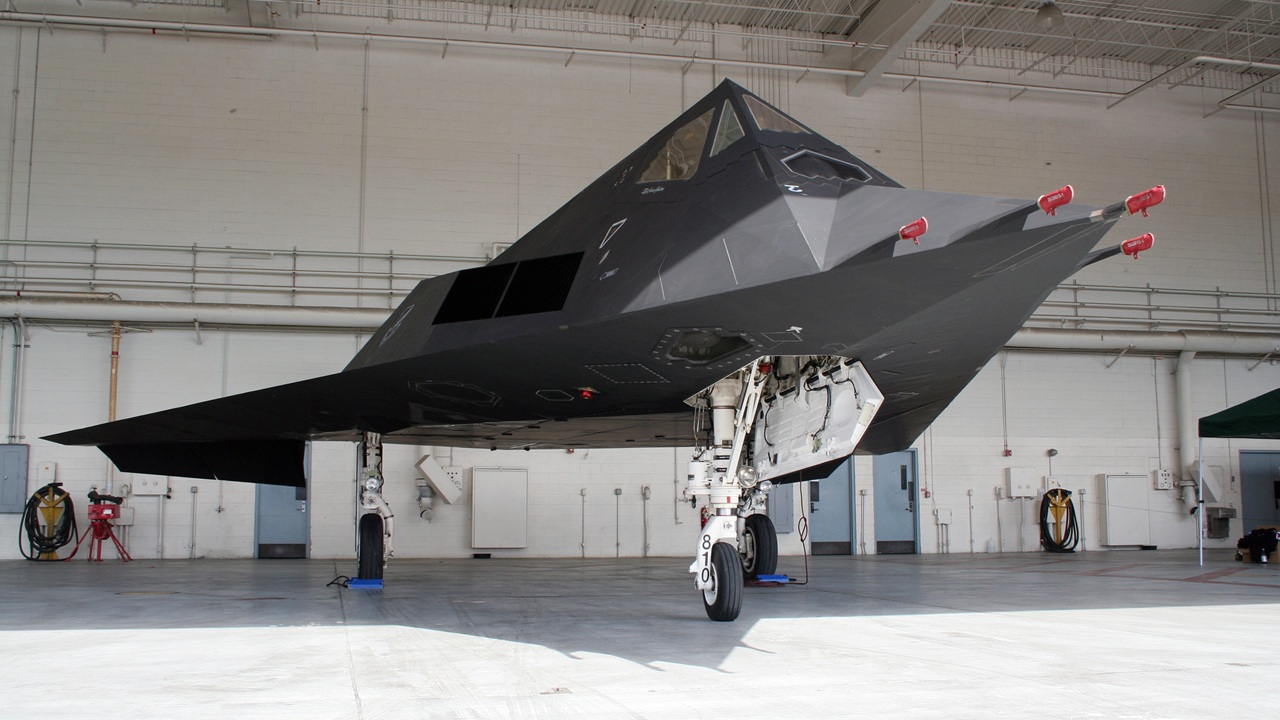
The aircraft’s technical specifications were relatively humble. Its top speed was subsonic, while its range and loadout were relatively modest. Yet beyond its top-line specifications, the F-117 was a groundbreaking platform. Before the F-117, no other aircraft had prioritized radar signature reduction above all other performance metrics. The appearance was optimized for low visibility, not aerodynamics, leading to an angular, alien-like shape that is still distinct amongst military airframes even today.
The F-117 was extremely difficult to fly; its faceted shape made the aircraft aerodynamically unstable, requiring a quadruple-redundant fly-by-wire computer just to maintain control. Pilots reportedly compared flying the aircraft to flying a refrigerator. The F-117 had no afterburners and was not able to outrun fighters or missiles, depending entirely on staying invisible for survival. To that end, the aircraft operated without radar, relying instead on infrared sensors and targeting pods.
But the F-117 nonetheless revolutionized air power doctrine, proving that stealth was not experimental, but strategically decisive. The F-117’s introduction shifted US procurement towards stealth aircraft (B-2, F-22, F-35, B-21) and forced adversaries to evolve; soon after the Nighthawk’s introduction, Russia, China, and others began developing low-frequency radar and networked defense systems to counter stealth technology—and building their own.
About the Author: Harrison Kass
Harrison Kass is a senior defense and national security writer at The National Interest. Kass is an attorney and former political candidate who joined the US Air Force as a pilot trainee before being medically discharged. He focuses on military strategy, aerospace, and global security affairs. He holds a JD from the University of Oregon and a master’s in Global Journalism and International Relations from NYU.
Image: Shutterstock / VanderWolf Images.