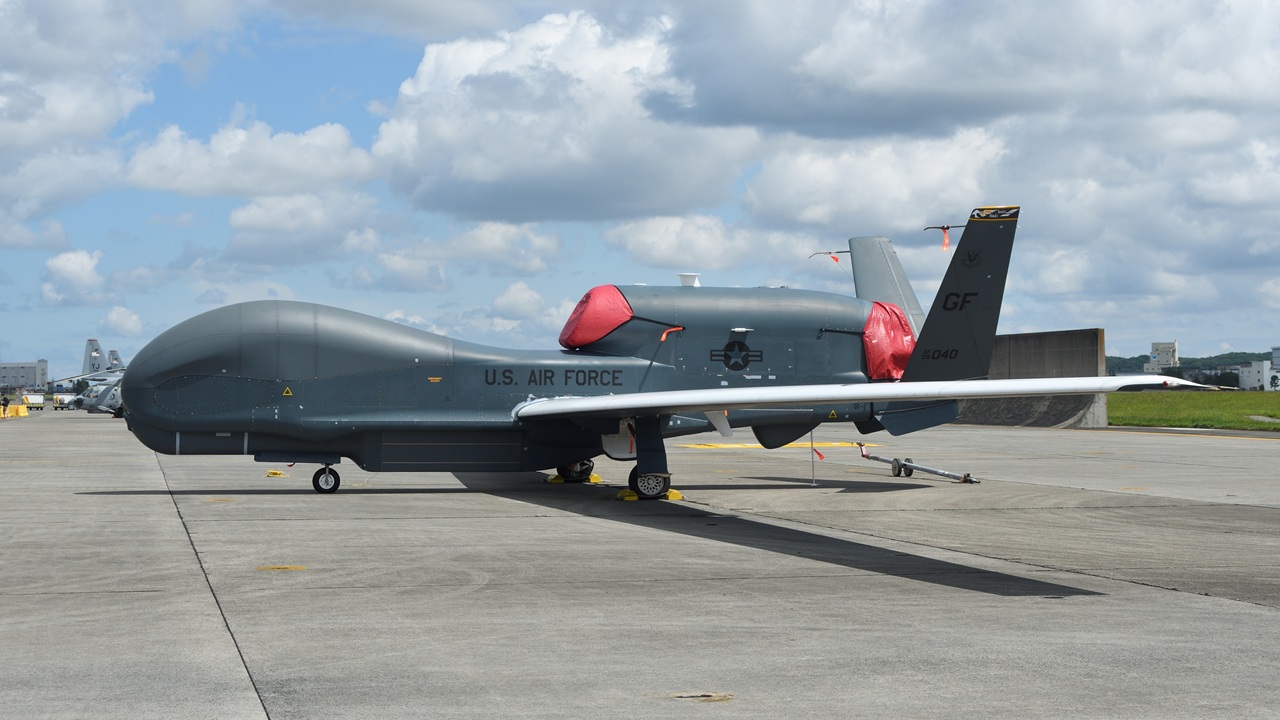
Designed as a replacement for the manned U-2 Dragon Lady spy plane, the RQ-4 drone has vastly expanded the US Air Force’s surveillance capabilities.
The RQ-4 Global Hawk is a vital intelligence-gathering aircraft, offering a high altitude, long-endurance unmanned system capable of providing persistent intelligence, surveillance, and reconnaissance (ISR) in real time. Born of DARPA’s High Altitude Endurance UAV program in the 1990s, the Global Hawk was conceived as a supplement and potential replacement for the U-2 Dragon Lady. The result was a strategic-level drone capable of conducting 30+ hour missions at 60,000 foot altitudes, with sensor coverage measures in tens of thousands of square miles per day.
The RQ-4 Global Hawk’s Specifications
- Year Introduced: 2001
- Number Built: ≈42 (U.S. inventory + NATO AGS)
- Length: ≈47.6 ft (14.5 m)
- Wingspan: ≈130.9 ft (39.9 m)
- Weight (MTOW): ≈32,250 lb (14,628 kg)
- Engine: One Rolls-Royce AE 3007H turbofan (~7,600 lbf)
- Top Speed: ≈310 knots (357 mph, 574 km/h) / Mach 0.50
- Range: ≈12,300 nmi (14,154 mi, 22,780 km)
- Endurance: ≈30–34 hours
- Service Ceiling: ≈60,000 ft (18,300 m)
- Armament: No weapons; EO/IR high-resolution camera suite; SAR/GMTI radar; SIGINT packages (variant-dependent)
- Aircrew: 0 (remote pilot + sensor operators)
Technologically, the RQ-4 is built around its massive wingspan, which optimizes the platform for efficiency at high altitude—loitering at altitudes well above most commercial air traffic. The monocoque airframe, V-tail, and lightweight composite construction allows the aircraft to operate with minimal drag, facilitating the long-duration missions the Global Hawk is renowned for.
The Global Hawk’s sensor suite varies by block and customer, but typically includes high-resolution electro-optical and infrared cameras, a powerful SAR (synthetic aperture radar) capable of ground-moving target indication (GMTI), signals intelligence payloads, and wide-area maritime surveillance arrays. These sensors can produce detailed imagery in all weather conditions, day or night, at standoff distances that keep the Global Hawk out of harm’s way, far from contested air space.
The Global Hawk’s History of Service
The Global Hawk entered service in the early 2000s and was used extensively in Iraq, Afghanistan, Libya, and throughout the Pacific. The platform’s ability to remain on station for more than a full day without refueling revolutionized ISR tasking. Instead of rotating multiple aircraft through a surveillance orbit, a single RQ-4 could watch the same battle space endlessly—detecting patterns, tracking vehicles, supporting special operations, and providing decision makers with a constant strategic window into the battle space.
Despite the platform’s success, the Global Hawk has faced controversy. The US Air Force has repeatedly attempted to retire earlier variants, arguing that operating costs were high and that satellite systems, manned U-2 aircraft, and emerging space-based and distributed autonomous systems could perform similar roles. Congress pushed back several times, citing the Global Hawk’s unique endurance, peacetime utility, and availability for non-combat operations such as humanitarian assessment, disaster mapping, and maritime search and rescue. The Navy, meanwhile, adopted its own maritime-optimized version—the MQ-4C Triton—which features reinforced wings, de-icing, and a powerful maritime radar for wide-area ocean surveillance.
From a strategic perspective, the Global Hawk embodies the shift from episodic reconnaissance toward persistent situational awareness. Modern conflict increasingly hinges on who can observe, process, and exploit information faster—abilities that the RQ-4 is well equipped to enhance while simultaneously reducing the risk associated with manned overflights.
However, as great power competition intensifies, putting the US into closer contact with near-peer adversaries, the Global Hawk’s vulnerability becomes more pronounced; high-altitude UAVS are detectable, trackable, and easy to shoot down.
Still, the Global Hawk remains in use with the United States, NATO, and several allied partners, while the Triton variant remains in use to expand coverage across the Pacific and Indian Oceans. Though newer systems may eventually replace the Global Hawk, the platform has already left its mark on the US military, ushering in a new era of ISR and unmanned performance.
About the Author: Harrison Kass
Harrison Kass is a senior defense and national security writer at The National Interest. Kass is an attorney and former political candidate who joined the US Air Force as a pilot trainee before being medically discharged. He focuses on military strategy, aerospace, and global security affairs. He holds a JD from the University of Oregon and a master’s in Global Journalism and International Relations from NYU.
Image: Shutterstock / viper-zero.