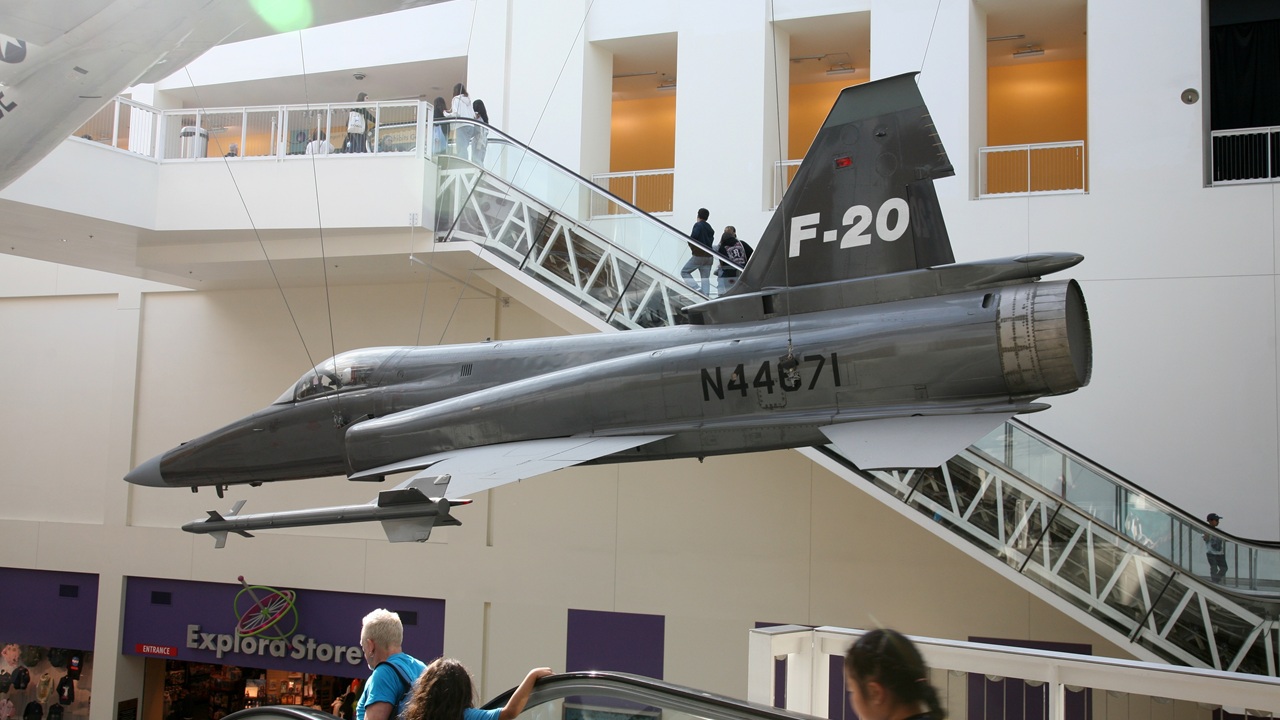
Northrop’s design methodology with the F-20 Tigershark—build a great fighter jet first and worry about sales later—was a catastrophic mistake.
The Northrop F-20 Tigershark is a case study into how performance metrics are not the only factor determining outcomes. Fast, agile, inexpensive, and convenient, the F-20 was one of the most capable light fighters ever developed. Yet it was completely shut out of the market—an example of how politics and timing sometimes matter more than the product itself.
The F-20 Tigershark’s Specifications
- Year Introduced: 1982 (first flight; never entered service)
- Number Built: 3 (prototypes)
- Length: 47 ft 4 in (14.4 m)
- Wingspan: 27 ft 4 in (8.3 m)
- Weight (MTOW): ~26,500 lb (12,020 kg)
- Engines: One GE F404-GE-100 turbofan (≈17,000 lbf with afterburner)
- Top Speed: ~1,400 mph (2,253 km/h) / ~Mach 2.0
- Combat Radius: ~340–400 mi (550–640 km)
- Service Ceiling: ~55,000 ft (16,800 m)
- Loadout: Two 20mm autocannons; 7 hardpoints (8,000 lb / 3,600 kg carrying capacity)
- Aircrew: 1
The F-20 Tigershark: A Plane Without a Country
Evolved from the F-5E Tiger II, which was widely exported and acclaimed for its simple and affordable design, the F-20 represented Northrop’s follow-up effort to create a low-cost, high-performance fighter for US allies who were not then allowed to purchase cutting-edge fighters like the F-15 and F-16.
However, in the early 1980s, the F-16 was approved for export—instantly ruining the F-20’s market rationale. In the decades since, the F-16 has since gone on to become one of the most successful export aircraft of all time, while the F-20 faded almost immediately into aviation obscurity.
To be clear, the F-20 was a capable aircraft. With one General Electric F404-GE-100 engine offering 17,000 pounds of thrust, the F-20 could hit Mach 2, making it as fast as the F-16. The avionics were advanced for the time, with the APG-67 radar, BVR capability, and a digital cockpit. Integrated weapons included the AIM-9, AIM-7, bombs, rockets, and guns.
Pilots praised the F-20’s handling as extremely agile but also extremely stable, a fantastic combination. Its thrust-to-weight ratio was excellent for a lightweight fighter. And the jet’s unique ability to go from a cold start to takeoff in under 60 seconds gave the platform rapid scramble capability, a practical benefit in a modern air war. Finally, the F-20 was cheap to buy and easy to maintain, making it a logical choice for nations with budgetary and logistical constraints.
Shifting US Export Policy Killed the F-20
So, on paper, the F-20 should have succeeded. It was low cost relative to the F-16, with a minimal logistics footprint, modernized avionics, and an excellent training platform. But the United States undermined its own product. New F-16 exports, right as the F-20 was debuting, poisoned the market. The selling point of American aircraft was their perceived quality compared to European or Soviet competitors, and the F-16 was seen as a better alternative to the F-20. So, in spite of the F-20’s lower price tag, every country that might have been interested in the F-20 opted instead for the F-16.
In the end, no country on Earth bought the F-20. Only three prototypes were ever built, meaning the F-20 was one of the most advanced and capable fighters to never even enter regular production.
The F-20 incident offered strategic and industrial lessons. For starters, the industry learned that self-funded fighters are a tremendous risk. Northrop had invested enormous internal capital, betting that the F-20 would earn a market share, despite not having a guaranteed buyer up front. When that didn’t pan out, the investment was effectively squandered, costing Northrop and its shareholders billions.
The F-20 incident also proved that the export market follows US procurement. If the US Air Force buys a fighter jet, it is a positive sign to the rest of the world that it is a good fighter jet. Conversely, if the Air Force doesn’t buy an American-made product, foreign buyers will not buy it, either. Most enduringly, the F-20 showed that the US and her allies were transitioning away from cheap, lightweight fighters, towards the advanced multirole fighters—F-16s, F/A-18s, JAS 39 Gripens, and Dassault Rafales—that have been in vogue ever since.
About the Author: Harrison Kass
Harrison Kass is a senior defense and national security writer at The National Interest. Kass is an attorney and former political candidate who joined the US Air Force as a pilot trainee before being medically discharged. He focuses on military strategy, aerospace, and global security affairs. He holds a JD from the University of Oregon and a master’s in Global Journalism and International Relations from NYU.
Image: Shutterstock / mikeledray.