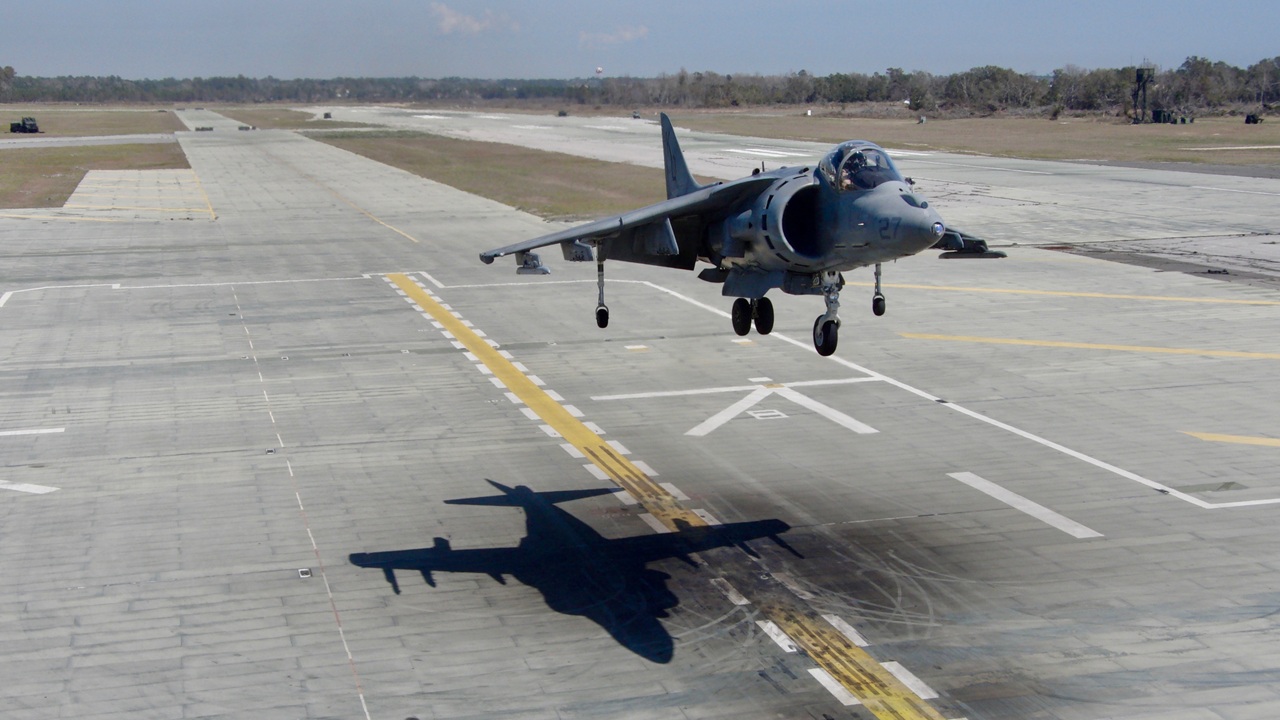
The AV-8B Harrier is now nearly retired—but its mission profile will live on in the F-35B Lightning II, which shares many of the same capabilities.
The AV-8B Harrier remains one of the most instantly recognizable jets in the world, one of the few that can take off vertically, hover, and land without a runway—a capability known as V/STOL. Of course, crafting a fixed-wing aircraft that could perform in such a manner required very intentional design elements, an engineering scheme that combined thrust-vectoring, reaction controls, and lightweight design, leading to an end product that helped redefine what an aircraft could do.
The AV-8B Harrier’s Specifications
- Year Introduced: 1985
- Number Built: ~340 (all AV-8B variants)
- Length: 46 ft 4 in (14.1 m)
- Wingspan: 30 ft 4 in (9.3 m)
- Weight (MTOW): ~31,000 lb (14,060 kg)
- Engines: One Rolls-Royce F402-RR-408 (Pegasus) turbofan, 23,800 lbf thrust with vectoring nozzles
- Top Speed: ~670 mph (1,078 km/h) / ~Mach 0.9
- Range: ~1,380 mi (2,220 km) ferry; combat radius ~300–400 mi (480–640 km) depending on load
- Service Ceiling: ~50,000 ft (15,240 m)
- Loadout: 7 hardpoints; up to ~9,200 lb (4,173 kg) payload; supports Sidewinder, JDAM, Mavericks, rockets, gun pods
- Aircrew: 1
How the UK Built the Harrier “Jump Jet”
The heart of the Harrier’s V/STOL performance is the Rolls-Royce Pegasus turbofan engine, which drives four rotating exhaust nozzles. Two “cold” nozzles in the front expel bypass air while two “hot” nozzles in the rear expel combustion gases. All four nozzles rotate in sync with one another, from 0 degrees (horizontal) to 98 degrees (downward/backward). This allows the Harrier’s thrust to be directed backward (for conventional flight), or downward (for vertical lift), or anywhere in between (for short takeoff or slow-speed control).
But allocating thrust in a way that facilitates V/STOL is only part of the equation. In a hover, conventional control surfaces lose effectiveness, which is why the Harrier is outfitted with the Reaction Control System (RCS). The RCS uses bleed air jets mounted at the nose, tail, and wingtips to provide pitch, yaw, and roll control when airflow is insufficient. The RCS is absolutely essential—without it, the Harrier would be uncontrollable during hover.
The Harrier’s airframe was specially calibrated to be lightweight and balanced. Specifically, the airframe designed to keep the center of gravity precisely aligned with the nozzle vector line. Large high-lift wings, with high aspect ratio, were added for stability at low-speed flight. And the undercarriage was built to handle vertical impact and uneven landing zones.
Why the Harrier’s V/STOL Technology Was So Useful
V/STOL allows the Harrier to operate from carrier decks, expeditionary strips, and improvised forward bases. Basically, the Harrier can go anywhere. Accordingly, this allows its operators—the US Marine Corps, in America’s case—to deploy fixed-wing air power close to troops, rather than hundreds of miles away. This allows for air cover without the need for a full carrier strike group. V/STOL tech also gives the Harrier versatility and heartiness, allowing the aircraft to operate from short sections of highways or roads, which is especially valuable in scenarios where runways may have been destroyed.
The Harrier also has trade-offs. Hovering requires massive thrust, and the expulsion of hot exhaust, which can destroy concrete. Also, payload and fuel capacity drop dramatically in vertical operations. And the Harrier’s high pilot workload and accident rates have historically been higher than conventional fighters.
The Harrier also carries significant strategic implications. Harriers allowed nations to field fighter jets without nuclear carriers, an equalizer for navies with limited budgets. Harriers also gave the Marine Corps their own source of air power without having to rely fully on the Navy for air cover and logistical support.
The Harrier era is ending, with the jet already nearly gone from active service. The Harrier is outdated, with high observability that would drastically lower survivability in contested air space against a peer like China. Yet, while the Harrier is being retired, the V/STOL concept will endure; its DNA lives on in the F-35B Lightning II, a fifth-generation multirole stealth fighter equipped with V/STOL.
About the Author: Harrison Kass
Harrison Kass is a senior defense and national security writer at The National Interest. Kass is an attorney and former political candidate who joined the US Air Force as a pilot trainee before being medically discharged. He focuses on military strategy, aerospace, and global security affairs. He holds a JD from the University of Oregon and a master’s in Global Journalism and International Relations from NYU.
Image: Shutterstock / Mrs. Frodo.