
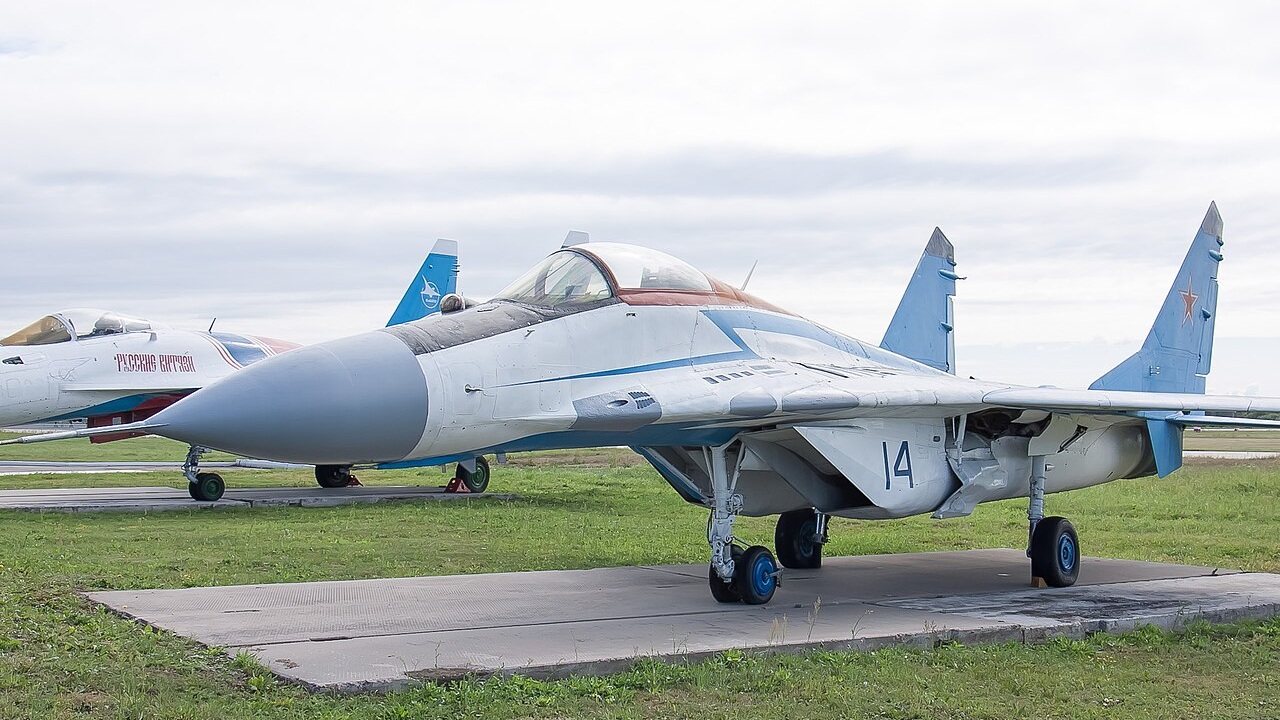
Russia’s MiG-29 fighter was more than capable of matching America’s F-16 Fighting Falcon and similar aircraft—but the Kremlin failed to keep it relevant over time.
America’s unveiling of fourth-generation aircraft such as the F-16 and the F/A-18 in the late Cold War inspired a Soviet response, which included the development of the MiG-29. Designed for front-line air defense rather than deep strike missions or global power projection, the MiG-29 has become a widely exported platform. Today, however, the MiG-29 is on the fringes of relevance, with a reputation derived more from airshow performance than actual combat.
The MiG-29 Fighter’s Specifications
- Year Introduced: 1983
- Number Built: ~1,600+ (all variants)
- Length: 56 ft 9 in (17.3 m)
- Wingspan: 37 ft 3 in (11.4 m)
- Weight (MTOW): ~40,800 lb (18,500 kg)
- Engines: Two Klimov RD-33 turbofans (≈18,300 lbf / 81.4 kN thrust each with afterburner)
- Top Speed: ~1,490 mph (2,400 km/h) ≈ Mach 2.25
- Range: ~900 mi (1,500 km) ferry; ~430 mi (700 km) combat radius
- Service Ceiling: ~59,000 ft (18,000 m)
- Loadout: One 30mm GSh-30-1 cannon; up to ~6,600 lb (3,000 kg) of air-to-air missiles and limited air-to-ground stores on 6 hardpoints
- Aircrew: 1
Why the Soviet Union Needed the MiG-29
In the late 1970s, the Soviet began to recognize that their MiG-21/23 fighters were being outpaced; Western fourth-generation fighters were demonstrably better than anything the Soviets could offer. The solution was the development of new aircraft, specifically the pairing of the Su-27 for long-range air superiority, and the MiG-29, for short-range defense. For the MiG-29, the design emphasis was on short takeoffs and rough-field operations, with a heavy reliance on IR missiles, like the R-73. The concept made sense, and the product execution was just fine—but the MiG-29 entered service just as the Cold War was ending, making for poor strategic timing.
The MiG-29 featured excellent thrust-to-weight ratio and an instantaneous turn rate. The powerful IRST system facilitates passive targeting while a helmet-mounted sight and the R-73 gave the aircraft a within-visual-range (WVR) advantage. The MiG-29 did have limitations, however, like a short combat radius and limited endurance. The small radar, on early variants, had a limited look-down/shoot-down performance. And the platform, especially the engines, carried a high maintenance burden. Basically, the MiG-29 was limited in its optimization for close-in dogfighting, without much ability to participate in the beyond-visual-range (BVR) engagements that were coming to dominate air combat. Later MiG-29 variants did address the platforms range and avionics, to facilitate improved BVR performance, but these increased the platform’s cost and complexity.
Why Russia’s Air Force Left the MiG-29 Behind
The MiG-29 was designed to sprint to intercept and engage quickly. The platform was strong in dogfighting and in defensive counter-air missions but weak in any form of multi-role strike configuration. Performance in real conflict, like Yugoslavia, Eritrea-Ethiopia, and Ukraine, has had mixed results.
The aircraft’s real legacy, arguably, has been through the export market; the MiG-29 has been widely exported across Eastern Europe, the Middle East, Africa, and South Asia. The platform is popular because it is relatively affordable, politically accessible, and stems from a familiar Soviet logistics chain. Still, many foreign operators struggle with sustainment and spare parts and pilot training.
Strategically, the MiG-29 is a prime example of the Soviet doctrinal contrast from Western air power. The Soviets emphasized defensive and centralized operations. The MiG-29 showed the limits of platforms that were optimized for a very specific role, a tendency that Western builders pivoted away from by the end of the Cold War.
Today, much of the MiG-29 fleet is aging out. Modernization is costly relative to new light fighters. And Russia clearly favors the Su-30/35/57 family over the MiG-29, which has relegated the remaining MiGs to secondary roles, likely to be phased out over the next few decades.
About the Author: Harrison Kass
Harrison Kass is a senior defense and national security writer at The National Interest. Kass is an attorney and former political candidate who joined the US Air Force as a pilot trainee before being medically discharged. He focuses on military strategy, aerospace, and global security affairs. He holds a JD from the University of Oregon and a master’s in Global Journalism and International Relations from NYU.
Image: Wikimedia Commons.
















.jpg - Wikimedia Commons)