Worry is the air in a world of unknowns. We breathe it in as if it were the life force by which we have our motion. Will war break out today in the world, on my block, in my soul? Are children becoming the men and women we’re teaching them to be? Will I have enough money to keep food on the table? Am I doing enough for others, for myself, for my God? With so many uncertainties in our world, it seems that every decision has its roots in worry—the impetus that keeps us alive.
We first worry about ourselves. Like children, we believe we are the center of the universe. We want our own “good,” and we don’t care about how it comes to us. This is the first stage of worry: egocentrism.
But it doesn’t satisfy. Even when we have all our needs and personal desires met, we still worry.
We then thrust our worry upon things beyond us. We worry about people first—family members, friends, our communities. Then, the worry extends to ideals—work, politics, society, social justice. We begin sacrificing for these people and ideals, and we become depressed. No person or thing can reciprocate the love which we give it—not entirely anyway. Worrying about others and ideologies results in a deceptive bitterness.
When this happens, some retrace their steps and return to worrying about themselves until it becomes a cycle. They “work on themselves” until they discover their next “love,” their next project, their next hobby, their next means to survival…and ultimately end up worried that they’ll never feel fulfilled, never meant for a purpose.
Nothing satisfies.
Others throw their worries on God. They worry about displeasing Him. They pray. They study. They participate in works of mercy.
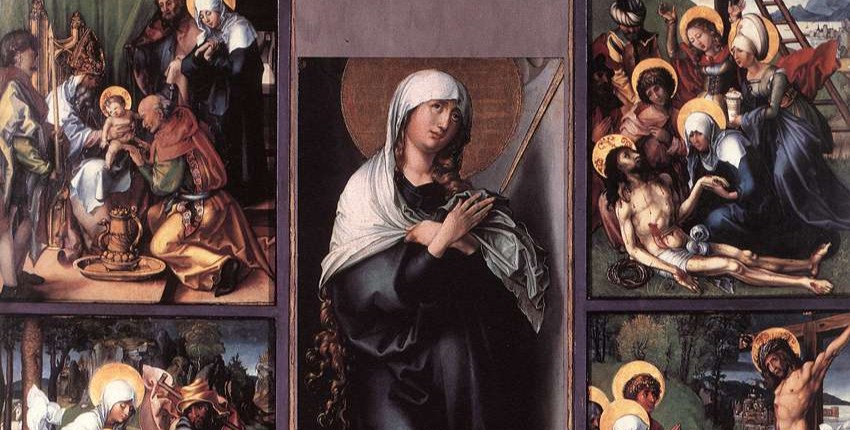
This is where we find Our Lady in the moment of the Presentation of Jesus in the Temple—she is worried. After raising the swaddled Christ into the air, Simeon exclaimed, “My eyes have seen your salvation, which you prepared in sight of all the peoples, a light for revelation to the Gentiles, and glory for your people Israel.” Then, he revealed Our Lady’s cross to her:
Behold, this child is destined for the fall and rise of many in Israel, and to be a sign that will be contradicted (and you yourself a sword will pierce) so that the thoughts of many hearts may be revealed. (Lk. 2:35)
Upon hearing those words, Mary had every right to become worried. She could have leaned on her human nature of wanting to control the situation, limiting the Lord’s access to the outside world, shielding Him from every possible danger. She could have told Joseph to build her a fortress of a house, to isolate her family from the world, to ensure the safety of the God-man, and to never let Him suffer even the possibility of a sliver. She could have let the wine run dry at the Wedding Feast of Cana instead of calling upon her Son to start His public ministry, a mission that would end in the cross and swords that pierced both her heart and that of her Son, Jesus.
But she didn’t do that. She didn’t let worry have the final word.
On the contrary, she allowed the Holy Spirit to fill her with His gift of patience.
When they had fulfilled all the prescriptions of the law of the Lord, they returned to Galilee, to their own town of Nazareth. The child grew and became strong, filled with wisdom; and the favor of God was upon him. (Lk. 2:39-40)
Our Lady waited patiently. For 30 years, she practiced joyful patience. She filled the Christ Child with wisdom. She made Him strong. She was, and still is, the “favor of God” that was upon Him. And Jesus was the “favor of God” that was upon her.
Just as the cross has two beams, so too do we have two perfect beings who fill us with the confidence necessary to complete our mission. Jesus and Mary are the “favor of God” upon us.
You never suffer alone. Mary is the guide who grows our wisdom, makes us strong, and walks with us to the cross, where love triumphs over evil and everlasting life is victorious over death.
So do not worry.
He tells you that swords will pierce your soul—do not worry.
He says you will be ridiculed and persecuted—do not worry.
He tells you that you will bear a cross—do not worry.
Instead, be patient.
Love is patient before everything else (1 Cor. 13:4). All sorrows, especially worry, must first be met with patience. This is how Mary accepted Simeon’s prophecy at the Presentation. With patience, all sorrow—no matter how massive the flood or how small the teardrop—pours into the abyss of love.
So, how does one find joy in the sorrows of life?
The answer: we love. St. John Paul II tells us that through Jesus’ sacrifice…
Human suffering has entered into a completely new dimension and a new order: it has been linked to love…to that love which creates good, drawing it out by means of suffering, just as the supreme good of the Redemption of the world was drawn from the Cross of Christ, and from that Cross constantly takes its beginning. (S.D. 18)
Worry, then, is the first sign that you are in love with God, and He with you. He loves you so much that he gives you the grace of patience, which will reveal the joy that hides in the shadows of your pain. As Kempis wrote:
…a mighty force it is, this thing love, mighty and altogether good; alone it takes the weight from every burden, alone it bears evenly the uneven load. It bears a burden as if no burden were there, makes the bitter things of life sweet and good to taste. (Kempis, 115)
Patience diffuses worry so that love can become strong.
Can any of you by worrying add a moment to your life-span? If even the smallest things are beyond your control, why are you anxious about the rest?” (Lk. 12:25-26)
Editor’s Note: This is the first article in a new CE series, Finding Joy in Our Crosses: The Paradox of Christian Happiness. This series comes from a collection of Lenten reflections by Catholic Exchange writer, TJ Burdick. To access the complete collection, visit TJ’s Substack at tjburdick.substack.com. No subscription necessary.
Image from Wikimedia Commons