It is hard to calculate the cost of a US invasion of Venezuela—but if past wars are any guideline, a conservative estimate would be hundreds of billions of dollars.
President Donald Trump has presided over a slow-rolling military buildup in the Caribbean—the largest increase in forces in the United States Southern Command’s (USSOUTHCOM) area of responsibility (AOR) in decades—and everyone is waiting with bated breath to see what will happen next.
Already, the Trump administration has ordered the destruction of multiple suspected drug-running boats emanating from Venezuela. It has also seized an Iranian-affiliated oil container ship that was allegedly running sanctioned Venezuelan oil to Cuba and was part of the global shadow fleet undergirding the black market. For these actions, it has been accused of war crimes—attacking the speedboats without due process—as well as piracy for taking the container ship and its contents for itself.
There does not appear to be any change in those policies from Trump. Meanwhile, the president has indicated that he intends to expand military operations against Venezuela’s drug cartels by deploying large numbers of US troops into Venezuela itself (there are around 16,000 US Marines sitting off the coast of Venezuela currently).
Venezuela 2026: Panama 1989, Redux?
Many in Washington who support the president’s belligerence toward Venezuela liken this action to what President George HW Bush did against Manuel Noriega in Panama. At the time, Noriega was credibly accused of involvement in the drug trade, and the United States launched a military intervention in Panama—codenamed Operation Just Cause—to remove him from power and arrest him. After a brief military struggle, and a two-week siege of the Holy See’s diplomatic mission in which Noriega had taken shelter, the Panamanian dictator was captured and brought back to the United States. All in all, the operation was a tremendous success.
There are some real differences between then and now. Notably, Venezuela is twelve times larger than Panama, with a population density that is ten times larger. The geography of Venezuela is fundamentally different in Venezuela from that of nearby Panama, too.
In Panama, the United States deployed a force of around 27,000 troops. As noted above, 16,000 troops—US Marines—standby to engage in combat in Venezuela. Not only is the Venezuelan Armed Forces far larger than the Panamanian forces were, but it also has considerably more military assistance and support from US rivals, chiefly Russia, but China and Iran as well.
Most experts believe that, if the president were to order an invasion of Venezuela, to have a chance not just of defeating Maduro’s forces but of holding the country, the US would need a force between 50,000 to 150,000 troops. There is no indication that Trump will get anywhere near that number.
And there does not seem to be much hustle on the part of American war planners.
Trump Might Be Launching the Slowest Invasion in US History
This is a stark difference from previous conflicts in which the US military has been engaged. In Afghanistan, Iraq, and other fights, the Americans moved swiftly to attack so as not to give the enemy time to prepare reliable defenses. Trump’s approach has been downright tepid to conflict. It’s almost as if he is not really interested in an invasion.
That’s what many in Venezuela and around the world are starting to believe, irrespective of the boats being destroyed and the seizing of the oil tankers. One does not need the force that Trump has deployed into the Caribbean to seize tankers and sink speedboats.
Perhaps the president instead intends to blockade the country and effectively choke out Maduro’s ability to make money on the global black market. In so doing, Trump might be hoping that Maduro will simply be forced to flee the country without making any demands for his departure. (Earlier this year, Maduro allegedly offered to leave the country and give the Americans exclusive access to Venezuela’s immense natural resources, but only so long as he was given safe passage to a country of his choice, gobs of money, and a blanket pardon for his alleged crimes.)
There’s a real problem with this scenario, though. For starters, Trump would need to escalate his partial blockade of Venezuela immediately to a hard blockade that genuinely choked off Venezuela’s exports. There’d need to be consistent interdiction and insurance compliance by shipping firms engaged in trade with Venezuela.
Oh, and Trump would need regional buy-in. From neighboring Colombia to Brazil to Mexico, there is hardly any real consensus from the region’s leaders that they’d support such a blockade on Venezuela’s goods—especially Venezuelan oil. Plus, with that ghost fleet floating around the entirety of South America, the Navy (and US Coast Guard) will be able to intercept many illegal trading ships…but not all. Caracas could easily reroute goods across the border with Colombia, for example, and then have them redistributed globally from there. Sure, the Americans might try to place troops at key border locations… but if Colombia declined to participate, would they invade Colombia, too?
If Trump did somehow manage to fully enact his hard blockade on Venezuela, though, it’d take probably at least nine months for there to be a severe cash crisis that would threaten Maduro’s grip on power. From there, it’d take an additional year or more for that cash squeeze to destabilize elite bargains, and even risk Venezuela’s military defecting from Maduro.
Remember, the Americans blockaded Saddam Hussein’s Iraq for almost a decade after Desert Storm with no-fly zones and steep sanctions. All it did was impoverish the Iraqi people and help to keep Saddam in power.
Even with a potential power transition plan in place, as the Trump administration seems to favor replacing Maduro with the democratic opposition leader Maria Corina Machado, unless those elite bargains with Maduro truly break down in the country, that regime can outlast any blockade Trump may impose.
Such a blockade that takes 18 months or longer might see the costs to the American taxpayer explode to anywhere between $5 billion to $15 billion per year—and that’s without any changes to the US power structure, and hence its foreign policy priorities, following next year’s midterm elections.
War with Venezuela Is Expensive!
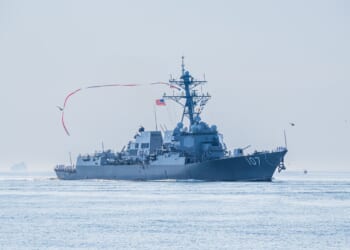
It has been assessed that the cost to the American taxpayer for maintaining a carrier strike group off the coast of Venezuela is roughly $6.5 million per day. The initial deployment costs for US forces deployed as part of Operation Southern Spear is estimated to be more than $600 million by late October/early November.
Breaking Defense, a major online trade publication, assessed that the Pentagon had requested around $355 million for Fiscal Year 2025 for enhanced regional presence, including counternarcotics missions. The Venezuelan operation goes beyond that.
Writing for the Stimson Center in October of this year, Evan Cooper and Alessandro Perri rightly cautioned that the costs of Trump’s Venezuela operations would transcend direct military buildup and confrontation.
It would have real costs to the American energy consumer, too. That’s because “oil prices might increase by as much as 10%-20% in the event of a conflict […] And an attempt to create regime change would require persistent presence and investment to stamp out resistance, incurring long-run costs.”
A remarkable Vanity Fair article on the current White House chief of staff Susie Wiles—who has been dubbed both by President Trump and multiple media outlets as the “most powerful woman in the world”—quotes her as admitting that Trump will continue blasting suspected drug boats off the Venezuelan coast until Maduro leaves.
So, the objective is regime change in Caracas, despite Trump’s repeated refusal to acknowledge that as his main goal with the slow-rolling US military buildup in the region. But who would replace Venezuelan President Nicolas Maduro?
And why this is even a concern of Washington remains as murky a topic as ever.
But, clearly, the 47th president of the United States has deemed overthrowing the Venezuelan regime as being the pathway to “making America great again.”
If hostilities commenced in earnest and US boots were put on the ground in Venezuela, the combination of conventional combat operations (especially in jungle canopy), the inevitable longer-term stabilization and/or reconstruction, and the likelihood of having to contend on some level with a protracted insurgency, that would place the costs at well over $100 billion.
If that insurgency and reconstruction program lasted for many years after the initial American military operation against Maduro, it could be more than $1 trillion over a decade. That’s not including the added, longer-term costs of veterans medical and disability care, the strain on logistics, equipment depreciation, and other weapons expenditures that would be needed (and likely unanticipated) for the operation. An initial invasion and short-term occupation of even part of the South American state would cost tens of billions of dollars.
Trump Is Acting All on His Own
Did we mention that none of what’s happened—or what may happen—has been voted on by Congress? That no additional funding for the kind of operation that Trump is clearly contemplating initiating has yet been appropriated by Congress? Or that overwhelming numbers of Americans from both political parties do not support this potential conflict?
The bottom line is that whatever returns Trump believes America would make in the long run by dominating Venezuela’s natural resources, in the short- and medium-term, the Americans will bear a considerable financial burden…that might not pay out what Trump thinks it would.
Venezuela could easily become for Donald Trump what Iraq became for George W. Bush: a legacy killer and a significant, persistent problem for the US.
About the Author: Brandon J. Weichert
Brandon J. Weichert is a senior national security editor at The National Interest. Recently, Weichert became the host of The National Security Hour on America Outloud News and iHeartRadio, where he discusses national security policy every Wednesday at 8pm Eastern. Weichert hosts a companion book talk series on Rumble entitled “National Security Talk.” He is also a contributor at Popular Mechanics and has consulted regularly with various government institutions and private organizations on geopolitical issues. Weichert’s writings have appeared in multiple publications, including The Washington Times, National Review, The American Spectator, MSN, and the Asia Times. His books include Winning Space: How America Remains a Superpower, Biohacked: China’s Race to Control Life, and The Shadow War: Iran’s Quest for Supremacy. His newest book, A Disaster of Our Own Making: How the West Lost Ukraine is available for purchase wherever books are sold. He can be followed via Twitter @WeTheBrandon.
Image: Shutterstock / Humberto Matheus.