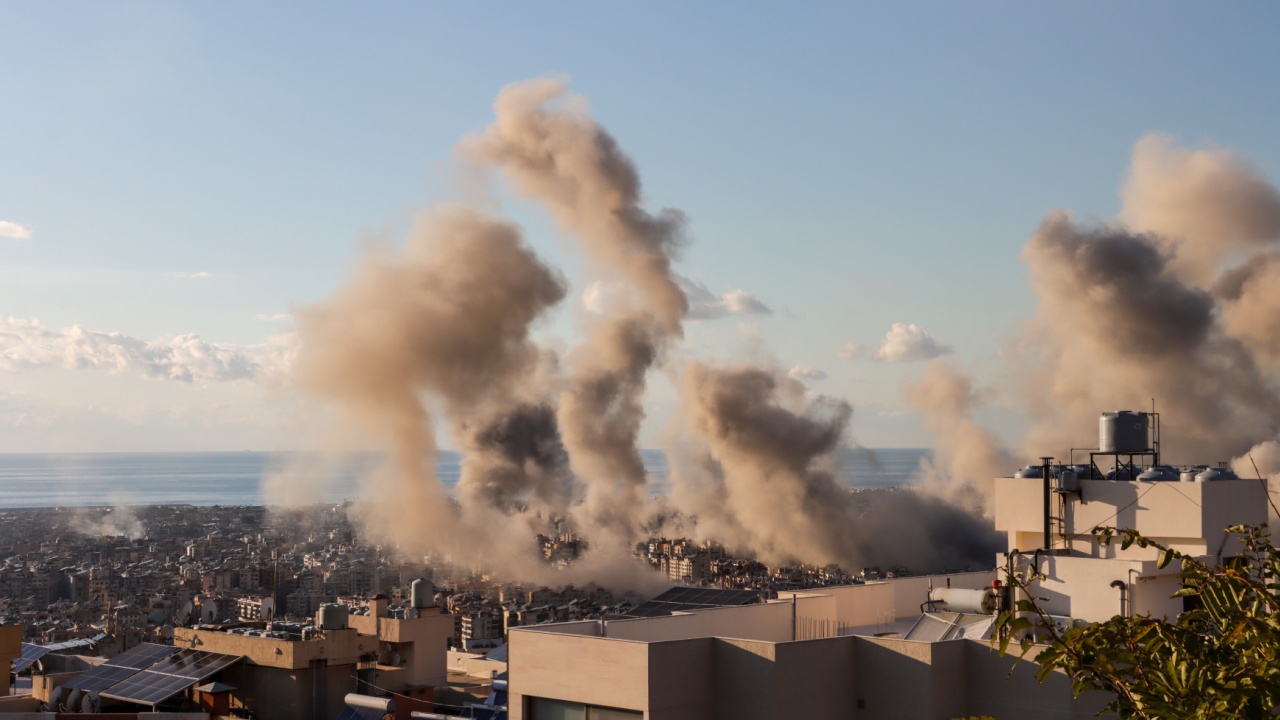
Lebanon’s stability and the disarmament of Hezbollah will depend on the longevity and eventual resolution of the Gaza ceasefire.
In his 2010 book, Beware of Small States: Lebanon, Battleground of the Middle East, David Hirst described Lebanon as the Middle East’s “battleground,” where regional and global rivalries repeatedly spill over into local conflicts. That metaphor became reality again on October 7, 2023, when Hamas and allied groups launched a series of coordinated armed incursions into parts of southern Israel, killing approximately 1,200 people and taking 251 people as hostages. The next day, Hezbollah opened a “support front” in solidarity with the Palestinians and began launching cross-border missile attacks.
The situation escalated in September 2024 when thousands of pagers and walkie-talkies used by Hezbollah members exploded, killing 42 people and injuring 3,500, including 1,500 fighters, which was followed by air and ground operations that lasted until a ceasefire was brokered in late 2024. The conflict significantly weakened Hezbollah militarily and politically, paving the way for an end to a two-year political deadlock. The election of Lebanese Armed Forces commander Joseph Aoun to the presidency and the creation of a new government under Prime Minister Nawaf Salam soon followed.
New leadership also presented an opportunity for the country to move past its diplomatic isolation and begin rebuilding its shattered economy by passing a series of economic, financial, judicial, and administrative reforms aimed at stabilizing Lebanon’s fragile institutions and disarming all non-state armed groups, as stipulated in the Taif Agreement. The dilemma moving forward is how to achieve these goals without alienating Hezbollah to the point that it risks causing civil conflict, while doing so at a pace that satisfies its external backers.
Up until September 2024, Hezbollah was the strongest political actor in Lebanon. It operated as a state within a state, with a network of social services, including education, healthcare, infrastructure, and youth programs. This garnered it strong support from the historically marginalized Shia community. The party, alongside its ally Amal, controlled all 27 seats in the Lebanese legislature allocated to the Shia community, ensuring they could block key votes.
Hezbollah also had considerable military resources that outmatched those of the Lebanese Armed Forces (LAF). A 2018 report from the Center for Strategic and International Studies (CSIS) called Hezbollah “the world’s most heavily armed non-state actor,” which could mobilize 40,000–50,000 men and an arsenal between 150,000–200,000 rockets and missiles. Hezbollah emerged from the 2024 conflict in a considerably weakened position. Much of its leadership was killed, including the group’s long-time leader Hassan Nasrallah, as well as his potential successor, Hashem Safiedine.
According to Nasrallah’s successor, Naim Qassem, Hezbollah also suffered 5,000 deaths and 13,000 wounded. According to Israeli estimates, the group also lost 80 percent of its missile arsenal. The Israelis also occupied five strategic points on the border and have walled off 4,000 square meters of Lebanese territory. Israeli intelligence thoroughly infiltrated the party with spies, and reports of the arrest of suspected Israeli agents by Hezbollah or Lebanese security agencies continue. Since the end of hostilities, Israel has targeted the group on a near-daily basis, with over 10,000 documented violations of the cease-fire agreement, including over 500 airstrikes that have killed over 330 people, including over 100 civilians, and injured over 900.
The collapse of the Assad regime in December 2024 was a further blow to the group as it lost its supply line and also curtailed Hezbollah’s ability to receive around $700 million in aid from Iran. The Lebanese government also banned all financial institutions from dealing with the party’s financial network, al-Qard al Hassan, making it more difficult for the party to move money around.
On the political front, Hezbollah is relatively isolated. Outside of its core base in the Shia community, the group is deeply unpopular. According to a 2024 Arab Barometer survey conducted before the conflict, 55 percent of Lebanese have “no trust at all” in Hezbollah, with only 9 percent of Sunnis and 6 percent of Christians viewing the group favorably. A 2025 Gallup poll found that 79 percent of Lebanese believed the Lebanese Armed Forces (LAF) should be the only armed entity in the country. Even within the Shia community, Hezbollah has suffered hits to its credibility, with many in the community only supporting the group out of a sense of “survival.”
Domestic opponents have become more assertively critical of Hezbollah, and even key allies such as the Free Patriotic Movement and the Progressive Socialist Party have voiced support for the group’s disarmament. The group has tried to mitigate its losses by rebuilding its capabilities, reorganizing its command structure, diversifying its revenue streams, and consolidating its control over the Shia community. These efforts have had a limited impact, and Hezbollah’s ability to militarily confront Israel and impose its will on the Lebanese political system is now blunted.
Hezbollah’s weakened position has allowed the new Lebanese government to pass more structural reforms, especially in banking transparency, bank restructuring, telecoms, and customs. It also appointed new officials to fill vacant positions, replaced staff at Rafic Hariri International Airport who were sympathetic to Hezbollah, and moved to normalize relations with the new government in Syria by agreeing to demarcate their shared border and curb cross-border smuggling.
The government has also taken steps to crack down on narcotics production, which had become a point of contention between Lebanon and the Gulf, as the country had become a major producer of Captagon, with substantial quantities of the drug ending up in the Gulf. This has had the dual effect of cutting off a source of revenue for Hezbollah and repairing ties with Saudi Arabia, and has helped bolster trade with the kingdom. Implementing these measures has been a delicate endeavor, and further attempts at reform have been hindered by pushback from entrenched interests and internal disagreements.
Lebanon’s government has been put into a difficult situation with the issue of Hezbollah’s disarmament. It has to contend with a US administration that has been pressuring the government to increase its disarmament efforts despite the fact that the LAF has dismantled 90 percent of Hezbollah’s infrastructure in southern Lebanon and has reportedly destroyed so many weapons caches that it has run out of explosives. The United States has also sent mixed signals, oscillating between statements of support and making disparaging remarks about the country’s leadership. It has also allowed the Israeli military to continue launching attacks on Lebanese territory while in the middle of direct negotiations.
Israel has justified these actions as a means of preventing Hezbollah from reestablishing itself in the south, even though UNIFIL has found no evidence to support those claims. A second concern is dismantling Hezbollah’s arsenal without antagonizing the party, without risking civil conflict, especially since the party rejects the principle of disarmament. To manage the situation, the state has adopted a passive strategy to disarm Hezbollah gradually, by buying time to restore state authority and prevent another round of conflict with Israel.
While a renewed war between Hezbollah and Israel is still possible, it isn’t inevitable. In an interview with Middle East Eye, Ori Goldberg highlighted that the longer the Gaza ceasefire continues, the less likely the Trump administration will be willing to tolerate a return to a state of conflict, especially as Trump is focused on achieving his “grand bargain,” which leaves more room for a diplomatic solution to the regional crisis.
As part of the agenda for his state visit to the United States, Saudi crown prince Mohammed bin Salman presented a set of proposals to address all outstanding issues regarding Iran, Lebanon, and Palestine. This was part of an effort to restore regional stability through a strategy of “regional integration,” with the goal of also preventing further escalation by trying to convince Iran to reach compromises on Yemen, Lebanon, and Iraq, while also preventing Israel from becoming a regional hegemon, which would keep the region in a state of perpetual instability. Further efforts by other actors, such as Egypt, Qatar, and France, have helped prevent tensions from escalating.
While the current government has managed to pass several important reforms and consolidate its control over the country’s territory, there is a limit to what it can do on its own and will require significant external support.
First, strengthen the Lebanese military, preserve its role as an “honest broker,” and encourage foreign direct investment in the country to help it recover economically, thereby providing the Lebanese government with much-needed political capital ahead of the 2026 elections.
Second, work to ease tensions by pressuring Israel to reduce its attacks on Lebanese territory and continue fostering direct negotiations.
Third, provide concrete guarantees that the country will remain diplomatically neutral and remain a geopolitical buffer zone. This will manage the risk of falling into further conflict by providing sustained, large-scale engagement, such as the deployment of a follow-up force to replace UNIFIL. This mission is set to withdraw at the end of 2026. A replacement force would aid the Lebanese military in extending its control over the South, a task that it would be unable to fulfill on its own.
Without sustained external engagement by its regional and international partners, Lebanon risks reverting to David Hirst’s description: a battleground where regional rivalries clash at the expense of Lebanese stability.
About the Author: Joe Boueiz
Joe Boueiz is an independent analyst specializing in Middle Eastern international relations, with a focus on the Levant and the Persian Gulf. He is a graduate of the American University of Beirut and the University of Texas at Austin, with a masters’ in Public Policy Analysis.
Image: Ali Chehade Farhat / Shutterstock.com.