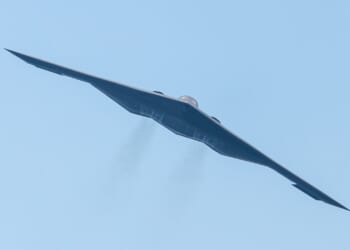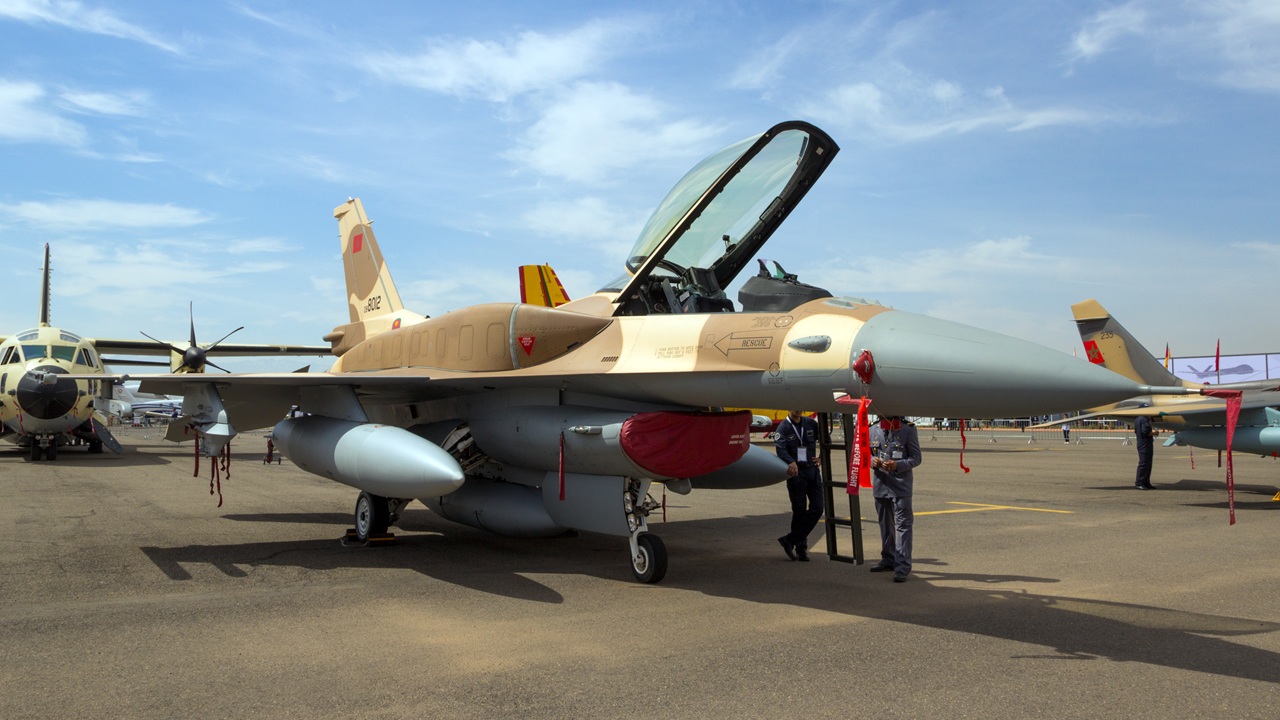
The rivalry between Morocco and Algeria extends to their air forces as well—with Morocco operating US equipment and Algeria maintaining a competing Russian-built fleet.
Algeria and Morocco maintain one of Africa’s most enduring rivalries—with the long-running dispute over the status of Western Sahara as its core political fault line. Both nations have invested heavily in air power as the primary instrument of deterrence towards each other.
However, the two nations have taken starkly different approaches to their airpower. Morocco operates a smaller, Western-integrated and networked force optimized for precision and interoperability. On the other hand, Algeria fields a heavier, Russian-oriented force optimized for high-intensity air warfare. And Algiers may now have another weapon in its arsenal—the Russian Su-57 “Felon” fifth-generation fighter jet, which was allegedly spotted near an Algerian airbase in the country’s northeast earlier in the month.
The West Africa Rivalry Is Centered on Western Sahara
The conflict in West Africa dates back to 1975, when—following Spain’s withdrawal from its colony along Africa’s western coast then known as Spanish Sahara—Morocco invaded and annexed the region. The invasion was diplomatically controversial, leading to Morocco’s expulsion from the African Union from 1984 until 2017. It also spawned a long-running insurgency by the Polisario Front, an Algerian-backed rebel group seeking Sahrawi independence.
Morocco and the Polisario Front signed a ceasefire in 1991, and Morocco and Algeria have avoided open war since then, but both have maintained military readiness. Air superiority would likely be decisive in any conventional clash. The two nations’ geography favors Morocco for shorter internal lines, but Algeria for depth and dispersal.
Understanding Moroccan and Algerian Air Doctrine
Algeria’s Air Force is historically aligned with Soviet and Russian doctrine, with an emphasis on heavy fighters, long-range strike, and layered air defenses. Key platforms include the Su-30MKA—which is used as a backbone, a multirole fighter with long range and heavy payload—variants of the MiG-29, and the Su-245 strike aircraft. Algeria also has modernized air defense networks including the S-300 and possibly S-400 SAM systems. In short, Algiers is capable of long endurance patrol, high payload air superiority, with strong BVR potential—all backed with an integrated ground-based SAM umbrella.
Algeria is also apparently the first export recipient of the Su-57 fifth-generation fighter, which was allegedly filmed in flight near the Oum El Bouaghi Air Base outside the city of Ain Beida. Moscow has been eager to export the Su-57, which has suffered production delays and still has unanswered performance questions; Algeria may have received discounts, and may have been willing to accept the developmental risks for the sake of preserving the relationship with Russia and signaling deterrence to Morocco.
If the Su-57 is ever delivered in operational numbers it becomes the first fifth-generation aircraft in Africa, enhancing Algeria’s stealth penetration and sensor fusion capability. But the production scale of the Su-57 remains limited, and the export configuration of the jet may differ from the Russian domestic version. Also, the sustainment and pilot training pipelines remain unknown. So there are a lot of barriers, and unanswered questions, before the Su-57 makes a meaningful impact on Algeria’s military capabilities.
In contrast to Algeria, Morocco’s air force is Western-aligned. The relationship between Morocco and the United States dates back centuries; the Sultan of Morocco was the first foreign leader to recognize American independence in 1777, and the country is traditionally regarded as the United States’ oldest ally in Africa. Accordingly, Morocco relies heavily on American aircraft, with a focus on precision strike, networked ops, and interoperability. The key platform for the Royal Moroccan Air Force is the F-16C/D, which has been upgraded to near F-16V standard with AESA radar and improved avionics. Morocco has also been outfitted with modern air-to-air missiles, like the AIM-120 AMRAAM, and precision-guided munitions capability. Overall, Morocco enjoys strong BVR capability, modern sensor fusion, NATO-aligned datalink integration, and high sortie generation potential.
Su-57 Felon vs. F-16 Fighting Falcon: A Head-to-Head Comparison
| Aircraft | F-16 Fighting Falcon (Morocco) | Su-57 Felon (Algeria) |
| Year Introduced | 1978 | 2020 (limited service) |
| Number Built | 4,600+ (all variants) | ~30–40 |
| Length | 14.5 m (47.7 ft) | 20.1 m (66 ft) |
| Wingspan | 9.45 m (31 ft) | 14.1 m (46.4 ft) |
| Weight (MTOW) | 16,875 kg (37,500 lbs) | ~35,000 kg (77,000 lb) |
| Engine(s) | One Pratt & Whitney F100-PW-220 afterburning turbofan (23,000 lbf) | Two Saturn AL-41F1 afterburning turbofan (~32,000 lbf) |
| Top Speed | 2,122 km/h (1,319 mph) / Mach 1.73 | 2,500 km/h (1,550 mph) / Mach 2.0 |
| Range | 2,020 km (1,260 mi) | 3,500 km (2,200 mi) |
| Service Ceiling | 15,240 m (50,000 ft) | ~19,800 m (65,000 ft) |
| Loadout | One General Electric M61A1 20mm six-barrel cannon; up to 15,200 lbs on nine hardpoints, including air-to-air missiles (AIM-9 Sidewinder on wingtip rails; alternatives include the MATRA Magic 2 or Rafael Python 3) | Internal bays for AAMs and strike weapons, external pylons available for non-stealth missions; can carry rockets, bombs, missiles |
| Aircrew | 1–2, depending on variant | 1 |
Which Air Force Would Win in a War?
In terms of air superiority, Algeria appears at first glance to have a slight edge, with around 600 aircraft in its arsenal, the second-largest air fleet on the African continent behind Egypt. Of these, roughly 140 are fighter jets. Morocco’s fleet is somewhat smaller; the Royal Moroccan Air Force operates around 260 aircraft, including roughly 120 fighter jets. Algeria also enjoys a qualitative edge, with the fifth-generation Su-57 theoretically able to outperform Morocco’s F-16s—at least on paper. On the other hand, Morocco is better integrated with Western avionics, with a mature missile ecosystem, and high training standards via US cooperation.
In BVR combat—likely the decisive domain in a hypothetical Algeria-Morocco air war—Morocco’s F-16s would probably face the Algerian Su-30, where missile quality and electronic factors may matter more than the platform itself. In WVR combat, both platforms are strong, the Su-30 is maneuverable, the F-16 is agile and combat-proven; training and pilot skill would likely prove the key variable.
In truth, the balance of the conflict would probably hinge on a range of unquantifiable factors: training, electronic warfare, sustainment, missile stockpiles, and so on. But it is clear that the conflict between Morocco and Algeria reflects the broader global arms alignment pitting Russia against the West, playing out on a regional scale.
About the Author: Harrison Kass
Harrison Kass is a senior defense and national security writer at The National Interest. Kass is an attorney and former political candidate who joined the US Air Force as a pilot trainee before being medically discharged. He focuses on military strategy, aerospace, and global security affairs. He holds a JD from the University of Oregon and a master’s in Global Journalism and International Relations from NYU.