Russia’s naval shortcomings relative to the United States and NATO have led it to invest heavily in asymmetric platforms.
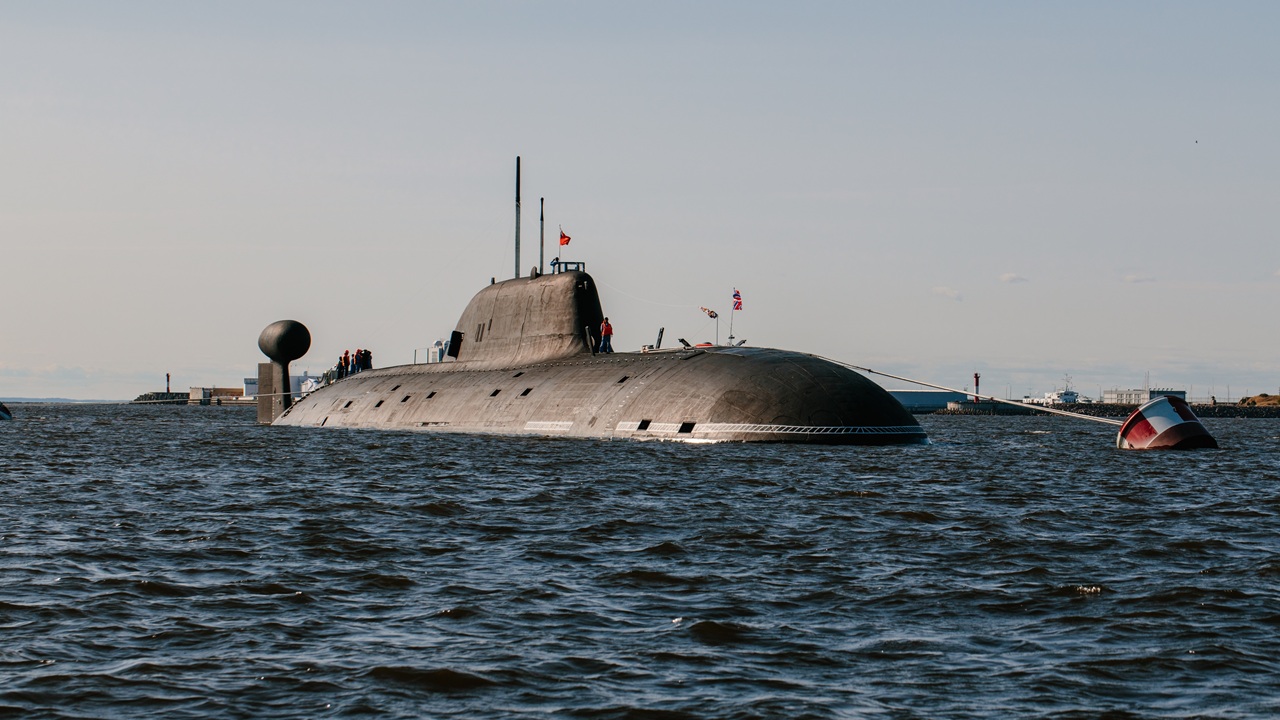
As the war in Ukraine enters its fifth year, the Russian Navy remains in a sorry state. The Kremlin appears to have finally accepted that its decrepit Admiral Kuznetsov aircraft carrier will never return to service. Its once-fearsome submarine fleet has also declined in relevance, with a handful of modern subs leading a greater number of aging Cold War-era vessels. The undersea fleet faces high maintenance backlogs, and industrial capacity limits how quickly older submarines can be replaced.
The Kremlin has faced similar issues with its main battle tanks and combat aircraft. The cost of these platforms is more than Moscow can bear, even as it will still receive some relief as its oil sanctions are being “temporarily” lifted.
As a result, Russia has taken the course of other states with financial constraints—namely pursuing asymmetric warfare through unmanned systems. Moscow has used Iranian-made “Shahed” drones to great effect against Ukrainian infrastructure throughout the four-year war. The Russian Navy has also expressed its intent to adopt new autonomous and remotely operated uncrewed surface vehicles (USVs) and uncrewed underwater vehicles (UUVs).
“Moscow now fields a growing mix of surface and deep-sea platforms designed for reconnaissance, seabed work, and military operations. While these platforms can be used worldwide, their primary operating environments remain the Arctic, the North Atlantic, and the Baltic Sea,” warned a new report by the Center for Maritime Strategy published on Wednesday. “Russia’s sea robotics span core missions such as underwater positioning, security operations, search and exploration, detection and tracking of underwater objects, operational hydrography, and communication.”
Russia Might Have a Head Start on Naval Drone Development
Russia isn’t alone in developing USVs and UUVs, but this week, Presidential Aide and Maritime Board Chairman Nikolay Patrushev touted Russia’s capabilities.
In an interview with Kommersant, excerpts of which were posted on the Russian state news agency TASS, Patrushev stated that Russia’s scientific institutes and design bureaus have already developed a “new generation” of UUVs for underwater exploration and added that the military is also embracing the technology. Patrushev claimed Russia’s efforts may be outpacing those of the West.
“In this area, our military science is not lagging; in many respects, it is ahead of foreign developments. An analysis of the domestic market is underway to identify the most promising solutions for creating sea drones,” Patrushev said. “Attention is also being paid to small private companies, a number of which have independently created prototypes that are on par with foreign counterparts.”
Russia Wants Its Drones to Rule the Sea
Among the most ominous undersea platforms now under development is Russia’s “Poseidon” nuclear drone. The Status-6 Oceanic Multipurpose System (NATO reporting name “Kanyon”), colloquially known as the “Poseidon,” is a nuclear-powered underwater nuclear-capable torpedo developed to operate at depths up to 1,000 meters, or 3,300 feet. It can travel at speeds exceeding 100 knots, making it challenging to detect and even more difficult to intercept.
With a potential yield of up to 100 megatons, the Poseidon—named for the Greek god of the sea, earthquakes, and horses—could be employed against coastal targets, naval bases, and even aircraft carrier strike groups.
As Brandon Weichert wrote for The National Interest in October 2025, “Even if Poseidon’s capabilities are overstated by the Russians, this system represents an entirely new form of strategic weapon in that it is both nuclear-powered and a drone. Therefore, Poseidon purposely complicates naval defenses and arms control agreements.”
Of course, the odds that Russia would actually use the Poseidon for nuclear purposes are extremely slim, as doing so would likely mark the start of World War III. Nevertheless, the torpedo’s existence is a contingency that American and NATO defense planners must reckon with—and highlights Russia’s advances in the maritime domain, despite comparatively limited resources.
Russian Drones Can Pursue Asymmetric Warfare at Sea
Beyond the Poseidon, Moscow has been developing and producing a fleet of UUVs that could be employed in reconnaissance, seabed mapping, infrastructure protection, and sabotage. In the latter role, that could include disrupting undersea cables and pipelines in the Baltic Sea and North Sea. Russia may not be able to gain control of the seas, but it can disrupt the infrastructure under the waves.
Even if Russia can’t complete the refit of its aircraft carrier and its submarines have had to limp home after a deployment (as was the case last fall), Russia can focus on unmanned systems, to the detriment of the West.
About the Author: Peter Suciu
Peter Suciu has contributed to dozens of newspapers, magazines and websites over a 30-year career in journalism. He regularly writes about military hardware, firearms history, cybersecurity, politics, and international affairs. Peter is also a contributing writer for Forbes and Clearance Jobs. He is based in Michigan. You can follow him on Twitter: @PeterSuciu. You can email the author: [email protected].