
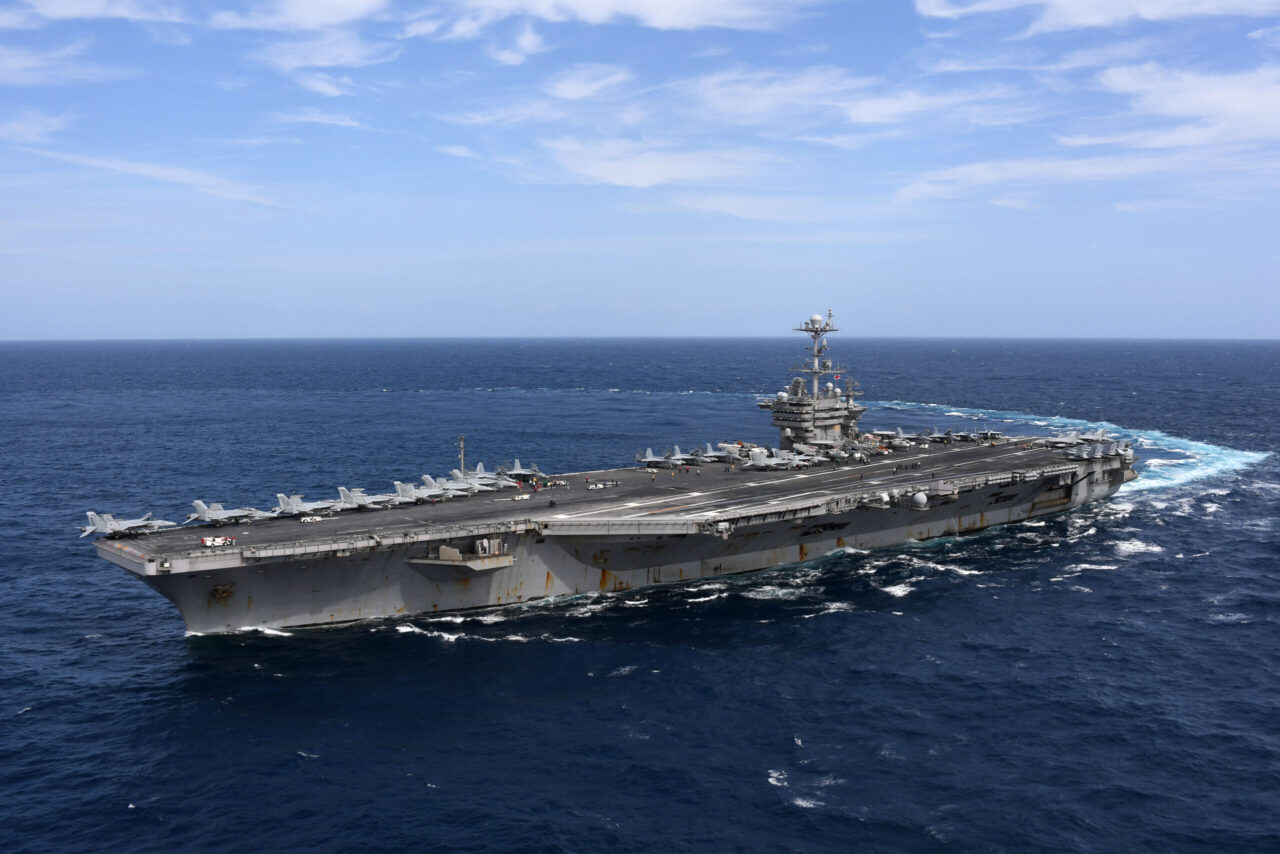
From October 2023 to October 2025, the US Navy rotated multiple carrier strike groups to the Red Sea, the Gulf of Aden, and the Persian Gulf, with dire implications for their crews.
For just over two years, the United States rotated multiple warships to the Middle East to deter escalation and to directly confront aggression from the Iranian-backed Houthis in Yemen. The militant group, which had initially targeted commercial shipping, in turn engaged the US Navy’s warships directly, resulting in some of the most intense combat the sea service had experienced since World War II.
That took a serious toll on the sailors, leading to a series of costly mistakes; it even cost the lives of two US Navy SEALS. Navy Special Warfare Operator 1st Class Christopher J. Chambers and Navy Special Warfare Operator 2nd Class Nathan Gage Ingram were declared dead after going missing during a nighttime boarding operation of an unflagged vessel off the coast of Somalia in the Arabian Sea on January 11, 2024. One of the men was swept overboard in rough seas, and the second jumped into the waters to save him. Both men drowned.
Super Hornet Lost in Friendly Fire Incident
From October 2023 to October 2025, the US Navy rotated multiple carrier strike groups (CSGs) to the Red Sea, the Gulf of Aden, and the Persian Gulf. None of the deployments could have been described as a pleasure cruise, but the eight-month mission of USS Harry S. Truman (CVN-75) was noted for being the most problem-plagued.
The eighth nuclear-powered Nimitz-class aircraft carrier of the United States Navy returned to her homeport of Norfolk, Virginia, last summer with three fewer aircraft and even a different commanding officer.
The problems began a year ago, on December 22, 2024, when the Ticonderoga-class guided missile cruiser USS Gettysburg (CG-64) mistook two F/A-18 Super Hornet fighters for incoming missiles and fired Standard Missile 2 (SM-2s) interceptors in response. One of the Super Hornets, assigned to Strike Fighter Squadron 11 (VFA-11), had just completed “a refueling mission,” and was shot down while attempting to land on the flattop.
Although the pilot and weapons systems officer (WSO) were able to eject and survive, the fighter was destroyed in the friendly fire incident. The second SM-2 barely missed the other F/A-18.
A subsequent investigation determined that there was a “lack of integrated training opportunities between USS Gettysburg and the Carrier Strike Group, lack of forceful backup on the cruiser, and lack of cohesion across the Carrier Strike Group contributed to the misidentification, and subsequent engagement, of the friendly aircraft and near miss of another.”
The Harry S. Truman Carrier Collides with a Merchant Ship
The supercarrier suffered another mishap just two months later. On February 12, 2025, CVN-75, the USS Harry S. Truman, collided with the Besiktas-M, a 53,000-ton Panamanian-flagged cargo ship, while operating in the Mediterranean Sea near Port Said, Egypt. USS Harry S. Truman had recently concluded a port call at US Naval Support Activity Souda Bay, Greece, joined by the Arleigh Burke-class guided-missile destroyer USS Jason Dunham (DDG-109), and was returning to the Red Sea.
The carrier was forced to return to Souda Bay for emergency repairs. However, a damaged bulkhead won’t be replaced until the ship undergoes its upcoming Refueling Complex Overhaul next year, a significant mid-life maintenance period.
Following the incident, Captain David Snowden was relieved of command, while Captain Chris Hill was named interim commander. Hill was well aware of the situation in the region, having previously commanded the Nimitz-class carrier USS Dwight D. Eisenhower (CVN-69), which had also spent much of her nearly nine-month deployment protecting commercial shipping from the Iran-backed Houthis in Yemen.
Two More Super Hornets Lost
In a span of less than three weeks last spring, CVN-75 also lost two other Super Hornet fighters. One, a single-seat F/A-18E, slid from the carrier’s hangar bay while the flattop turned to evade an incoming missile. The aircraft, assigned to Strike Fighter Squadron 136 (VFA-136), was being towed when the move crew lost control. Both the aircraft and the tow tractor were lost.
That was followed by a two-seat F/A-18F from VFA-11 “Red Rippers” going over the edge of the carrier during a failed landing. The pilot and WSO were able to eject safely and were rescued after their jet crashed into the Red Sea.
“In each case, the investigating officers independently concluded that each mishap was preventable,” USNI News reported. “Service officials emphasized the high operational tempo in the Red Sea, where sailors repeatedly came under drone and missile fire from the Yemen-based Houthis. Despite the incidents, the officials praised the overall performance of the strike group throughout its nine-month deployment.”
Investigations determined that the primary cause of the April 28, 2025, incident was a failure of the aircraft’s brake system, which was compounded by insufficient communication between the bridge, the flight deck control teams, and the sailors in the hangar bay control station. The US Navy stated that the crew’s quick thinking prevented further damage to the ship and any serious injury to personnel.
The other mishap on May 6, 2025, was caused by malfunctioning equipment, notably the arrestor wire and the number-four starboard sheave damper. Other factors included inadequate maintenance, low manning levels, and insufficient training. The Navy also acknowledged that the high operational tempo and combat operations against the Houthis contributed to a strained environment.
Each Super Hornet had a price tag of around $60 million, and the Navy estimated the cost of repairs to the arresting cable and engine from the May 6 incident at around $207,000. The repair costs from the February 2025 collision have yet to be fully determined.
The Stresses of War Impact Humans and Machines Alike
The 2024-2025 deployment of USS Harry S. Truman was extended from a planned six months to more than eight months, lasting 251 days. Despite the mishaps, the warship was up to the task, but the Navy acknowledged it needs to do better.
“These investigations reinforce the need to continue investing in our people to ensure we deliver battle-ready forces to operational commanders,” said Admiral Jim Kilby, vice chief of Naval Operations. “Despite the challenges, the sailors of the Harry S. Truman Strike Group demonstrated adaptability, professionalism, and complete commitment to the mission throughout the deployment.”
Lengthy deployments have become the norm for CVN-75, which saw its 2020 mission extended to nearly nine months to protect the crew from COVID-19 during the global pandemic, even as the official mission ended. It was followed by a nine-month-long deployment in 2022-2023 following Russia’s unprovoked invasion of Ukraine, the longest of a US carrier operation in the United States European Command area of responsibility in decades.
However, the combat operations in the Middle East are still the most intense the US Navy has faced in generations.
“The navy’s sustained combat operations in the US Central Command area of operations for the past two years demonstrated our battle effectiveness and ability to maintain freedom of navigation,” said Kilby. “As we reflect on these incidents and ongoing improvement efforts, the Navy remains laser-focused on producing battle-ready sailors and forces to ensure the Navy provides our nation with the most lethal, combat-credible, and ready force possible.”
About the Author: Peter Suciu
Peter Suciu has contributed over 3,200 published pieces to more than four dozen magazines and websites over a 30-year career in journalism. He regularly writes about military hardware, firearms history, cybersecurity, politics, and international affairs. Peter is also a contributing writer for Forbes and Clearance Jobs. He is based in Michigan. You can follow him on Twitter: @PeterSuciu. You can email the author: [email protected].
Image: Wikimedia Commons.












_underway_in_the_Atlantic_Ocean_on_11_September_2018_(180911-N-EA818-2106).JPG)