When I was confirmed in the Church during graduate school, I would not have said, as many other converts do, that my conversion was initiated by the beauty of Catholic art and music. To be sure, I became aware of the rich tradition of Catholic aesthetics in the process of my conversion, but it was not a central cause. Having said that, however, my Catholic faith has subsequently been sustained and enriched not merely by “Catholic” art, but by a greater appreciation of beauty more generally. Over these 30-odd years, I have come to understand that truth, goodness, and beauty are three different expressions of participation in the eternal mind of God.
And I have come to appreciate that beauty is beauty, whether its expression in art is explicitly “Christian” or otherwise. Glimpses of the truth of God’s love and grace can be found in unlikely songs, films, television shows, and other media. For example, I have written about theological truth in such sources as the TV series Breaking Bad and Ted Lasso, films such as The Godfather and Crazy Heart, and music by Jelly Roll, Tom Waits, and (of course) Bob Dylan.
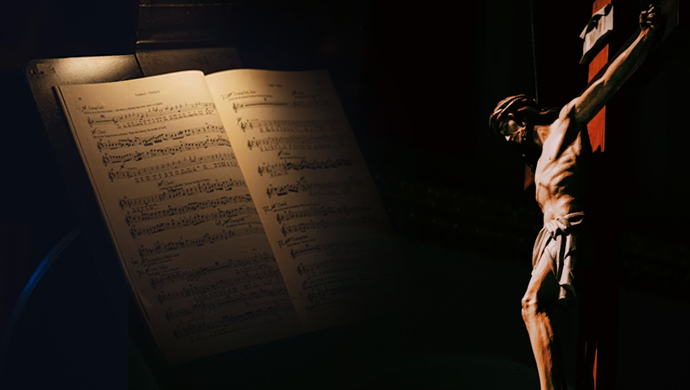
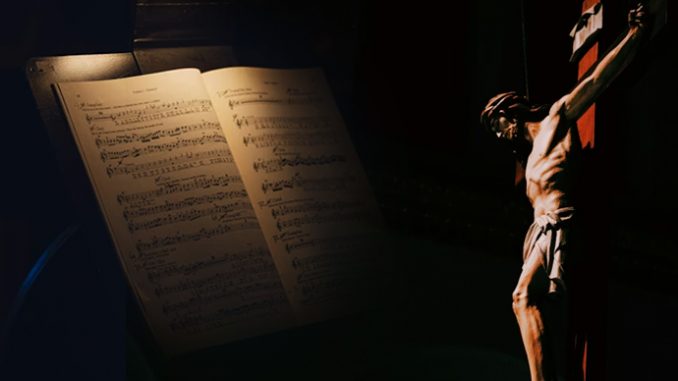
Nonetheless, there are seasons of the liturgical year in which expressly devotional music and verse come to the fore both as aids in deepening our theological understanding and enriching our moral and spiritual lives. Passiontide—these two weeks between the fifth Sunday of Lent and up to and including Easter Sunday—are just such a time. Thus, I suggest some perhaps lesser-known Passiontide music that has enriched and enhanced my own appreciation of the events of Holy Week and the Easter Triduum.
Of course, the more familiar compositions are important. Handel’s Messiah, Bach’s St. John Passion and St. Matthew Passion, and Mozart’s Mass in C Minor are set pieces in Passiontide listening. But we can dig a little deeper into the catalogue for lesser-known, but just as enriching, verse and music for this season of suffering, death, and Resurrection.
Quomodo sedet sola civitas
Tenebrae might be considered the poor cousin of Holy Week. While we are all familiar with the liturgies of the Easter Triduum—from Maundy Thursday, through Passion Friday, to Easter Sunday—Tenebrae is celebrated on the Wednesday of Holy Week. It is a signal that things are about to turn very bleak indeed.
The central theme of Tenebrae is desolation, emptiness, and abandonment, exemplified by a signature passage from the Book of Lamentations about the destruction of Jerusalem around 586 B.C., “Quomodo sedet sola civitas plena populo”—”How lonely sits the city that was once full of people.” In the Christian tradition, this has been used to illustrate the desolation and despondency of a world without a savior, as we anticipate the Triduum.
These despairing lamentations, attributed to the prophet Jeremiah, are hauntingly presented in Thomas Tallis’s a cappella settings, Lamentations of Jeremiah, composed in 1565 for male voices in five-party polyphony. While the setting is not written for instruments, the close, complex harmonies of Tallis’s Lamentations sound as though they are accompanied by an instrumental bass line in a minor key.
Their mournful, emotionally-laden tone makes the Lamentations a perfect prequel to the Easter Triduum liturgies. And what better way to listen than a recording by The Tallis Scholars, directed by Peter Phillips.
Stabat mater dolorósa
The Stabat Mater is a 13th-century hymn to the Blessed Virgin Mary as she stands at the foot of the cross of Jesus. Its origin is disputed by musical historians, but regardless, it has been set to music by scores of composers throughout history. Three compositions from three musical eras are equally compelling: a Renaissance setting by Giovanni Palestrina (ca. 1590), a Baroque composition by Giovanni Pergolesi (1736), and the classical arrangement by Luigi Boccherini (1781). While composed in distinctly different styles, all of these sample settings portray the profound grief and sadness of Our Lady as she stood at the foot of the Cross.
While St. Mary was preserved from original sin, she was not all-knowing and, thus, was likely deeply confused and perplexed by the fate of Jesus as he was condemned and executed. We cannot comprehend the depth of her sorrow and anguish. But the poem, and all three settings above, draw us into her misery as she watched the agony of Christ on the cross. “At the Cross her station keeping/Stood the mournful mother weeping/Close to Jesus to the last,” begins the poem in the standard English translation by 19th-century Oratorian priest Edward Caswall.
And it continues in part, “Christ above in torment hangs/She beneath beholds the pangs/Of her dying glorious son.” The poem calls us to join the suffering of Our Lady, drinking deeply from the cup of sorrow to which she was destined: “Let me share with thee His pain/Who for all sins was slain/Who for me in torments died.”
The three suggested settings above vary widely in their approach to the poem. But all preserve the sense of hopelessness, sorrow, shame, and despondency that the Blessed Virgin must have felt as she watched her Son suffer and die. And they all draw us into the poem spanning the centuries from Golgotha to our own reflection on the agony of the Cross.
“Out of the depths, I cry to you, Lord.”
Estonian Arvo Pärt is among the greatest composers of the 20th and 21st centuries, writing in the classical tradition. In addition, he is a devout Orthodox Christian, having written dozens of liturgical and devotional pieces over her seven-decade career. His short but profound setting for Psalm 130, De Profundis, is both a signature Pärt piece and another appropriate musical accompaniment to Passiontide.
Psalm 130 begins as a lamentation of profound anguish and abandonment, anticipating all the depth of despair that accompanies the Passion of Christ. “From the depths [De profundis] I call to you, Lord;/Lord, hear my cry!/May your ears be attentive to my cry for mercy,” the Psalm begins. “If you, Lord, keep account of my sins, Lord, who can stand?” (It is no wonder that Oscar Wilde’s profound and stirring epistolary prison memoir, De Profundis, takes its title from this psalm of distress.)
Yet, the Psalm does not abandon its reader to hopelessness, recognizing that God’s mercy can raise us out of the depths of despondency to the hope of redemption. “But with you is forgiveness/and so you are revered,” says the psalmist. Therefore, “Let Israel hope in the Lord/For with the Lord is mercy/With His is plenteous redemption.” From the depths of anguish, we ascend to the hope of celestial joy.
Arvo Pärt’s setting for Psalm 130 captures both these aspects of the psalm in his one-movement composition. Set for a male choir in four parts, organ, and percussion, the recording will shake your soul and rattle your windows, as it begins with a very low drum beat that might accompany a funeral procession. But as the psalm itself ascends from desolation to hope, so too do the four voices break through the claustrophobic early stanzas into the liberation of ultimate deliverance from despair at the conclusion of the composition. The music becomes lighter, more melodic, and uplifting as it progresses through the text of the psalm, perfectly capturing the psychological, moral, and spiritual complexity of Passiontide, Holy Week, and Easter.
Truth, beauty, and goodness—the three transcendentals—are tightly joined and concentrated in these most holy weeks of the Christian calendar. And all three are captured in these wonderful pieces of music, taking us through the depths of despair to the heights of redemption. May you have a rich and blessed Easter season!
If you value the news and views Catholic World Report provides, please consider donating to support our efforts. Your contribution will help us continue to make CWR available to all readers worldwide for free, without a subscription. Thank you for your generosity!
Click here for more information on donating to CWR. Click here to sign up for our newsletter.