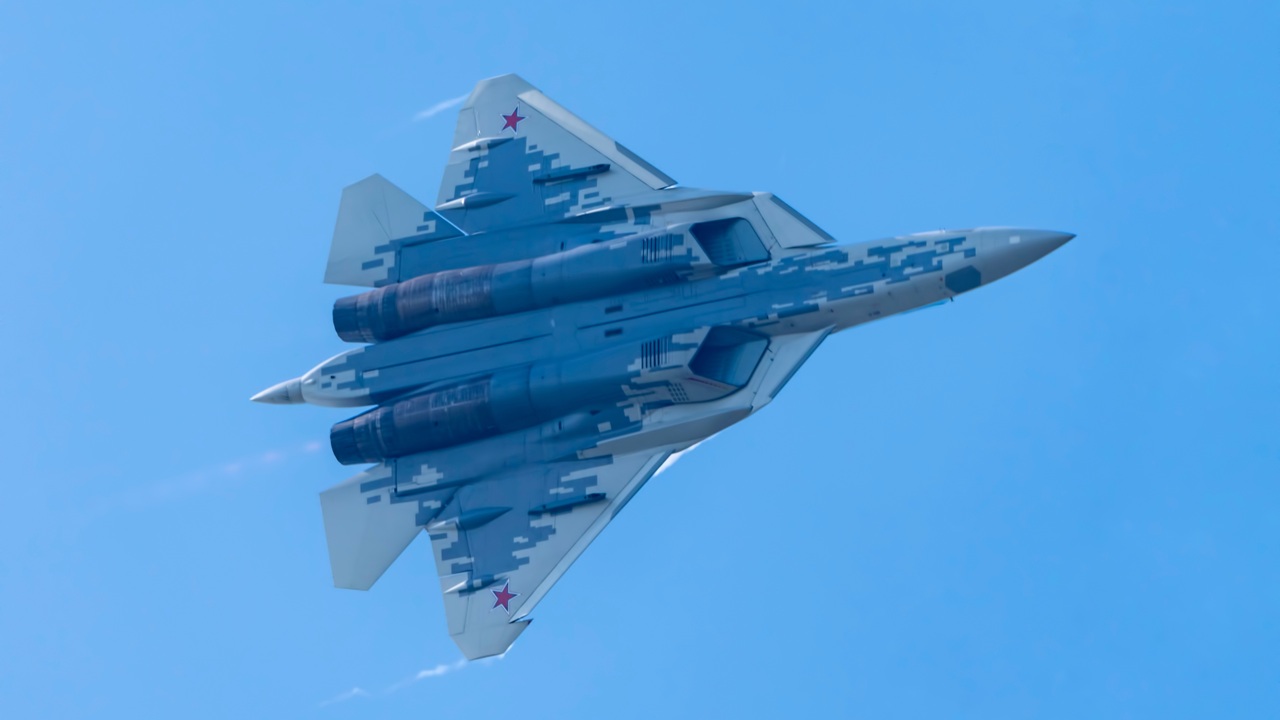
Russia has always placed a doctrinal emphasis on extreme maneuverability, usually at the expense of certain stealth features.
The Su-57 Felon is Russia’s first fifth-generation fighter. But unlike Western counterparts, the Su-57 places an extreme emphasis on maneuverability. While stealth and sensors matter, the Su-57’s most visible calling card is its ability to maneuver at extreme angles of attack—a skillset often demonstrated to great astonishment at international airshows. The focus on maneuverability reflects a distinctive Russian design philosophy: control and lethality in-flight.
The Su-57 Felon’s Specifications
- Year Introduced: 2020 (limited operational service)
- Number Built: ~30–40 (est., including test aircraft; production ongoing)
- Length: 66 ft 0 in (20.1 m)
- Wingspan: 46 ft 5 in (14.1 m)
- Weight (MTOW): ~77,000 lb (35,000 kg)
- Engines: Two Saturn AL-41F1 turbofans (≈32,000 lbf / 142 kN each with afterburner); future Izdeliye 30 planned
- Top Speed: ~1,550 mph (2,500 km/h) ≈ Mach 2.0
- Range: ~2,200 mi (3,500 km) ferry; ~900 mi (1,500 km) combat radius (est.)
- Service Ceiling: ~65,000 ft (19,800 m)
- Loadout: Internal bays for AAMs and strike weapons; external pylons available for non-stealth missions
- Aircrew: 1
Russia’s Air Force Has Always Prioritized Maneuverability
Soviet and Russian air combat doctrine has historically emphasized visual-range combat and pilot skill and kinematic dominance. The doctrine stemmed from Cold War experiences, flying against NATO fighters; Soviet designers assumed that missiles were fallible and that ECM would degrade sensors—and that as a result, engagements would deteriorate into close-in dogfights. This belief led to a lineage of highly maneuverable aircraft, i.e., Su-27, Su-30, Su-35, Su-57.
The Su-57 in particular is a feat of maneuverability. The multirole stealth fighter was intended to replace legacy Flanker variants, but has been produced in such limited numbers as to make the new platform operationally negligible. Nevertheless, the Su-57 was designed for air superiority, strike, and interception—and was not optimized purely for low observability operations like the F-22 but instead designed with a stronger emphasis on agility.
The Felon’s two Saturn AL-41F1 engines give it a high thrust-to-weight ratio, even at combat loads, and a full digital fly-by-wire system complete with thrust vectoring integration. The 3D thrust vectoring nozzles are a major factor in the Su-57’s maneuvering, allowing for pitch, yaw, and roll control independent of airflow. This facilitates post-stall maneuvering, rapid nose-pointing at low speed, and airshow dramatics like the “Pugachev’s Cobra.”
The aerodynamic design was also built for agility. Large blended lifting surfaces, leading-edge extensions and a wide fuselage—all generate lift at high angles of attack, giving the aircraft controlled instability. And the flight control software is calibrated to allow the pilot to push the aircraft beyond traditional limits.
Does the Su-57 Stand a Chance in Beyond-Visual-Range Combat?
In theory, were the Su-57 ever to be produced at the scale sufficient to support combat operations, the maneuverability would be an asset, allowing rapid nose alignment for high off-foresight missile shots and last-second defensive maneuvers. In defensive situations, the aircraft’s maneuverability allows for post-stall positioning that can help defeat incoming missiles by forcing overshoots—especially when combined with flares, jamming, and IR countermeasures. The Su-57 is also at an advantage in low-energy states, which should, in theory, allow for dominance in within-visual-range engagements.
Doctrinally, the Su-57 shows that Russia is less convinced than the US that air combat will be decided beyond-visual-range. The Su-57 design offers insurance for situations where stealth or sensors are degraded, where pilots must rely on the stick and rudder to succeed. But this design emphasis comes with trade-offs, like an increased radar cross-section and higher infrared signature—all while Western fighters are prioritizing stealth and sensor fusion and a first-shot doctrine. If the Su-57 is engaged early, the way Western fighters are designed to engage, then the Su-57’s agility is irrelevant.
About the Author: Harrison Kass
Harrison Kass is a senior defense and national security writer at The National Interest. Kass is an attorney and former political candidate who joined the US Air Force as a pilot trainee before being medically discharged. He focuses on military strategy, aerospace, and global security affairs. He holds a JD from the University of Oregon and a master’s in Global Journalism and International Relations from NYU.
Image: Shutterstock / aarrows.