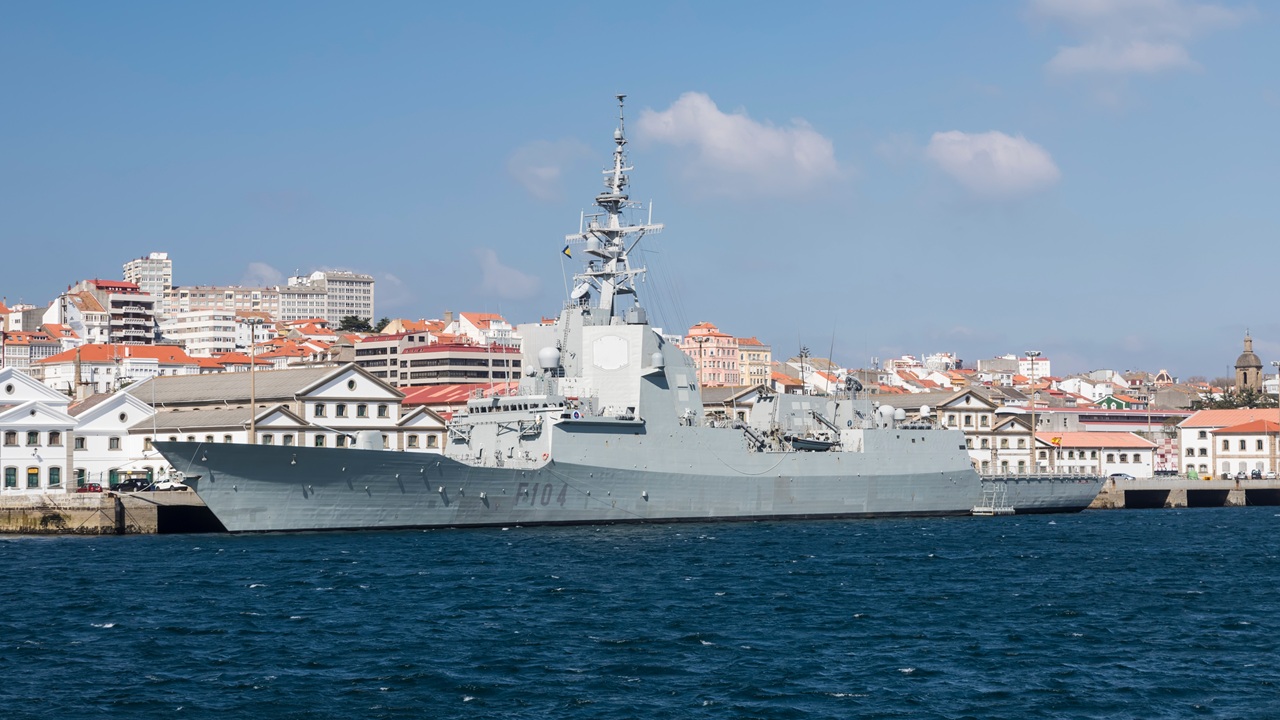
By all accounts, Spain’s attempt to modernize its F100 frigate for the decades ahead is a good use of its limited defense budget.
Spanish shipbuilder Navantia is working alongside the Spanish military to extend the service life of their F100 frigates until at least the year 2045. Navantia will be adding a bevy of new features on these frigates, including enhanced armaments to include anti-ship missiles and an advanced electronic warfare (EW) suite. The plan is part of the Industrial and Technological Plan for Security and Defense.
This comes after Madrid’s representatives earlier this year defied the calls of their NATO partners to increase Spain’s national defense spending and chose to maintain them at their current levels.
Rather than give into the hysteria over a resurgent Russia, Madrid prefers to keep things on a more even keel. It is opting to refurbish their existing finite assets rather than invest money they don’t really have in expanding their military.
The F-100 Frigate’s Specifications
- Year Introduced: 2002
- Number Built: 5 (6 planned, 1 canceled)
- Length: 146.7 m (481 ft)
- Beam: 18.6 m (61 ft)
- Displacement: 5,900 to 6,594 tons (full load)
- Engine(s): Combined Diesel or Gas (CODGO) propulsion, including two GE LM2500 gas turbines and two Caterpillar 3600 engines
- Top Speed: 28.5 knots (32.8 mph, 52.8 km/h)
- Range: 4,500 nautical miles (5,178 mi, 8,334 km) at 18 knots
- Armaments: Vertical Launch System (VLS); surface-to-air missiles (RIM-162 ESSM, SM-2MR Block IIIA); eight Boeing Harpoon anti-ship missiles (to be replaced by Naval Strike Missile); Mk 32 triple torpedo launchers with Mark 46 torpedoes; one Mk 45 mod two gun naval gun; Meroka 2B Close-In Weapons System (CIWS); one Sikorsky SH-60B helicopter
- Crew: 201 (officers and enlisted personnel)
The F100 Frigate Has Served Spain Well for Years
The F100 frigates are a storied system in Europe. Delivered between 2002 and 2012, the five frigates are in the middle of their service lives. According to Baird Maritime, an online industry publication, “The F100 program was the first European shipbuilding project to integrate the AEGIS combat system”—helping to ensuring that Spain’s Navantia remained a world-class leader in the global arms export market.
Currently, the F100 frigates come equipped with Harpoon missiles. Now, the Spanish are replacing those older systems with Kongsberg Naval Strike Missiles (NSM). They are upgrading to the ESSM Block II for better air defense. Navantia is also integrating tools to better stop cyberattacks and similar unconventional threats to their warships.
Meanwhile, the Spanish are installing anti-drone systems to better detect and counter the growing threat of unmanned aerial vehicles (UAVs). The program is slated to cost around $3.7 billion and will be conducted mostly at the Ferrol shipyard.
Spain’s F100 are the premier surface combatant for the Spanish Navy. They combine advanced air, anti-submarine, and ant-surface warfare capabilities that will be essential for any NATO force operating at sea. What’s more, these warships can provide comprehensive fleet protection and would permit the Spanish to project power reliably over long distances
These frigates were among the first modern vessels of the Spanish Navy. Spain will not so easily part with these warships.
About the Author: Brandon J. Weichert
Brandon J. Weichert is a senior national security editor at The National Interest. Recently, Weichert became the host of The National Security Hour on America Outloud News and iHeartRadio, where he discusses national security policy every Wednesday at 8pm Eastern. Weichert hosts a companion book talk series on Rumble entitled “National Security Talk.” He is also a contributor at Popular Mechanics and has consulted regularly with various government institutions and private organizations on geopolitical issues. Weichert’s writings have appeared in multiple publications, including The Washington Times, National Review, The American Spectator, MSN, and the Asia Times. His books include Winning Space: How America Remains a Superpower, Biohacked: China’s Race to Control Life, and The Shadow War: Iran’s Quest for Supremacy. His newest book, A Disaster of Our Own Making: How the West Lost Ukraine is available for purchase wherever books are sold. He can be followed via Twitter @WeTheBrandon.
Image: Shutterstock / Guillermo Pis Gonzalez.