An actual ground invasion of Venezuela is still unlikely—but the United States could launch a military campaign from the air, as it did in Libya in 2011.
The Trump administration has deployed 11 warships and roughly 15,000 naval personnel to the Caribbean as tensions escalate with Nicolás Maduro’s regime in Venezuela. The buildup, paired with the controversial and arguably extrajudicial killings of alleged drug smugglers, has raised legitimate questions about the prospect of American military intervention.
While avoiding foreign entanglements was one of President Donald Trump’s core campaign themes, the current force posture in the Caribbean—most notably the presence of the USS Gerald R. Ford supercarrier—suggests preparations for potential action. If that action were to occur, and US troops were sent into Venezuela against the wishes of the government in Caracas, what might US military operations actually look like?
There Might Be War—but a Ground Invasion of Venezuela Is Unlikely
Any intervention would center on coercing or potentially removing Maduro from power. Trump has publicly issued an ultimatum to Maduro, which the Venezuelan leader has rejected.
The United States has a long history of toppling unfriendly governments, especially in Latin America, so a removal campaign would have historical precedent. But removing a regime almost always requires occupation—and after the costly, protracted occupations of Iraq and Afghanistan, the American public has little appetite for another open-ended commitment. The naval forces massed in the Caribbean are also not optimized for large-scale ground operations, and too few in number to credibly occupy Venezuela if the government were overthrown.
For both political and practical reasons, a limited intervention is a much more likely scenario. If this were to play out, it would more closely resemble Libya in 2011 than Iraq in 2003: a sustained air campaign aimed at coercing or degrading the regime, without an accompanying ground occupation.
How Would the US Air Campaign Work?
A limited intervention would begin with efforts to neutralize Venezuela’s ability to contest US operations in the air or at sea. Cyber and electronic warfare attacks would target Venezuelan communications, early-warning radars, and integrated air-defense networks. Standoff cruise missiles—Tomahawks from destroyers and submarines, along with JASSM-class weapons launched by US bombers or carrier-based aircraft—would strike long-range SAM sites, radars, major air bases, hardened aircraft shelters, and key command-and-control nodes. Venezuela fields several Russian-made SAM systems, including S-300VM batteries, but these would be early priority targets and unlikely to survive sustained U.S. suppression. The goal would be to blind and stun the Venezuelan military, allowing US aircraft operating from the Gerald R. Ford—functionally a mobile airbase—to maneuver with significantly lower risk.
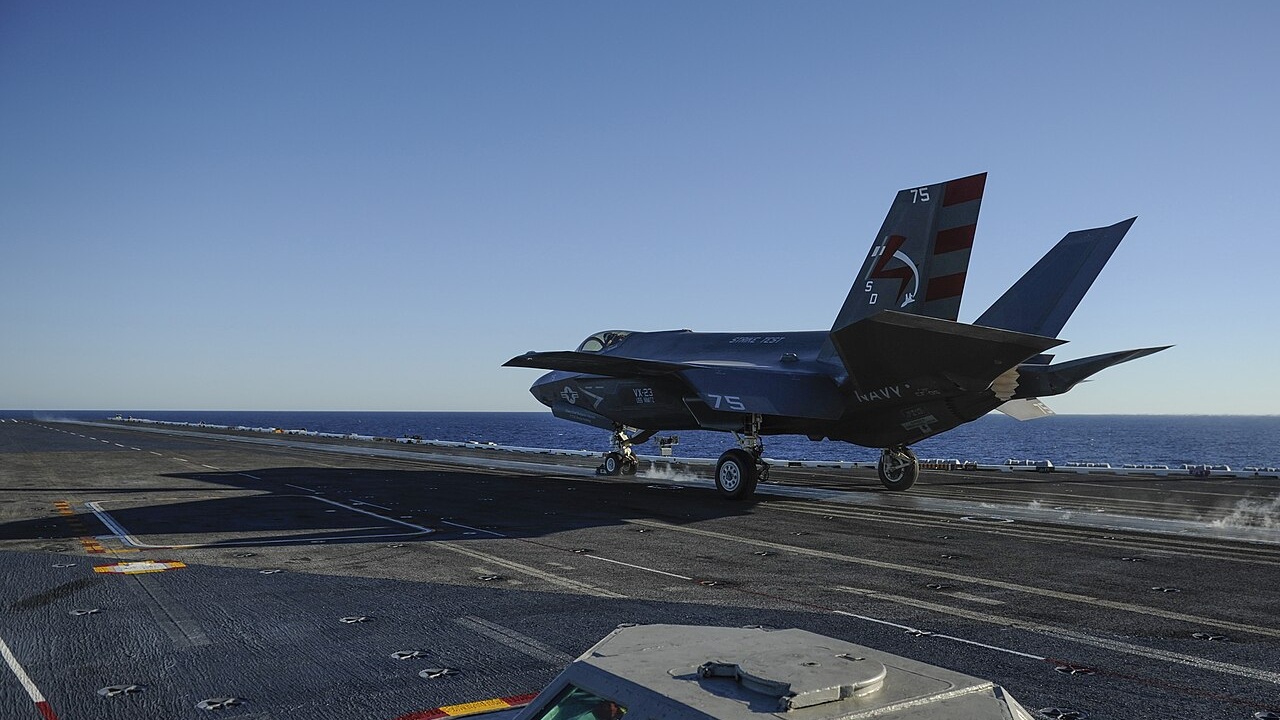
Carrier-based F/A-18E/F Super Hornets and potentially F-35Cs would then enforce air superiority and intercept any Venezuelan fighters attempting to take off. They would also escort strike packages and employ precision-guided munitions against air-defense nodes, logistical hubs, ammunition depots, and regime security units. Enablement aircraft such as the E-2D Hawkeye and EA-18G Growler would provide airborne early warning, battle management, electronic attack, and suppression of enemy air defenses.
Additional US airpower could be launched from the continental United States. Strategic bombers—B-1Bs, B-2s, and B-52s—could deliver standoff cruise missiles and precision weapons against high-value fixed targets. The overall pattern would mirror previous US campaigns: a concentrated, multi-day air operation designed to degrade the adversary’s military infrastructure and compel regime compliance.
Simultaneously, the US Navy would likely impose maritime interdiction or a blockade around key Venezuelan ports. Special operations forces might conduct limited missions on the ground to designate targets, facilitate local intelligence, or secure critical nodes. But, as noted earlier, a large-scale ground invasion remains politically and logistically implausible.
The Political Implications of America Attacking Venezuela
From a purely military perspective, Venezuela lacks the capacity to withstand a US attack; the United States would degrade most meaningful Venezuelan military infrastructure within days. But the political costs would be substantial. A strike could prove deeply controversial domestically—and would likely provoke sharp condemnation across Latin America, a region highly sensitive to US intervention.
As the war in Iraq showed, there are profound long-term risks to the United States from a botched military intervention. Any action that inadvertently creates a power vacuum, requires sustained US presence, or leads to chronic instability in Venezuela could entangle Washington in yet another unpredictable, open-ended crisis.
About the Author: Harrison Kass
Harrison Kass is a senior defense and national security writer at The National Interest. Kass is an attorney and former political candidate who joined the US Air Force as a pilot trainee before being medically discharged. He focuses on military strategy, aerospace, and global security affairs. He holds a JD from the University of Oregon and a master’s in Global Journalism and International Relations from NYU.
Image: Wikimedia Commons.