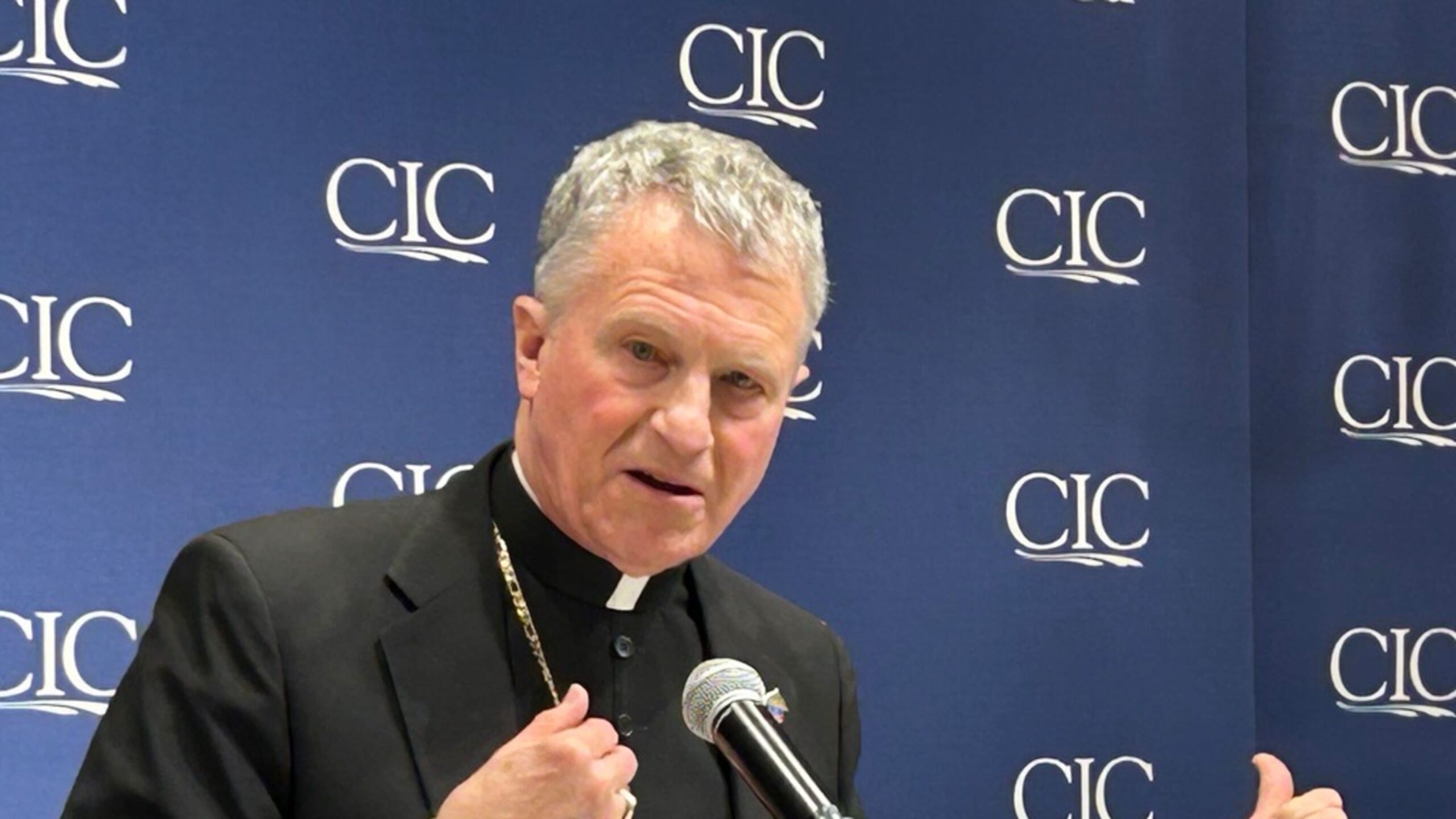
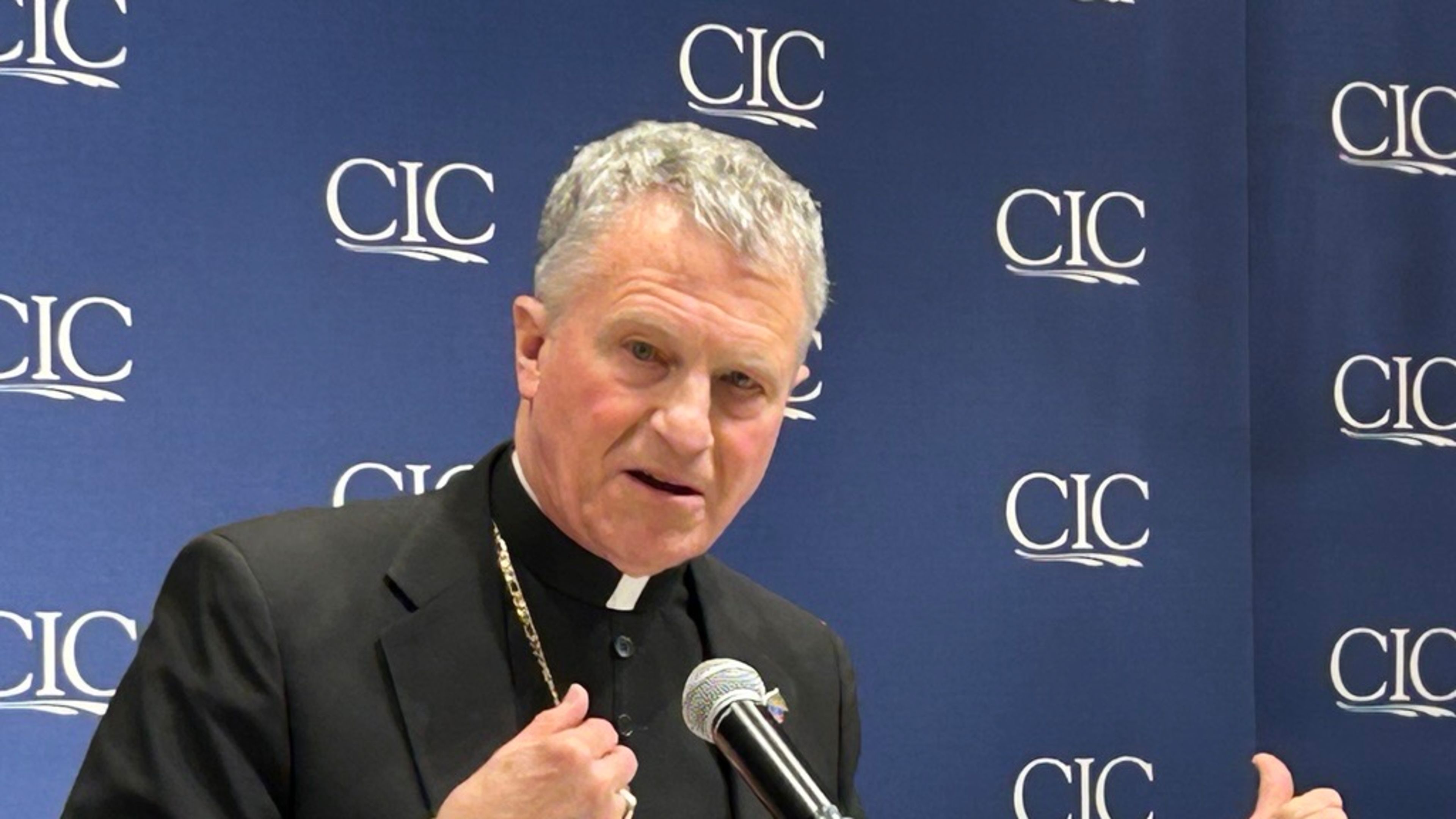
Archbishop Timothy Broglio of the Archdiocese for the Military Services, USA, spoke positively about a recent initiative launched by Defense Secretary Pete Hegseth that seeks to restore the focus of the military chaplain corps toward spiritual ministry.
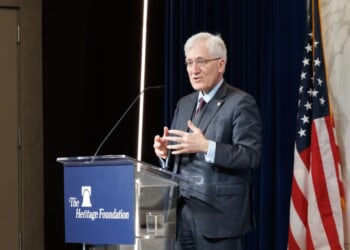
“[Hegseth] definitely wants to return the chaplaincy to responsibility for religious services, religious instruction, and advising the commanders,” Broglio said in a speech at the Catholic Information Center in Washington, D.C., on Jan. 28.
In December, Hegseth ended the use of the official spiritual fitness guide, which he said never mentions virtue and only references God once but makes 11 references to “feelings” and nine to “playfulness.” He said the guidelines were “pushing secular humanism” and were a disservice to military service members who have religious faith.
“Our chaplains are chaplains, not emotional support officers, and we’re going to treat them as such,” Hegseth said at the time.
Broglio noted in his speech that when George Washington set up the chaplaincy, he wanted the chaplains to do two primary things: “He wanted them to meet the spiritual needs of the faithful and he wanted them to tell him the truth [in advising the command], and that is still the function of the chaplaincy in the United States military.”
“Our priests who are chaplains have very clear ideas about what their responsibilities are,” he said. “They know what a priest is supposed to do and they understand the needs of Catholics in the military.”
The archbishop echoed Hegseth’s sentiment about the prior spiritual fitness guide and the effort to “reduce the chaplaincy to either … social work or cheerleading, none of which is really the chaplain’s job.”
He said the defense secretary’s shift will “reduce the notion of them being social workers — because we already do have social workers on military installations, who do their jobs very well.”
Broglio said he is “very hopeful” about the shift, which will allow chaplains to focus on their spiritual ministry “above and beyond everything else that they might ask the chaplains to do.”
Chaplain contract situation, priest shortage
The archbishop also reported improvements to problems that arose last year, when the U.S. Army canceled contracts for religious educators, administrators, and musicians, saying in his speech “the contracts are gradually being reestablished and we’re getting people to fulfill those roles.”
In October, the archdiocese warned that the contract cancellations were staining the Catholic ministry in the Army. Although the Army said the needs would be filled with federal employees, such as religious education directors, the archdiocese said this would be inadequate, because the Catholic ministry requires Catholics who are properly trained by the archdiocese.
Broglio said in his speech that Hegseth and the White House had been interested in resolving the issue and bringing the contracts back. Broglio told EWTN after the speech the archdiocese is waiting to formally declare that the issue has been resolved but that things are moving in the right direction.
The archdiocese, however, is still facing a priest shortage, similar to what the broader Church in the United States and globally is facing. He said there are about 190 priests in the archdiocese, but “we should probably have about 500 to actually meet the needs.”
“We don’t have enough priests,” the archbishop said, noting that the archdiocese is “global” because “the United States has troops all over the world.”
One way in which they’ve tried to respond is by establishing Team Saint Paul, which is present on four military installations so far. He said the group, which was established in 2021, “they just invite Catholics to practice their faith — so almost an extension of what happens in the chapel.”
“They do that with Bible studies, they do it with meals, outings, invitations to come to Mass, and it’s very much on its first leg, but it is a great sign of hope … and hopefully [it] will grow,” Broglio said.
Just war doctrine in the military
Broglio also expanded on the role of chaplains advising the military command and noted it is important to advise decision-makers about when military action can be just and when it would not be just.
Commenting on Catholic just war doctrine, he said the doctrine focuses on three main areas: the criteria to start a war, conduct during a war, and justice after the war.
“It dictates that conflict must be a last resort, [it must be] declared by a proper authority, [it must be declared] for a just cause, such as self-defense, [it must have] a reasonable chance of success, and [use] proportional force,” the archbishop said.
During President Donald Trump’s second term, Broglio expressed concern about some military actions and rhetoric from the administration, specifically on the destruction of alleged drug boats off the coast of Venezuela that killed 126 people and threats to annex Greenland from Denmark.
In an interview with BBC earlier this month, Broglio spoke about “morally questionable” orders, saying that for some soldiers, “within the realm of their own conscience, it would be morally acceptable to disobey that order.” Yet, he said doing so would be “putting them in an untenable situation.”
However, he told EWTN after his speech that a soldier would need “to do a lot of studying and a lot of preparation” to conclude an order is unjust. He said when advising on matters of just war, that is a matter chaplains should be discussing with the military commanders.