Much of what makes Diogenes the Cynic (d. ca. 323 B.C.) such a fascinating but difficult figure to reckon with can be gleaned from the opening anecdote of the most complete surviving biography of the philosopher, written by another Diogenes (Laertius) some five hundred years after his subject’s death. After explaining that Diogenes was a native of Sinope (a Greek city in modern-day Turkey) and the son of a banker, the biographer writes:
Diogenes himself actually confesses in his Pordalus that he adulterated the [city’s] coinage. Some say that having been appointed to superintend the workmen he was persuaded by them, and that he went to Delphi or to the Delian oracle in his own city and inquired of Apollo whether he should do what he was urged to do. When the god gave him permission to alter the political currency, not understanding what this meant, he adulterated the state coinage, and when he was detected, according to some he was banished, while according to others he voluntarily quitted the city for fear of consequences.
Note the abundance of hedging phrases such as “some say” or “according to others.” In sources dealing with the Cynic, such ambivalence is a feature, not a bug, because, contrary to what Diogenes Laertius here asserts, Diogenes of Sinope almost certainly never wrote anything down. That makes the biographer’s task, whether ancient or modern, exceedingly difficult. It also makes Inger Kuin’s recently published biography all the more impressive.
The passage is a good place to start for investigating the philosopher’s life and legacy. First, it memorably illustrates Diogenes’ signal claim to fame: his iconoclasm, in this case quite literal. Defacing the currency of one’s native city represents the radical rejection of not just politics but also the civilized life of the polis (city-state) itself, which, as Aristotle famously observed, is the natural sphere of (Greek) man. But the act has an even deeper philosophical significance: as Kuin points out, the Greek word for currency, nomisma, is cognate with the central Greek concept of nomos, usually translated as law or custom. In ostentatiously rejecting nomos, Diogenes became the standard-bearer of phusis (nature), and specifically of living in accordance with nature. His great opponent, in the fourth-century B.C. iteration of the foundational Greek intellectual debate between nomos and phusis, was none other than Plato himself. The two even sparred in Athens, where Diogenes lived as a resident alien.
The most revealing aspect of the passage, however, is the mention of Diogenes’ trip to consult the oracle of Apollo at Delphi. This detail should be read as a direct allusion to the most famous philosopher who visited the oracle of Delphi: Socrates, declared the wisest of men by the Pythia. Although the story of Diogenes’ visit may well be apocryphal, it does suggest that the philosopher was perceived, at least by some, as Socrates redivivus.
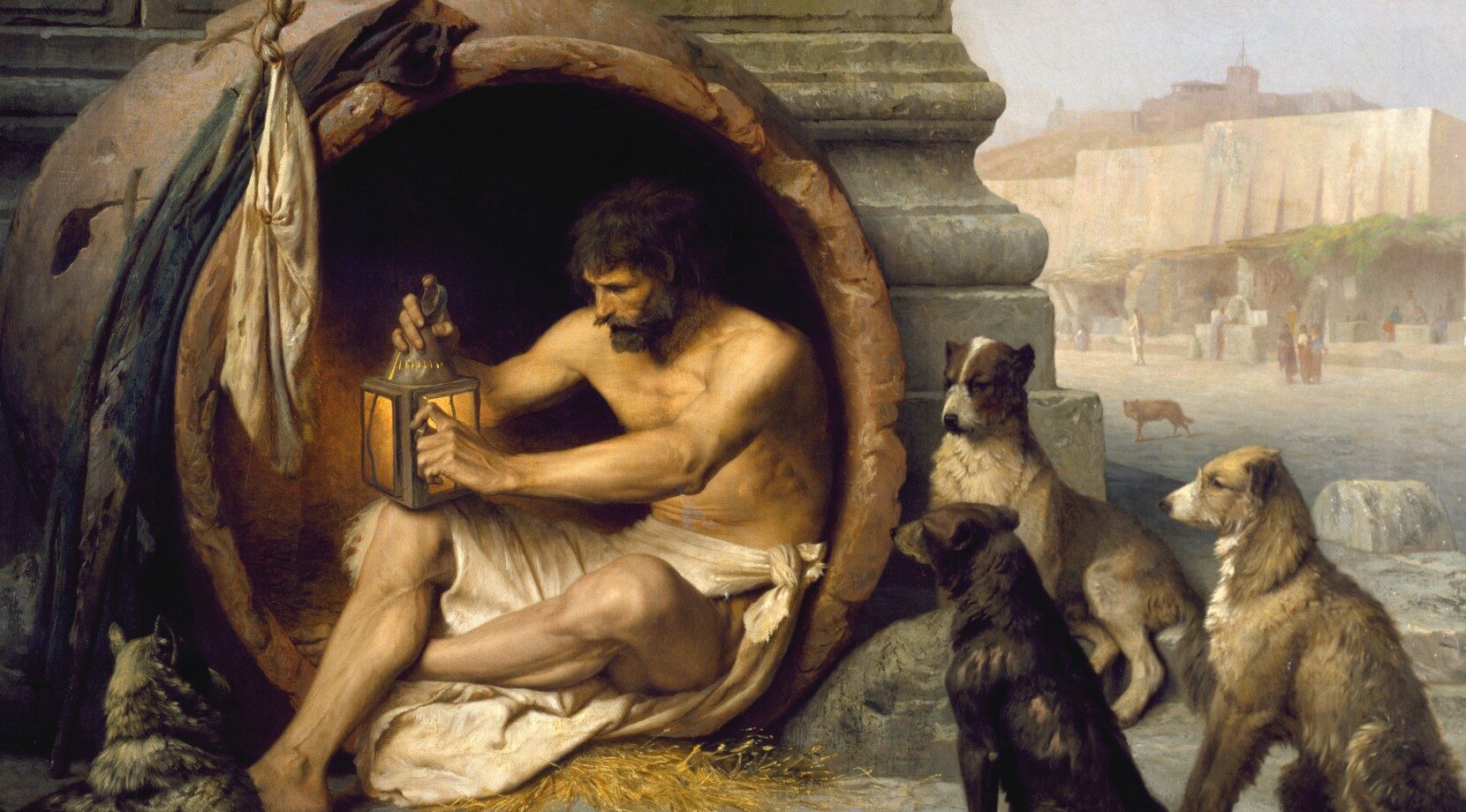
At first, one balks at the comparison. What does the proudly Athenian Socrates, who spent his time at drinking parties with young aristocrats, have to do with a homeless exile who deliberately lived the solitary life of a dog (“cynic” comes from the Greek word for dog), living in a large jar (not a barrel, contrary to legend), urinating on passersby, eating only raw food, and masturbating in public? Quite a lot, it turns out.
Perhaps the biggest similarity is that both men practiced what they preached, contrary to almost every other major philosopher, ancient or modern. For Diogenes as for Socrates, philosophy was above all a way of life, no matter the consequences, which were severe for both men. Neither was perturbed or silenced by the threat of the death penalty for the one and the grim circumstances of slavery for the other. Socrates was famously ugly, unpretentious, and walked barefoot, all of which Diogenes was also known for. In “living his truth,” it is Diogenes, and not the idealistic Plato, who is the true heir to Socrates.
Kuin teases out some of these parallels, but she is at her most insightful in illustrating the surprising degree of influence that Diogenes had on later, much more mainstream philosophical schools, in particular Stoicism. The founder of Stoicism, Zeno, had started out as a Cynic, and it shows: the Stoics’ emphasis on askesis, daily exercises meant to train the mind and body to be rid of desire, comes directly from Diogenes, who abandoned all worldly comforts precisely so that he could be autonomous and free of the tyranny of desire.
Kuin is less convincing in her political analysis of Diogenes. She repeatedly returns to the famous meeting of Diogenes and Alexander the Great, which, she insists, really did take place. When the great king asked what he could do for Diogenes, the philosopher told Alexander to stop blocking the sun and get out of the way. For her, the episode proves Diogenes’ “anti-authoritarian attitude,” but this is a misreading: Diogenes was almost certainly as hostile to democratic politics as he was to kings and aristocrats. He was apolitical in the truest sense of the word, in that he considered the polis itself as just another unnatural social convention; as Kuin notes earlier on in her work, Diogenes identified as a “cosmopolitan” and may well have coined the term.
In presenting Diogenes as a kind of proto-revolutionary, Kuin sometimes veers into the realm of the improbable, even the ahistorical. She bizarrely suggests, for instance, that Jesus may have been a follower of Diogenes, from whom he got his own “anti-authoritarian attitude” as well as the belief that “social norms are arbitrary.” One wonders what she makes of “render unto Caesar.”
In the closing chapters of the book, Kuin traces how Diogenes has influenced Western thought. In 1753, Jean le Rond d’Alembert, the coeditor of the Encyclopédie and one of the key figures of the French Enlightenment, wrote, “Every age, and especially ours, would need a Diogenes. The difficulty is in finding men who have the courage to be him, and men who have the courage to endure him.” D’Alembert may be right, but before discovering a Diogenes for our age, we might begin by finding the original. For those wishing to get on the trail of the “heavenly dog” (as Diogenes’ disciples called him), Inger Kuin’s biography, despite its occasional pandering to twenty-first-century sensibilities, is an excellent place to start.