O only begotten Son and Word of God, immortal as you are, you condescended for our salvation to be incarnate… – “Hymn of the Incarnation,” Emperor Justinian, 6th Century
Nothing much positive comes to mind by the word “condescension.” When people act in a condescending way, we think of obnoxiously lofty behavior or a demeaning attitude. But despite these negative connotations, the term has a connection to the most benevolent action of God that was in no way an act of superiority, but one of tremendous love, lowering Himself to be with His beloved.
There is an ancient patristic thought-legend that the fall of the angels was caused by their rejection of the inconceivable plan of the Incarnation. In their angelic outrage over the seeming indignity of God becoming man—becoming a little less than the angels themselves—Lucifer and his legions refused to serve, and in their hellish pride, they revolted at the outrage of such heavenly condescension.
And, indeed, there is something alarming about the idea—let alone the reality—of God becoming man. But so it was and so it is. As St. Athanasius famously put it, the Son of God became man so that man might become God. Or, in the words of the modest St. Francis of Assisi:
“What wonderful majesty! What stupendous condescension! O sublime humility! That the Lord of the whole universe, God and the Son of God, should humble Himself like this under the form of a little bread, for our salvation.”
Putting to side the preeminent wonder of the Eucharist, it is a profoundly stirring and striking thought that the Almighty God would become a little baby—something so small, so helpless, so vulnerable. But, at the same time and by those same qualities, He became instantly and wholly adorable to all—not a haughty power that stooped to our slime. God did lower Himself to our state (except that of sin), but in so doing, did not debase Himself or make Himself austere. Rather, He accomplished the mightiest of miracles in this that brought greater glory to His Name and elevated us in the same moment.
This concept of Divine Condescension is indispensable during Advent. Many, if not most, Catholics rightly think of Advent as a “coming toward” Christmas, as the Latin, ad-ventus, etymologically suggests, hearkening to narratives like Mary and Joseph traveling to Bethlehem or the Three Kings following the Star over great distances to the King of Kings. In this sense, we imagine ourselves coming to Christ, going to worship at the manger, in the spirit of “O come, let us adore Him,” and “Come to Bethlehem and see Him Whose birth the angels sing.”
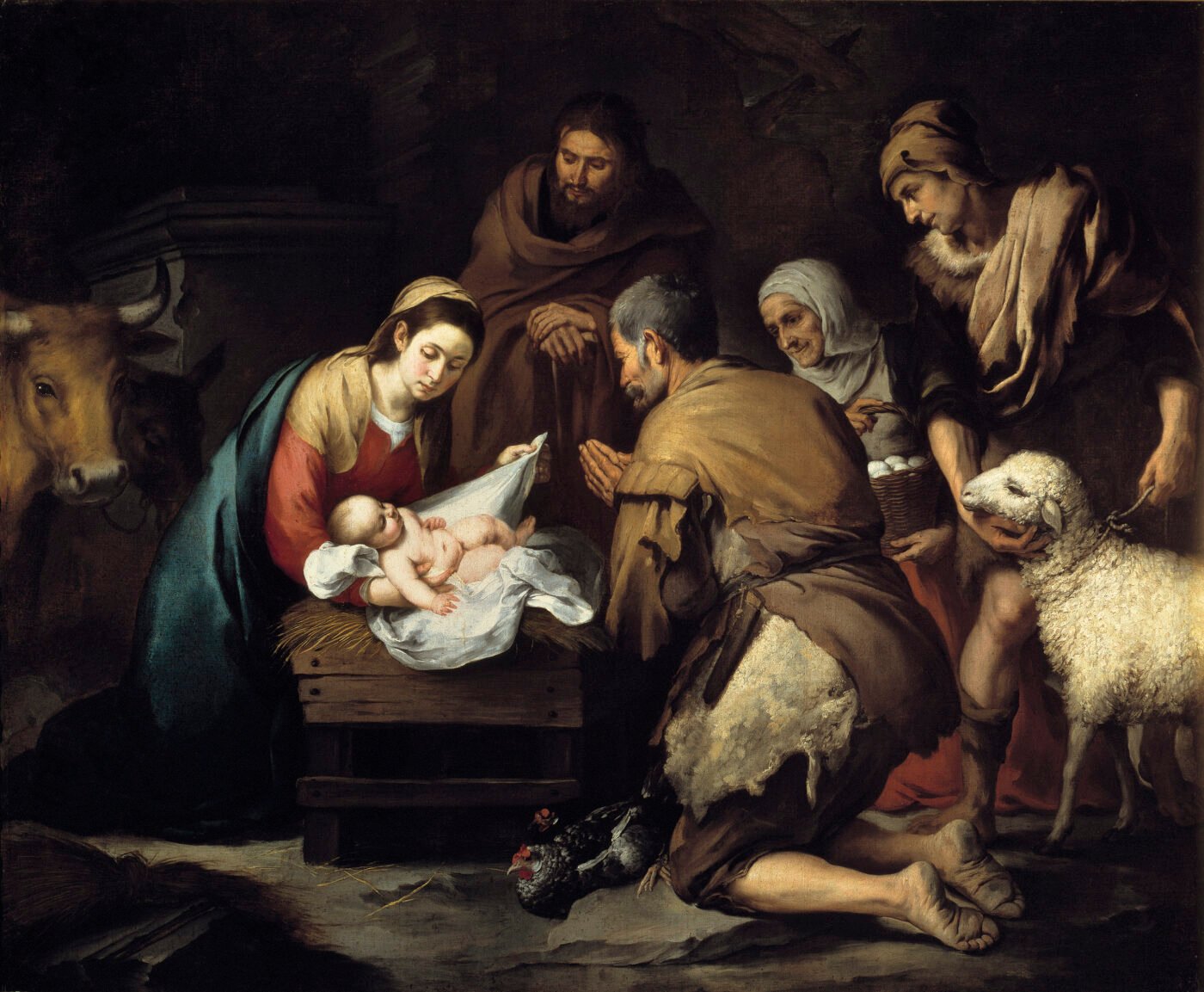
But it is the Advent carol “O come, O come, Emmanuel” that reverses this context in a profound way, reorienting the minds of those “in sin and error pining” to consider Christ coming to us rather than we coming to Him. The enormous impossibility of the Word becoming flesh and dwelling amongst us invites an immediacy which is only natural, such as joining the shepherds as they stumble across the Christ Child under a bush in Bethlehem. But ’tis the season for the impossible, as the words of Gabriel remind us at the first moment of the Incarnation, and as we see played out in the familiar yet strange juxtapositional paradoxes of kings and peasants, angels and beasts, virginity and motherhood, man and God. Christmas is the preeminent time for miracles, and a miracle is when the natural is visited by the supernatural—as Mary visited Elizabeth with the Holy Unborn Infant, with God Himself, leaping in her womb.
Thus it is that the Divine Condescension brings with it a divine elevation. The hymnody of the Byzantine Catholic liturgy is particularly helpful in encountering Christ’s loving condescension. The hymns to Mary the God Bearer (Theotokos) are wonderfully powerful in connecting the tremendous reality achieved by these mysteries.
For instance, the poetic phrase, “For to us is born a new Child, being God from all eternity,” brings out the paradox of newness and eternity, and the wonder associated with the God Who fixed the stars in their firmament becoming a babe beneath those same stars. The Lenten Hirmos to the Mother of God sings, “Our God Who exists before all eternity took flesh and became a little Child, He has taken your womb as His throne, making it more spacious than the heavens!”
More spacious than the heavens. A mindboggling, universe-shaking mystery is plainly stated here—easily overlooked and perhaps impossible to understand—but, as Catholics, we believe in the impossible. Can it be that, in deigning to become Man, Jesus Christ made the womb of Mary and the habitations of man wider than heaven itself? With God, nothing is impossible.
The great God became little in order to become even greater. It is here with us, whether walking along the boundaries of sea and sand with His friends as the Messiah, or enthroned invisibly in our narrow hearts, or enshrined under the appearance of Bread and Wine in tiny tabernacles, that God enters into a restricted space, filling it with His infinite being and infinite love. G.K. Chesterton captures this mystery in his poem, “Lepanto,” commemorating the 1571 battle where the first copy of the pregnant Virgin of Guadalupe was unfurled over the flagships of the Holy League during their victory over the Ottoman Empire:
The hidden room in man’s house where God sits all the year,
The secret window whence the world looks small and very dear.
In descending, only God could cause ascent at the same time, thereby making Himself even higher, putting Hamlet’s ironic words into a reality He alone could achieve: “O God, I could be bounded in a nutshell, and count myself a king of infinite space.” And it is only in imitating His descent, His condescension, His meekness, that we, too, can rise with Him to the heights of eternal life.
This is the greatest example and opportunity afforded to us by the Incarnation. It is the challenge of Divine Condescension—and we all know it when we see it or do it ourselves. It was not human condescension that made Mr. Scrooge send the biggest goose at the grocer’s to the Cratchits. Neither was it human condescension that made him promote Bob as a partner or render himself a second father to Tiny Tim. It was nothing ingratiating and self-aggrandizing. It was something like Divine Condescension, in the realization that Christmastime is the time for coming down to earth, when, in Dickens’ words:
…men and women seem by one consent to open their shut-up hearts freely, and to think of people below them as if they really were fellow-passengers to the grave, and not another race of creatures bound on other journeys.
It is the infinite condescension of the Lord God which calls for a corresponding uplifting of devotion to Him, even as it sparks fellowship with our neighbors.
This Advent, there is a new book from TAN that delightfully and profoundly guides the mind and heart through the cosmic realities caused by this coming of comings. Devotion to Our Lord in the Womb by Fr. Henry James Coleridge, SJ, is a sweetly spiritual volume, easy to read and beautifully meditative and informative.
In this excellent little work, Fr. Coleridge writes:
For the act of the Incarnation was the greatest act of the divine mercy and condescension possible. It was the fulfillment of the loftiest and most far reaching of the counsels of God. It was the elevation of the whole of creation by its union with the Creator.
The Divine Condescension was not just for our salvation, but also for our participation. Advent is the perfect time, the purposed time, for us to prepare to encounter Christ’s condescension and to recognize it as a mystery of exquisite hope and happiness even unto beatitude. Moreover, it is the penitential season that draws us through discipline and determination to participate in that saving condescension through our own acts of mercy and charity. This is the whole of what is truly meant by the Christmas spirit.
So, this Advent, pick up Devotion to Our Lord in the Womb to better imitate the beautiful condescension of Our Lord through deeds of loving service that bring eternal merit to all the holly-jolly jingles we hear, like “Say hello to friends you know and everyone you meet.” Come down so that all might be raised up. Make your Advent and Christmas about being Christlike, Who came down to us when we had fallen to raise us up again in the purity and perfection of newborn babes.
Image from Wikimedia Commons