US policy is allowing Israel to undermine the ceasefire and further degrade the humanitarian situation in the Gaza Strip.
United States President Donald Trump is reportedly pushing ahead with faulty reconstruction and humanitarian plans in Gaza that amount to prolonging Israel’s occupation at the expense of Palestinians. Sadly, this is the trend since October 2023, as the Trump and former Biden administrations repeatedly committed to strategies that failed to address the Strip’s ongoing humanitarian crisis. If Washington truly hopes to resolve that crisis and the broader Israel-Palestine conflict, it should reorient its approach to consider the needs of Palestinians and Israel’s spoiler role, aligning its interest in decreasing its Middle East footprint with ceasefire and peace efforts.
Unfortunately, the Trump administration is doing the opposite. Regarding reconstruction planning, it is reportedly pushing only to rebuild the Israeli side of the now-split Gaza Strip, opting to rebrand its “alternative safe communities” (ASC) planning for roughly 2.2 million Palestinians. Human rights advocates, humanitarians, Palestinians in Gaza, and even ex-Israeli prime ministers have described ASC as nothing more than an effort to place Palestinians in Gaza into concentration camps, as they would be unable to leave amid a lockdown by Israeli forces or the still-pending International Stabilization Force (ISF) recently approved by the UN Security Council in a resolution backing Trump’s 20-point peace plan for Gaza.
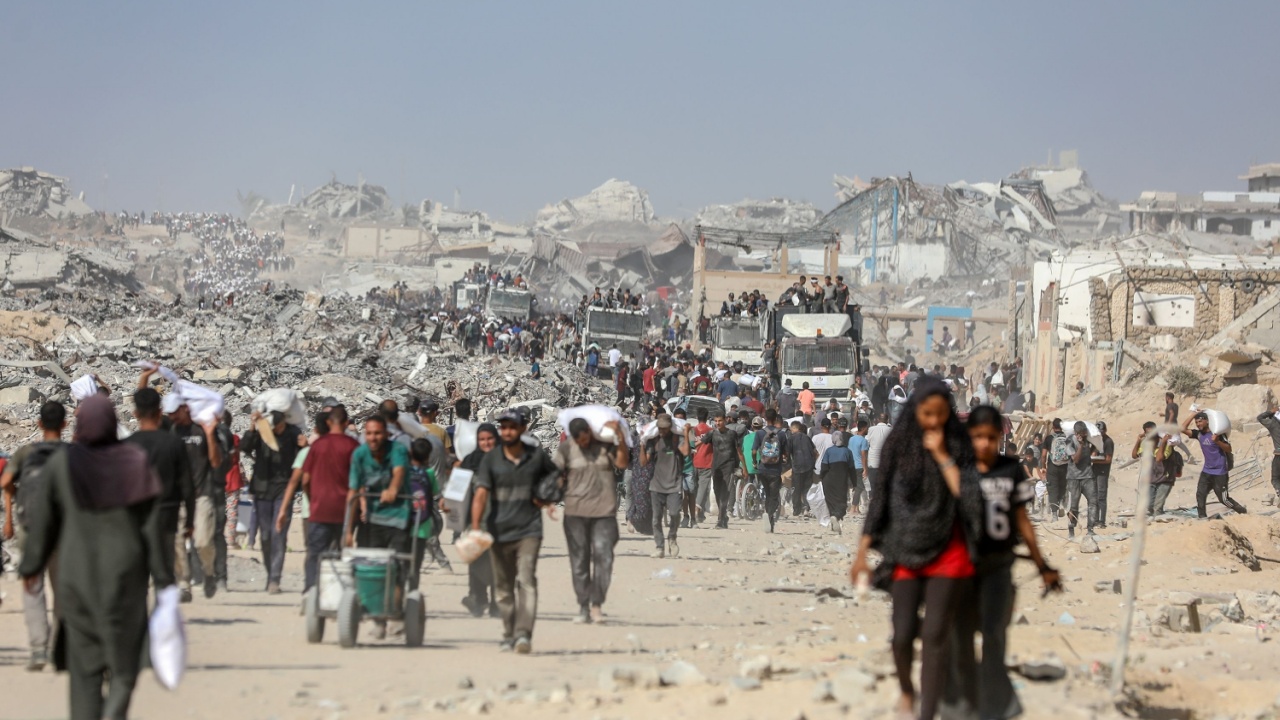
To be clear, Washington’s shift does not stem from altruism. Instead, the understood purpose of rebuilding parts of Gaza not available to Palestinians, leaving them to suffer in less than half the Strip’s territory amid little more than ruins and limited humanitarian aid still largely blocked by Israel in violation of the ceasefire and international law, is to pressure Hamas to disarm. Washington and Israel likely hope to increase pressure on the Palestinian faction in the street, with Israeli leaders cementing their hold on the territory they occupy.
Indeed, Israeli prime minister Benjamin Netanyahu has openly declared that his forces will not leave without Hamas disarmament, in contravention of the ceasefire. Since Israel first began its “General’s Plan” in October 2024, the thinking has been—and remains—to force Palestinian displacement to non-Hamas-controlled areas by weaponizing humanitarian aid and shelter. The ASCs were an extension of this concept. More recently, the idea was anchored in Israel-backed gangs controlling so-called “safe zones,” opening the door for even more indiscriminate bombing campaigns in Hamas-controlled territory.
The underlying assumption behind Palestinian displacement to safe zones has always been about disarming and wiping out Hamas. Rumors have persisted in recent weeks that the United States is wobbling on Hamas disarmament, given the difficulty of establishing the ISF, as potential participating countries fear having to enforce any effort to remove weapons. Ultimately, that would likely lead to direct combat with Hamas.
Regarding humanitarian aid flows, new reports suggest that the security contractor behind the Gaza Humanitarian Foundation (GHF), North Carolina-based UG Solutions, is recruiting for a widespread expansion of its operations in the Strip. Previously, US ambassador to Israel Mike Huckabee said that the GHF would expand to 16 distribution sites. However, the group announced on November 24 that it would cease Gaza operations while remaining a functioning NGO, suggesting it could resume work in the Strip in the future, contingent on the corresponding recruitment drive.
As a US and Israeli-backed and private aid mechanism operated by American contractors, alongside Israeli businessmen and former defense officials, the GHF only managed to open four aid distribution sites in late May under the guise of preventing Hamas from siphoning aid. The UN aid system operated over 400 distribution sites across Gaza and was generally considered functional.
The GHF was not and is not a humanitarian organization. It fails to honor the core tenets of humanitarianism as outlined in international law: humanity, impartiality, neutrality, and independence. Leading humanitarian organizations and UN officials, alongside GHF’s initial executive director and former UG Solutions employees, have accused the organization of failing to operate along these core tenets. Indeed, some reports highlight clear human rights violations on the part of the security contractors supporting the GHF operation.
Operating in close coordination with the Israeli military in closed military zones—areas where anything that moves is destroyed—the GHF violated basic humanitarian principles by putting Palestinians in harm’s way, espousing Israeli talking points about aid, and collecting Palestinian facial data with AI tools in collaboration with Israeli defense and intelligence arms. UG Solutions reportedly employed numerous security contractors with links to an Islamophobic biker gang in the United States.
Israel killed over 2,000 Palestinians near the sites, with the GHF excusing the killings as unrelated to its operations while blaming Hamas for the deaths. This is not impartiality or neutrality—it is collaboration at the expense of civilian life.
The foundation also failed to provide adequate assistance to Palestinians. The group aimed for 300 million “meals” in its first 90 days, equating to roughly 1.6 meals per person in Gaza. While already lacking, its claim of distributing just 135 million meals by August 23—90 days into its operations—speaks for itself. Famine hit Gaza because this mechanism was a disaster.
Such defects are by design, not unlike those of former US president Joe Biden’s aid pier operations or the continued use of dangerous air drops. The former effort hardly brought any impactful level of aid into the Strip, resulting in the injury of multiple US soldiers while laying the groundwork for ignoring and sidelining impartial aid systems in Gaza. The latter killed multiple Palestinians while failing to seriously put a dent in the hunger crisis in Gaza, which grew into a famine under the Trump administration-backed GHF.
Ultimately, it is the toxic US-Israel relationship that continues to drive Washington into such policies. It is the political class’s inability to recognize that US interests—not Israeli ones—should drive American foreign policy. It is the cowardice of administrations, spanning decades, to recognize that contorting to the whims of a junior partner in a conflict that should have ended long ago has implicated Washington in brutal human rights violations, reputational harm, and wasted resources, which is nothing compared to what Palestinians have experienced and continue to suffer through on a daily basis.
The United States should not invest taxpayer funds in any effort that fails to achieve the stated objective of a sustainable and secure ceasefire, improved humanitarian metrics, and broader peace in Gaza, let alone one that actively advances the interests of another country at the expense of all else, including innocent life. The real solution is to pressure Israel to adhere to the ceasefire and honor the 20-point plan. Even this approach falls far short of what is truly necessary to end the conflict: an immediate Israeli withdrawal and efforts to establish a Palestinian state without preconditions.
Hardening the current “yellow line” dividing Hamas-controlled and Israel-controlled territory in Gaza is a recipe for further perpetual war, which is not in the US interest. It will foster deeper involvement in the Middle East, distracting Washington from major concerns at home and in other regions of the world. Any decision to deepen US involvement in Gaza in blatant one-sided support for Israel, especially when that effort backs failing and illegal policies killing civilians, does not reflect the behavior of a president seriously interested in peace.
About the Author: Alexander Langlois
Alexander Langlois is a foreign policy analyst, the senior editor at DAWN, and a contributing fellow at Defense Priorities. He is focused on the geopolitics of the Levant and the broader dynamics of West Asia. Langlois holds a Master of Arts degree in International Affairs from American University. He has written for various outlets, including The Carnegie Endowment for International Peace’s Sada, the Atlantic Council’s MENASource, the Lowy Institute, the Gulf International Forum, the New Arab, the Nation, and Inkstick. Follow him on X: @langloisajl.
Image: Anas-Mohammed / Shutterstock.com.