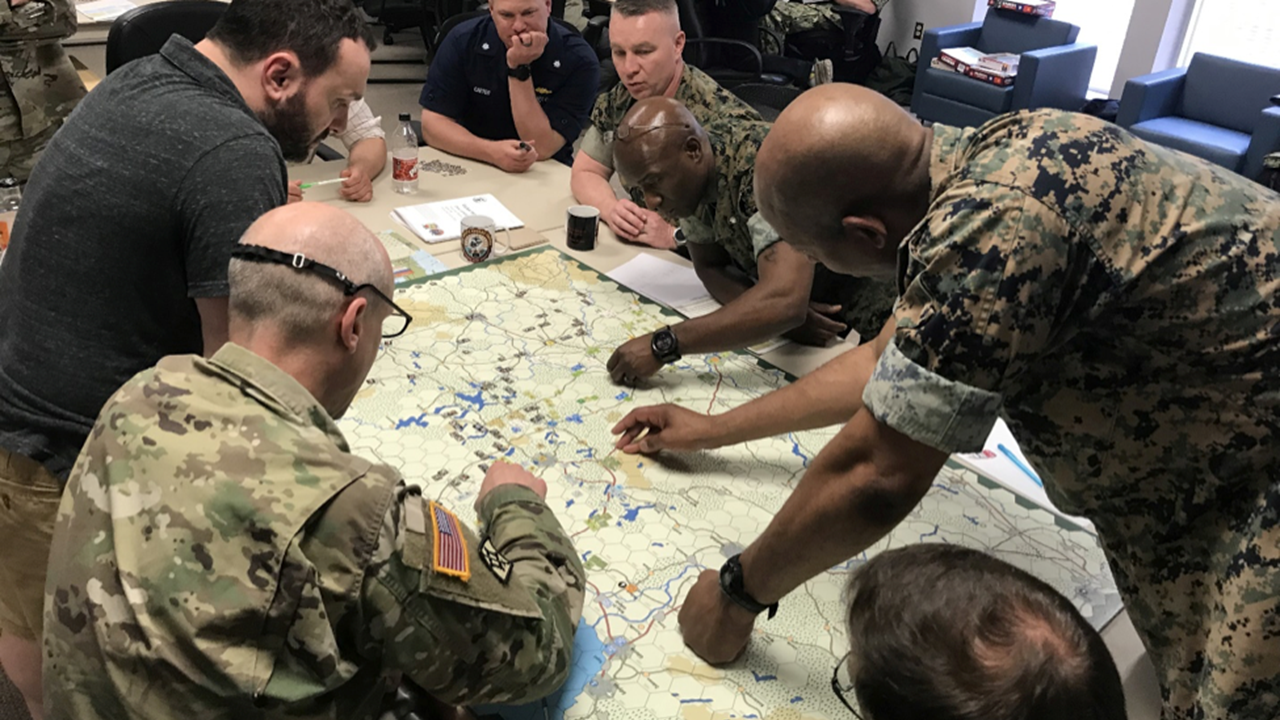
Military wargames date back thousands of years, but their modern versions have many of the same challenges that civilian wargames do—in particular, weak computer opponents.
The United States Air Force is ready for the big game—and not of the football variety, although the Air Force Falcons had a good year. Instead, the Department of the Air Force is now looking at how next-generation artificial intelligence (AI) could accelerate its computer wargaming.
The DAF has called for a “digital sandbox” that could generate and run simulations at speeds of up to 10,000 times faster than real time. This isn’t about developing a next-generation first-person shooter or action video game; instead, the wargame effort focuses on predicting how real-world battlefield scenarios could play out.
As Long As There Have Been Wars, There Have Been Wargames
The DAF’s wargaming follows a long trend that goes back not years, but millennia.
“The military has been using games for training, tactics analysis, and mission preparation for centuries. Each generation has had to wrestle with the personal and public image of a game being used for something as serious as planning warfare in which people’s lives are at stake,” wrote Roger Smith, US Army PEO for Simulation, Training, and Instrumentation, in a 2010 white paper titled Simulation & Gaming, 40th anniversary issue.
Smith noted that as early as the Roman era, centurions used sand tables and abstract icons to represent soldiers and units in battle. It was among the earliest ways leaders could visualize an engagement before it happened. In the centuries since, military thinkers have played games such as Chess and Go, while in the 19th century, the United States Naval War College used wargames to plan US defenses against a theorized British naval invasion of New York Harbor.
Military wargames have gone digital, but the “wargames” shouldn’t be confused with mass-market games for civilians like Risk, Axis & Allies, Civilization, or Age of Empires. Moreover, some simulations are so multifaceted and detailed that even experienced gamers might be overwhelmed by their complexity.
AI promises to make wargames and simulations especially resource-intensive.
The “WarMatrix” AI Could Change Military Wargaming Forever
Determining the outcome of a military confrontation isn’t about shooting opponents or just moving pieces on a board (digital or otherwise). It involves considering a range of factors. This is where AI comes into play—but it also means that the systems need to be beyond even a hardcore gamer’s computer rig.
“Currently, the DAF faces challenges including the inability to answer critical questions about capabilities, Courses of Action (COA) analysis, or costing, due to a reliance on disconnected, outdated, and vendor-locked tools,” an Air Force request for information (RFI) explained.
Posted last month, the RFI called for information from “vendors capable of providing advanced software, modeling and simulation (M&S), and Artificial Intelligence (AI) technologies relevant to the US Air Force’s Advanced Wargaming initiative. The Air Force requires a transformed, future-ready system to achieve Decision Superiority and deliver an integrated Force Design.”
The envisioned WarMatrix Ecosystem will require technologies that can deliver simulations at “Super Real-Time” speeds, and function as a “modular, cloud-based, multi-domain application that acts as an integration hub for digital wargaming.” The DAF requires a system that can be used by hundreds of users and scaled to tens of thousands of entities, making the current 64 vs. 64 online games look minuscule by comparison.
This would also be built with security beyond the average firewall, capable of operating across various security clearance levels, from Unclassified to Secret and even TS/SCI/SAP (Top Secret with Sensitive Compartmented Information and Special Access Programs).
Despite its sophistication, the effort still remains a “wargame” at heart. This means it needs to overcome the same issues as consumer-focused games—chiefly weak computer opponents that struggle with pathfinding. Improvements with AI are meant to address some of these challenges. In addition, the WarMatrix can incorporate challenges that humans might not immediately consider while offering endless, unpredictable scenarios.
“WarMatrix fuses both computational precision and human insight, ensuring decisions are transparent and strategically sound,” a DAF spokesperson told Defense News.
“Compute and tooling, data integration, a human-centered design, and auditable trails address shortcomings of ‘black box’ mega-sims by making assumptions and outcomes inspectable and integrated,” the spokesperson added. “This tool is being built by wargamers for wargamers.”
Companies that think they are ready to enter the WarMatrix must submit their briefs to the DAF by January 9, 2026.
About the Author: Peter Suciu
Peter Suciu has contributed over 3,200 published pieces to more than four dozen magazines and websites over a 30-year career in journalism. He regularly writes about military hardware, firearms history, cybersecurity, politics, and international affairs. Peter is also a contributing writer for Forbes and Clearance Jobs. He is based in Michigan. You can follow him on Twitter: @PeterSuciu. You can email the author: [email protected].
Image: Wikimedia Commons.