For those of us who celebrated the Easter Vigil—with its nine readings and eight psalms, its celebrations of Pascal fire and light and water, its sacraments of baptism and Eucharist, lasting late into the night—“rising again” Easter morning can sometimes be less than glorious. If anything, Easter morning seems rather anticlimactic.
The First Easter
In the struggle to sustain sentiments of joy and glory, it is helpful to remember that the disciples also awoke on Easter morning feeling anything but glorious. If you bring to mind the most profound grief you ever experienced and combine that with the most agonizing guilt, the most palpitating fear, and the most utter confusion, it would still be a far cry from the ruin in the disciples’ hearts that morning: Jesus had been crucified the evening before last, and (with the exception of John) they hadn’t even been there at the end. They had utterly failed.
And now the sun was rising on another day, the first of many long, empty days before them. The Holy City was still full of pilgrims; the festive week of Unleavened Bread was still underway. But their life as disciples of the Messiah was over. What reason did they even have to stay together, aside from their common sense of loss? Why even get out of bed, except that their dreams were probably just as painful as their waking thoughts? “O my God, I cry by day, but thou dost not answer; and by night, but find no rest” (Ps. 22:2).
As if all this weren’t enough, now there was some commotion about the tomb—the tomb sealed and watched by a guard of soldiers. The women had this crazy idea that they were going to be allowed to enter the tomb and anoint the body of Jesus. They had been working on preparing spices since the sun went down yesterday. It was dangerous and pointless, but they wouldn’t listen to reason. In any case, it seems to have all come to nothing; here they are back again quite early.
But what is this Mary Magdalene is saying? “They have taken the Lord out of the tomb, and we do not know where they have laid him” (Jn. 20:2). Who are they? Lowlife certainly, but also powerful—if they are in league with the chief priests and the guards. Why would they want the body? Was it too late to stop them, whatever their intentions were?
And so the Easter morning race to the tomb begins… By noon, everyone is in total confusion. The women say they have seen Him alive (Mt. 28:9-10), but Peter and John saw nothing at the tomb except the burial linens. Maybe it is better just to get out of Jerusalem and leave all these broken dreams behind. Clopas says he is going home after lunch, and maybe he is right. “We had hoped…”
The Touchstones of Our Easter Experience
We won’t necessarily feel risen with Christ just because He is risen, and how we feel doesn’t affect the facts one way or another. Feeling is not the measure of faith. Most of us won’t be given an apparition to jolt us into the joy of the Resurrection, but there are several other ways to access the mystery, and we are invited to make them the touchstones of our resurrection experience this Easter.
The Empty Tomb
The first is the empty tomb. Peter sees the empty tomb and burial cloths and goes home perplexed, but John sees and goes home believing. If the tomb and linens are a sign for John, it is because John is keenly aware of how the tomb used to be. He had been there when the shattered body of Jesus was bound and laid in just that position. Now Jesus has passed through death to life without even disturbing the position of the linens that enveloped Him.
In each of our lives there are empty spaces and burial places that we know all too well. Things that have ended in brokenness—and no matter how much we wish, we cannot change them now. They are lying in the dust of death, most likely forgotten by everyone except ourselves, and something of our life with the Lord is bound and buried with them. But then, to our amazement, once we have truly surrendered them, we look again to “see the place where he lay”—the tomb is still there and the burial cloths, but “he is not here, for he has risen as he said” (Mt. 28:6) and, with Him, our hearts have passed from death to life.
The Word of God
A second powerful “sacrament” of the Resurrection is the living word of God. As the Risen Lord walks alongside Clopas and the other disciple on the road to Emmaus, and later that evening with the apostles, he “interpreted to them in all the scriptures the things concerning himself” (Lk. 24:27). In the light of Moses, the prophets, and the psalms (Lk. 24:44), the event of the Resurrection speaks to them from within in the language of their fathers: “Did not our hearts burn within us while he talked to us on the road, while he opened to us the scriptures?” (Lk. 24:32).
Listening to and meditating on the word of God, whether quietly in our homes or in two-by-two conversation, or in the communal celebration of the liturgy, the Risen Christ is there in our midst, opening our hearts to understand. “When therefore he was raised from the dead, his disciples remembered that he had said this; and they believed the scripture and the word which Jesus had spoken” (Jn. 2:22).
The Breaking of the Bread
For the disciples on the road to Emmaus, however, it takes yet another sacrament of Resurrection to finally open their eyes to the Risen One in their midst: the Eucharist. It is when he “took the bread and blessed, and broke it, and gave it to them” (Lk. 24:30) that they suddenly recognize Him. Whether or not this was a eucharistic meal is unclear. But the symbolism is unmistakable.
In the unforgettable words of Pope St. John Paul II:
Those who feed on Christ in the Eucharist need not wait until the hereafter to receive eternal life: they already possess it on earth, as the first-fruits of a future fullness which will embrace man in his totality. For in the Eucharist we also receive the pledge of our bodily resurrection at the end of the world: “He who eats my flesh and drinks my blood has eternal life, and I will raise him up at the last day” (Jn. 6:54). This pledge of the future resurrection comes from the fact that the flesh of the Son of man, given as food, is his body in its glorious state after the resurrection. With the Eucharist we digest, as it were, the “secret” of the resurrection. (Ecclesia de Eucharistia 18)
Awakening to the Resurrection
The empty tomb, the word of God, and the breaking of the bread are three obvious places where the Resurrection overtakes us if we allow it to. There are others as well. For Mary Magdalene, it is hearing the Lord call her by name (Jn. 20:16). For most of the apostles, it is the testimony of Peter that awakens their faith: “The Lord has risen indeed, and has appeared to Simon!” (Lk. 24:34).
But one apostle seems impervious to all this and persists in his unbelief the entire week of Easter: Thomas. He was the only one not there when Jesus appeared on Easter evening, and all week long he struggles, remaining outside the Easter joy that grips the others. For Thomas, nothing short of touching the wounds of Jesus will convince him of the Resurrection: “Unless I place my hand in his side, I will not believe” (Jn. 20:24).
In a beautiful way, Jesus’ wounded heart is the alpha and the omega of the resurrection experience—His and ours. Unlike the wounds in Jesus’ hands and feet, inflicted in agony on the Cross and now transfigured in glory, the wound to His side is something He experiences only in the glory of the Resurrection, because it was inflicted after His death (Jn. 19:33-34).
Even if the Resurrection itself surpasses all that we can imagine, the image of a mortally wounded yet beating heart is an eloquent one. It gives an approximation of what the first intimate experience of rising from the dead must have been like in the holy humanity of Christ and tells us what our daily resurrections can be expected to resemble. In short, the resurrection—Christ’s and ours—is an experience of “standing as it were slain” (Rev. 5:6, Douay-Rheims). (Arise, 2025, p. 123)
The wounds in our hearts do not disappear. But contrary to what we might think, they are not experiences of death; they are experiences of resurrection. Laying down one’s lives for one’s friends also means taking them up again, to continue loving in and through the wounds. “We know that we have passed out of death into life, because we love the brethren. He who does not love remains in death” (1 Jn. 3:14).
Author’s Note: Drawing from patriarchs and prophets, psalms and parables, teachings and miracles of resurrection, Arise: A 50 Day Journey into the Mystery of the Resurrectionreveals the progressive unfolding of resurrection faith throughout salvation history, culminating in Christ’s own ministry and mystery of resurrection: “I AM the Resurrection.” Accessible and powerful, Arise is divided into fifty short chapters—perfect for daily prayer, retreat, or group study. Each section includes Scripture references, reflection questions, and a reading plan, making it an ideal companion for the Easter season or any time of year when faith needs rekindling.
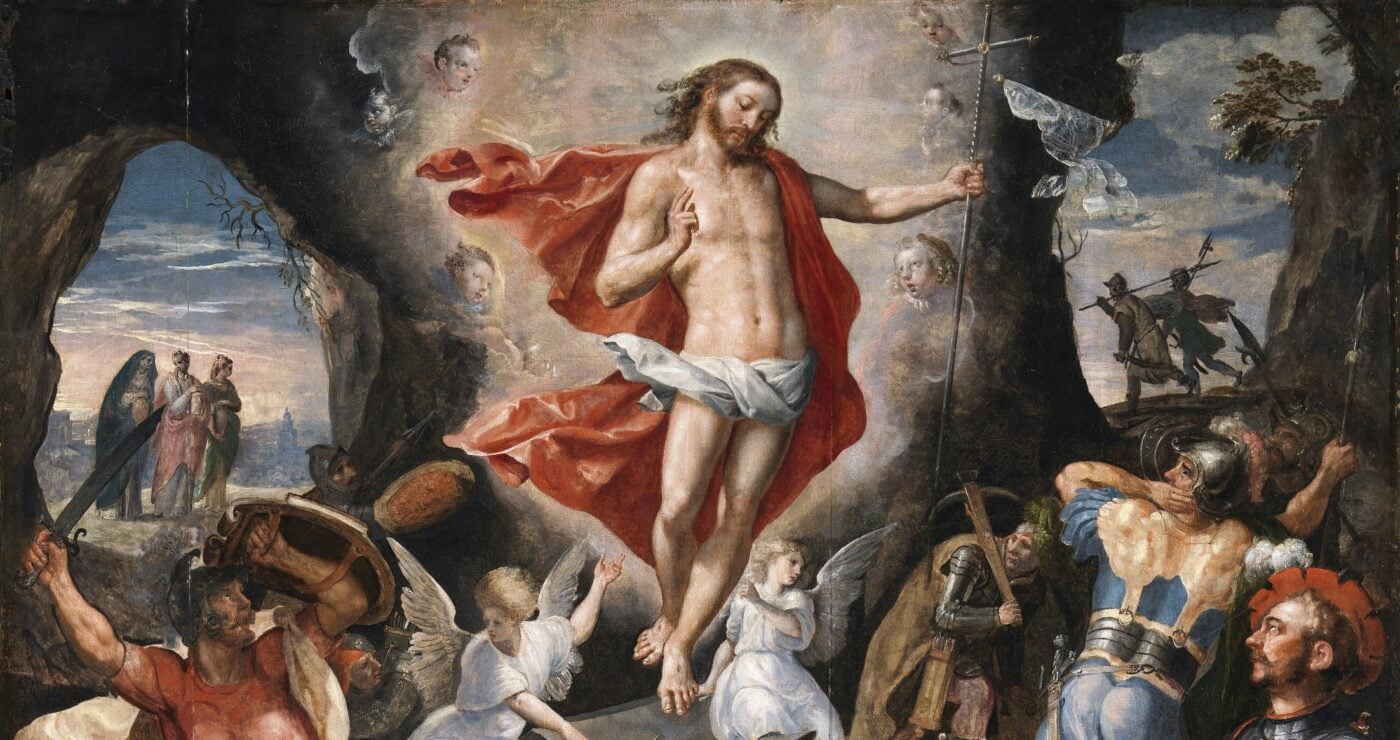
Image from Wikimedia Commons