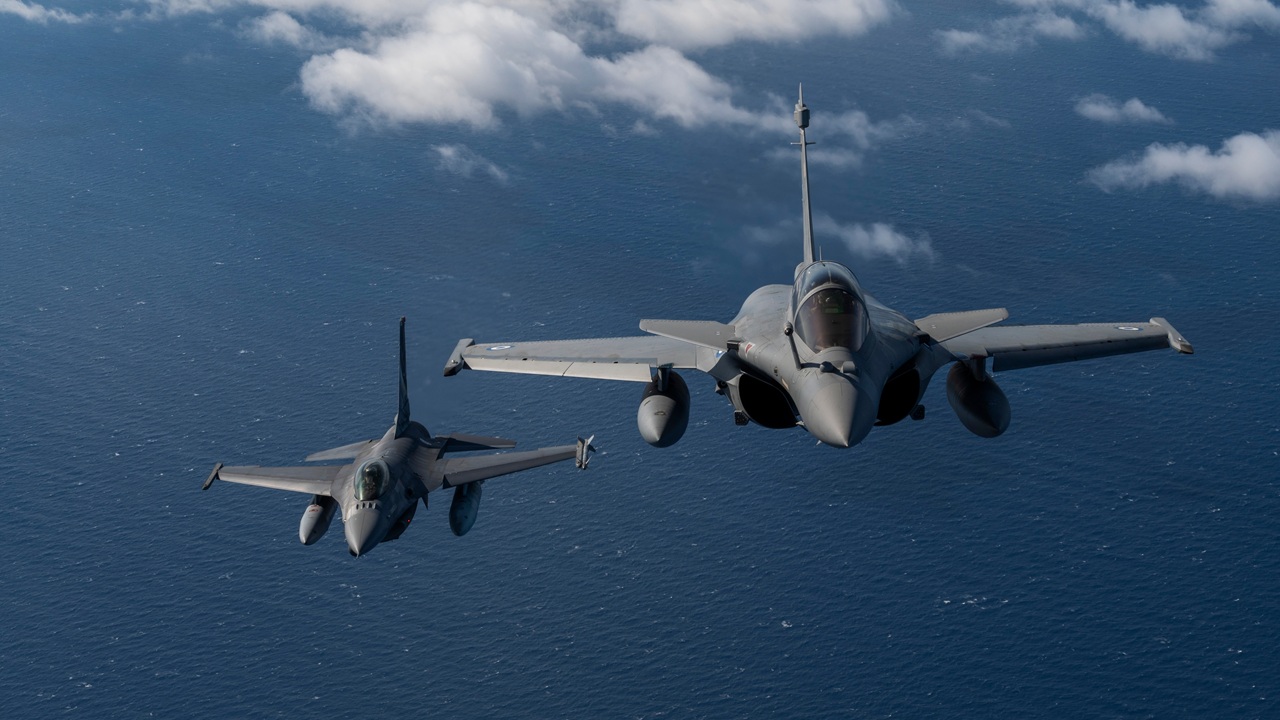
In general, the Dassault Rafale’s sensor suite is superior to the Su-35’s, while the Russian jet enjoys advantages in speed and maneuverability.
The Rafale and Su-35 are often framed as peers: advanced, non-stealth multirole fighters of the fourth-plus-generation. Both represent the pinnacle of their respective design philosophies. But the two aircraft are very different, raising questions—especially as tensions between NATO and Russia escalate—over which aircraft would win out in a head-to-head confrontation.
The Dassault Rafale vs. the Su-35 Super Flanker: A Head-to-Head Comparison
| Fighter Jet | Dassault Rafale (France) | Su-35 Super Flanker (Russia) |
| Role | Multirole (Omnirole) | Air Superiority / Multirole |
| Year Introduced | 2001 | 2014 |
| Crew | 1–2, depending on variant | 1 |
| Weight (MTOW) | ~54,000 lb (24,500 kg) | ~76,300 lb (34,600 kg) |
| Engines | 2× Snecma M88 | 2× Saturn AL-41F1S |
| Max Speed | Mach 1.8 (~1,190 mph / ~1,915 km/h) | Mach 2.25 (~1,500 mph / ~2,414 km/h) |
| Supercruise | Mach 1.4 (~920 mph / ~1,480 km/h) | No sustained supercruise |
| Combat Radius | ~1,150 mi (1,850 km) | ~1,000 mi (1,600 km) |
| Ferry Range | ~2,300 mi (3,700 km) | ~2,200 mi (3,600 km) |
| Service Ceiling | ~50,000 ft (15,240 m) | ~59,100 ft (18,000 m) |
| Radar | AESA (RBE2-AA) | PESA (Irbis-E) |
| Max Payload | ~20,900 lb (9,500 kg) | ~17,600 lb (8,000 kg) |
Two Fighter Jets, Two Design Philosophies
The Rafale and Su-35 were designed for very different functions.
The Rafale was designed as a true multirole, or “omnirole,” fighter—with an emphasis on sensor fusion, electronic warfare, and flexibility. The model was optimized for coalition warfare and networked operations, as many contemporary Western fighters are.
The Su-35, meanwhile, was designed primarily as an air-superiority platform with an emphasis on raw performance—speed, altitude, and maneuverability. The platform has a de-emphasis on sensors and advanced networking, and in order to succeed more broadly, it depends on strong ground-based radar support.
The Rafale is a medium-weight, twin-engine delta-canard design with AESA radar and an advanced electronic warfare suite. Though the Rafale has a lower radar cross-section (RCS) than most legacy fighters, it is not a stealth platform. For the aircraft’s size it has excellent range and payload—and has been optimized for BVR combat and precision strike.
Conversely, the Su-35 is a large, heavy twin-engine fighter derived from the Su-27 lineage. Outfitted with powerful, thrust-vectoring engines, the Su-35 has a large radar and long missile reach. The aerodynamic performance is exceptional, while the fuel and payload capacities are both high.
The Rafale holds an advantage with respect to sensor fusion, the electronic warfare suites, and pilot workload reduction. The Su-35 meanwhile holds an advantage with radar detection range and infrared search and track (IRST). Head-to-head, the Rafale likely wins out with respect to seeing, prioritizing, and reacting faster than the Su-35.
So Which Plane Would Win in a Fight?
The question of which plane would win in a head-to-head air battle depends on many factors. Both aircraft are capable of long-range BVR combat, though the Rafale emphasizes coordinated missile employment; the Su-35 emphasizes missile reach and kinematic performance. Missile effectiveness depends heavily on cuing, EW, and tactics.
Closer in, for WVR combat, the Su-35 excels in extreme maneuverability and energy states. The Rafale is agile, but not fully optimized for knife fighting, prioritizing instead a control and efficient maneuvering regime. And of course, at close-range, individual pilot skill becomes a more substantial factor than the plane’s pure specifications.
At BVR range, the Rafale likely holds the edge, thanks to sensors, EW, and integration; within WVR, the Su-35 likely holds the edge, thanks to its slight maneuverability advantage. So, overall, which aircraft is preferable depends highly on circumstances. Neither aircraft guarantees dominance over the other. All of this remains hypothetical, as no confirmed combat engagements have ever taken place between the Rafale and Su-35.
The two aircraft reflect the convergent doctrines of their two states. The Rafale underscores the Western emphasis on networks and coalition warfare; the Su-35 reflects the Russian emphasis on airframe performance and missile reach. Both aircraft are among the best non-stealth fighters in service. But the Rafale is a systems fighter while the Su-35 is a performance fighter. And in modern air combat, information and integration increasingly outweigh raw kinematics, suggesting the Rafale is more adapted to future war fighting. Still, it would be poor judgment to dismiss a fighter as powerful and maneuverable as the Su-35.
About the Author: Harrison Kass
Harrison Kass is a senior defense and national security writer at The National Interest. Kass is an attorney and former political candidate who joined the US Air Force as a pilot trainee before being medically discharged. He focuses on military strategy, aerospace, and global security affairs. He holds a JD from the University of Oregon and a master’s in Global Journalism and International Relations from NYU.
Image: Shutterstock / Faizinraz.