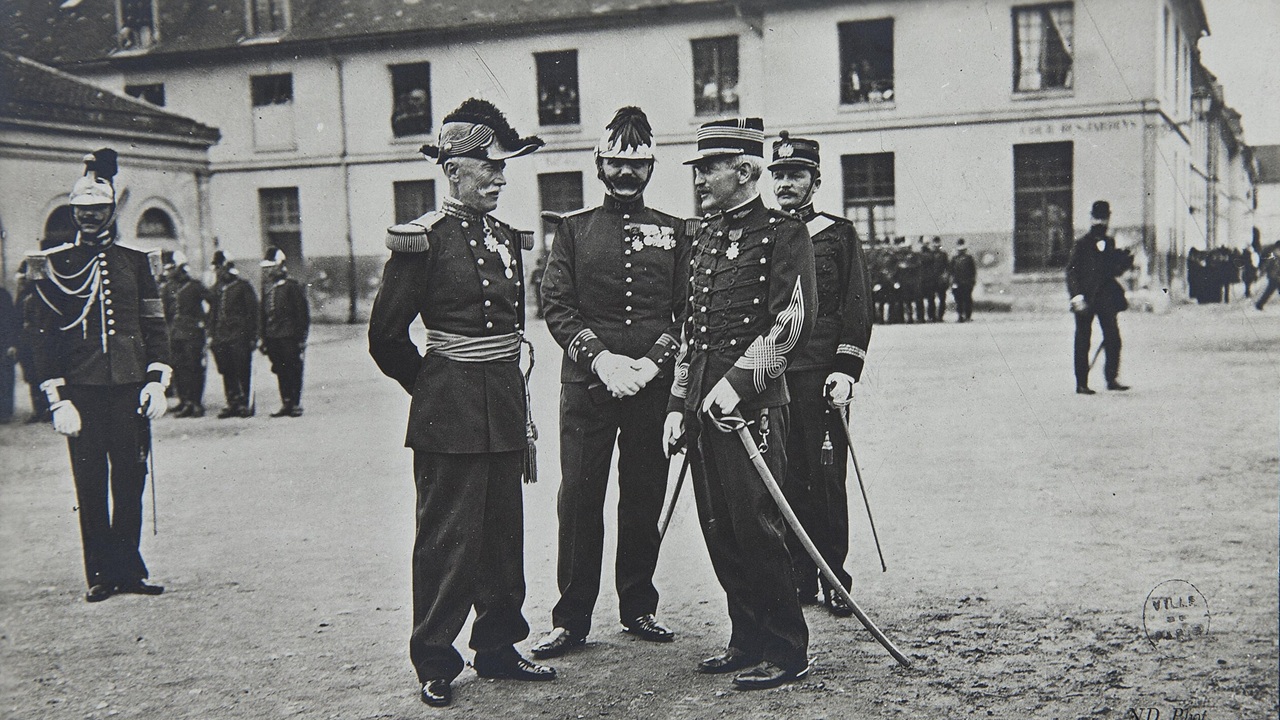
Last week, the government of France posthumously promoted Alfred Dreyfus to the rank of brigadier general in the French Army.
Though Dreyfus is little-remembered today, in France or elsewhere, the Jewish army captain was at the center of one of the most notorious cases of anti-Semitism in French history. In 1894, Dreyfus was scapegoated and wrongfully convicted for espionage. After a decade-long political and social crisis, his conviction was overturned, and he returned to military service and went on to serve with distinction in World War I—but the French government never made recompense for his time imprisoned on the notorious Devil’s Island penal colony in French Guiana.
The “Dreyfus Affair” Became a National Scandal in France
In 1894, Dreyfus, then a captain in the French Army, was falsely accused of selling military secrets to Germany based on flimsy and dubious evidence. The military court, influenced by anti-Semitic prejudice, quickly convicted Dreyfus and sentenced him to life imprisonment on Devil’s Island.
The real culprit in the treason, Major Ferdinand Esterhazy, was identified just two years later by Georges Picquart, the counter-espionage chief for the French Army and later Minister of War. However, Esterhazy was acquitted in a court-martial, and thereafter fled the country. Fearing a scandal, the French military sent Picquart to a remote posting in Tunisia and suppressed evidence from the trial.
Over time, however, evidence of forgery during the first trial emerged, and a movement supporting Dreyfus began to grow in France. French novelist and publisher Emile Zola wrote J’accuse…! (I Accuse), a highly influential pamphlet supporting Dreyfus, that further brought the matter to light. Amid public outcry, the French government ordered a new trial for Dreyfus in 1899. Further efforts were made to cover up the matter, and Dreyfus was convicted yet again, but an appellate court annulled the verdict in 1906, declaring him innocent of the crimes. By that time, Dreyfus had spent more than a decade on Devil’s Island, and the brutal conditions there damaged his health for the remainder of his life.
The case became known as the Dreyfus Affair. It deeply polarized French society, while exposing deep prejudice within France’s military and French society writ large.
Dreyfus was subsequently reinstated in the French Army and promoted to the rank of major, but it was still a lower rank than his years of service warranted. Even so, Dreyfus went on to serve in World War I, and by 1918 had been promoted to the rank of lieutenant colonel and awarded the Officer of the Legion of Honor. Dreyfus passed away in 1935 at the age of 76.
“Dreyfus’s only fault was to be born Jewish, and as such he was the ideal traitor for the antisemites of the army and the antisemitic nationalist leagues,” Yael Perl Ruiz, the great-granddaughter of Alfred Dreyfus, told The Jerusalem Post last year.
France Has Finally Given Dreyfus His Promotion—a Century Too Late
Seeking to undo the great injustice of more than 125 years, this month, French President Emmanuel Macron and Prime Minister Sebastien Lecornu signed into law in the Official Journal, the promotion Dreyfus so rightfully deserved. The legislation received unanimous approval from the French Parliament’s lower house in June, and its Senate ratified the bill this month.
“The French nation posthumously promotes Alfred Dreyfus to the rank of brigadier general,” the law read.
The move to honor Dreyfus and to put the affair back in the spotlight follows an increase in anti-Semitism in France, which is “home to the largest Jewish population outside Israel and the United States,” France 24 reported, “As well as one of the largest Muslim communities in the European Union.”
A Recent Dreyfus Film Had Its Own Controversy
The story of Alfred Dreyfus may seem tailor-made for Hollywood, but it wasn’t until 2019 that a movie was made about the affair. The film An Officer and a Spy, based on the 2013 novel of the same name by Robert Harris, won the second-largest prize at the Venice Film Festival, but went on to become a worldwide box-office bomb.
The controversy surrounding the film came in large part because it was made by Roman Polanski, the famed Hollywood director who fled the United States in 1978 to evade imprisonment for drugging and raping a 13-year-old girl. Polanski, who remains a fugitive from justice, has fought the charges against him, and after viewing An Officer and a Spy, some critics alleged that he had inserted parallels to his own legal case into the film.
Due to these and other controversies involving Polanski, An Officer and a Spy had never been released theatrically or even on home video in the United States, until it played at the Film Forum in New York City earlier this year. Even that limited engagement was met by protests, including from the Film Forum’s union.
It is another controversy that Dreyfus didn’t need!
About the Author: Peter Suciu
Peter Suciu has contributed over 3,200 published pieces to more than four dozen magazines and websites over a 30-year career in journalism. He regularly writes about military hardware, firearms history, cybersecurity, politics, and international affairs. Peter is also a contributing writer for Forbes and Clearance Jobs. He is based in Michigan. You can follow him on Twitter: @PeterSuciu. You can email the author: [email protected].
Image: Wikimedia Commons.