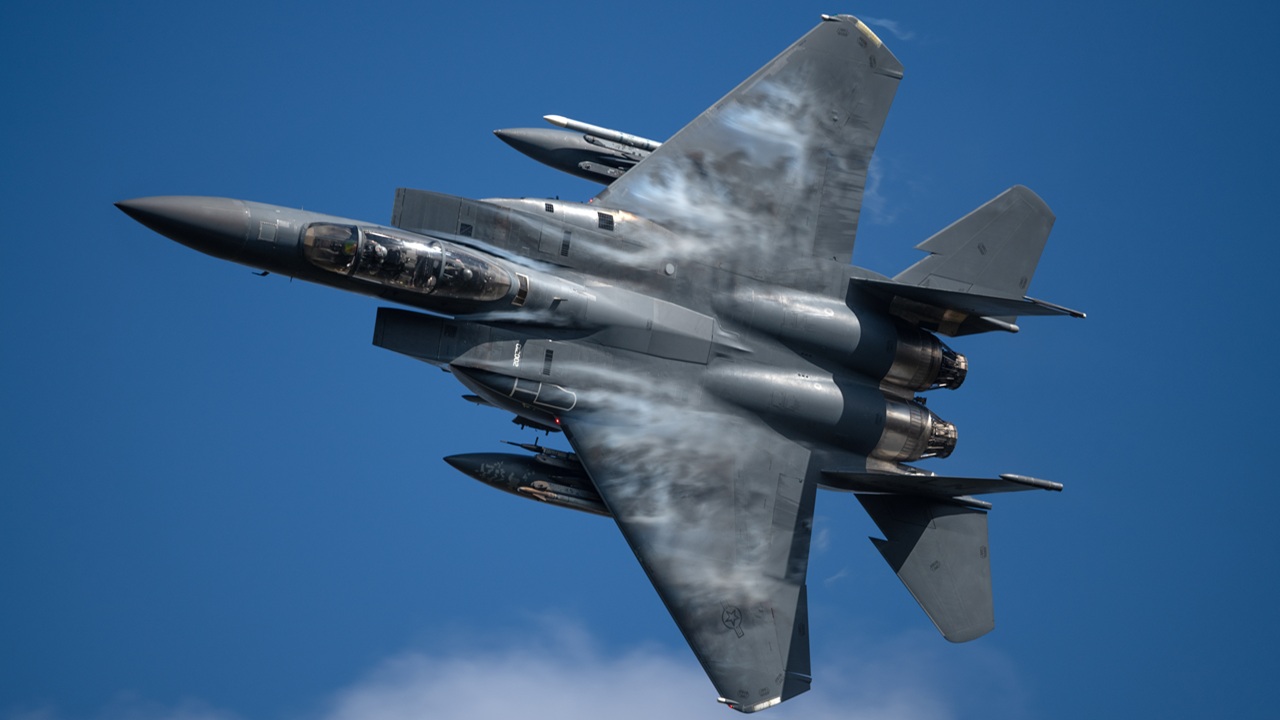
The shootdown of three American F-15E Strike Eagles appears to have been a case of mistaken identity by Kuwaiti air defenses.
Three US Air Force F-15E Strike Eagle fighter jets were shot down by friendly fire on Sunday night. All six air crew ejected safely.
The Shootdown Was a “Blue-on-Green” Incident
Last night, the US military suffered its first aircraft casualties since Operation Epic Fury began on Saturday morning.
The three Air Force F-15E Strike Eagles were conducting operations in support of the strikes against Iran over Kuwait when the local air defense systems mistakenly locked on and shot down the aircraft.
“All six aircrew ejected safely, have been safely recovered, and are in stable condition. Kuwait has acknowledged this incident, and we are grateful for the efforts of the Kuwaiti defense forces and their support in this ongoing operation,” US Central Command, the combatant command responsible for the Middle East and the ongoing operation, said in a press release.
Although the incident is unfortunate, it is also understandable to a certain degree. Since Saturday, there have been hundreds of combat aircraft from multiple countries operating in the area. There are, moreover, hundreds of other assets, including friendly and enemy missiles and unmanned aerial vehicles, in the air. In such a complex operational environment, it would be easy for even an experienced air defense crew to mistakenly identify friendly aircraft as hostile and open fire.
The cause of the incident remains under investigation.
The F-15E Strike Eagle’s Specifications
The F-15 is one of the most capable fighter jets in the world, with multiple versions flying. It can carry a host of munitions and conduct both air-to-air and air-to-surface engagements effectively. No F-15 has ever been shot down by enemy fire, while the platform has racked up over 100 aircraft and unmanned aerial systems kills.
- Year Introduced: 1988
- Number Built: ~236
- Length: 63 ft 9 in (19.43 m)
- Wingspan: 42 ft 10 in (13.05 m)
- Weight (MTOW): ~81,000 lbs (36,700 kg)
- Engines: Two Pratt & Whitney F100-PW-229 afterburning turbofans (~29,000 lbs each)
- Top Speed: ~Mach 2.5 (~1,650 mph / 2,655 km/h) at altitude
- Combat Radius: ~600–1,000 mi (965–1,610 km), depending on mission profile, fuel state, and loadout
- Service Ceiling: ~60,000 ft (18,300 m)
- Loadout: One 20 mm M61A1 Vulcan cannon; up to ~23,000 lbs (≈10,400 kg) of external stores including AIM-120 AMRAAM and AIM-9 Sidewinder air-to-air missiles and a wide mix of air-to-ground ordnance (AGM-65 Maverick, AGM-88 HARM, GBU-10/12/24 laser-guided bombs, JDAMs, JSOWs), plus targeting/recce pods and conformal fuel tanks
- Aircrew: 2 (pilot and weapon systems officer)
About Kuwait’s Air Defenses
The Kuwaiti Air Force operates three air defense systems: the MIM-104 Patriot, the MIM-23 Hawk, and the British-made Starburst missile. The F-15s were likely shot down by the MIM-104, a US-made weapon and one of the most capable air defense systems in the world.
So far, four US troops have been killed in the ongoing military operation. These were likely part of an Army sustainment unit based in Kuwait; there is no connection between them and the shootdown incident on Monday morning.
The US launched Operation Epic Fury with Israel on Saturday morning. The objective is to decapitate the Iranian leadership and bring about regime change. The White House has stated that it will not put any boots on the ground. So, the operation’s success largely depends on the effectiveness of the air campaign.
About the Author: Stavros Atlamazoglou
Stavros Atlamazoglou is a seasoned defense journalist specializing in special operations and a Hellenic Army veteran (national service with the 575th Marine Battalion and Army HQ). He holds a BA from the Johns Hopkins University and an MA from the Johns Hopkins’ School of Advanced International Studies (SAIS). His work has been featured in Business Insider, Sandboxx, and SOFREP.