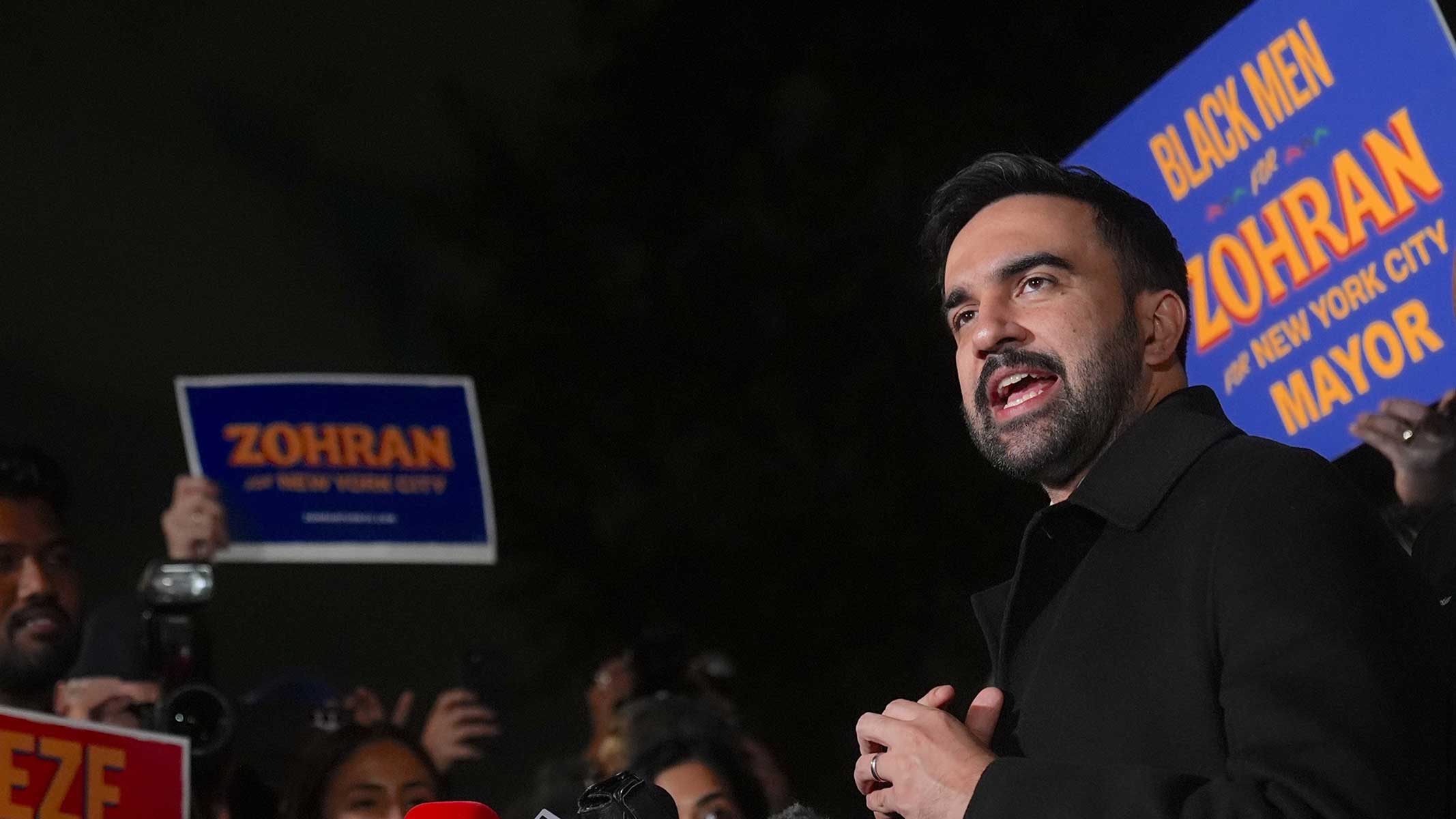
Mayor-elect Zohran Mamdani, who has a long history of support for radical activism, tried to pivot to moderation in the waning days of the campaign. But he also pledged to address “repression” on campus, specifically citing “faculty members who are facing not just discipline but termination for the crime of expressing solidarity with the fight for Palestinian human rights.”
Now militant faculty unions and New York City’s chapter of the Democratic Socialists of America are plotting to force his hand on this pledge by pressuring him to reinstate four fired City University of New York professors associated with the anti-Israel protest movement. How Mamdani responds to this pressure may be the first test of how firmly he will hold to his progressive platform.
Finally, a reason to check your email.
Sign up for our free newsletter today.
An internal planning document from the NYC-DSA’s Anti-War Working Group shows that the group has spent weeks plotting how to pressure the new administration to “Divest CUNY endowment and reinstate wrongly fired professors.” At a recent meeting of CUNY’s Professional Staff Congress (PSC)—a “militant union,” according to one of the dismissed professors—faculty members openly discussed their expectations that Mamdani will intervene. With two of his most ardent blocs of supporters pushing a demand that is deeply unpopular with the broader public, Mamdani, a former Students for Justice in Palestine president, is facing a dilemma that cuts to his core.
In mid-June of this year, four adjunct faculty members at CUNY were effectively fired (three were not reappointed, and one was explicitly terminated). They quickly became known as the “Fired Four.” So far, only one, Corinna Mullin, has gone public; the other three have avoided the spotlight.
The reasons for their firing remain unclear. PSC CUNY claims that all four were known for their “public protest against Israeli policies and advocacy for Palestinian rights.” According to PSC advocates for the Fired Four, “[n]o reasons were provided for the non-reappointments, and the adjuncts’ department chairs were not notified in advance.”
But Mullin’s track record of radical activism—which includes ties to a protest that turned violent and to a terrorist group—offers ample grounds for termination. She was arrested at the City College encampment, a protest that caused an estimated $3 million in damage, including fire damage from a thrown flare and $500,000 in security cameras destroyed.
Within Our Lifetime’s Nerdeen Kiswani, a pro-Palestine protester, alleges that CUNY professors like Mullin surrounded their students at the encampment and even told the police, “You’ll have to go through us to get through our students.” In December 2024, a bipartisan efforted in the New York City Council led by Inna Vernikov and Kalman Yeger called on CUNY to launch a formal investigation into Mullin. Legislators asserted they had “credible information” that she was among the chief architects of the encampment protest.
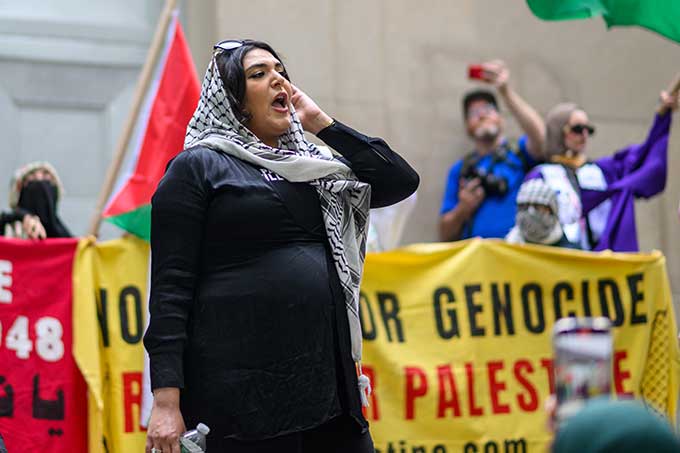
For years, Mullin also maintained ties to Samidoun, which last year the United States officially designated a “sham charity” affiliated with the terrorist Popular Front for the Liberation of Palestine. In 2015, Mullin appeared on a panel at the World Social Forum that Samidoun promoted as part of its pro-Palestine programming. In 2017, she protested after an event celebrating 50 years of “the PFLP and the Palestinian revolutionary Left.” In 2023, she was invited by Samidoun to travel to Venezuela as an expert on sanctions for a fact-finding mission.
This radical activism extends to her work on campus. Mullin has never been shy about her role as an organizer with CUNY 4 Palestine, “the collective Palestinian liberation organizing body within CUNY.” Mullin and other professors often hosted weekly teach-ins with controversial figures such as Charlotte Kates of Samidoun and anti-imperialist scholars who seemingly endorse violence as a legitimate tool for political change. For example, she introduced Shellyne Rodriguez, a Hunter College professor who was fired after she attacked a pro-life student table and held a machete to the neck of a New York Post reporter. Mullin has appeared on panels or hosted individuals tied to Palestine Action UK (a designated terror group), one of Hamas’s lawyers, and even Fidel Castro’s niece. It’s easy to see why CUNY viewed this adjunct as a liability rather than an academic asset.
In spite of all this, Mullin and the other Fired Four attracted Mamdani’s attention. During a rally with Senator Bernie Sanders during the campaign, Mamdani wore a PSC-CUNY hat. He said that he could not “begin [his] remarks this evening without first acknowledging PSC-CUNY and the fact that no faculty member should be disciplined for supporting Palestinian human rights,” adding, “I want to thank PSC-CUNY for standing alongside their rank and file.”
Later, during the Q&A, Mamdani linked the Fired Four’s situation to broader issues of policing on campus.
“We are seeing faculty members who are facing not just discipline but termination for the crime of expressing solidarity with the fight for Palestinian human rights,” he said, after putting on the PSC-CUNY hat. “I know that this is a repression that is not unique to Brooklyn College. It is a repression that extends even to the ways in which we choose when to send police officers onto college campuses.”
Mamdani is also linked to the Fired Four through one of his former interns, Hadeeqa Arzoo Malik. Malik is among the students disciplined alongside the dismissed professors and has appeared in interviews with Mullin.
As mayor, Mamdani will have no formal authority over CUNY’s hiring and firing decisions and cannot intervene in disciplinary cases, such as the suspension of his former intern. But he is not powerless. He can apply indirect pressure by urging trustees to act, issuing public statements, or using the media to amplify his stance. And he holds one ace up his sleeve: he can make appointments to CUNY’s Board of Trustees, giving him a lever to influence the system over time.
This perhaps explains why PSC-CUNY has been focused recently on Mamdani’s next moves. On November 13, PSC CUNY joined the American Association of University Professors and Higher Ed Labor United for an event titled “Combatting Contingency in a Time of Political Repression.” Mullin spoke about her experience being fired while professors from across the country brainstormed ways to support her.
When Mamdani’s name came up, the meeting’s tone became borderline giddy.
“My question is, short of revolution, which I think is a good idea, what concrete demands can the union make to the new mayor?” one audience member asked, adding, “it seems to me he should rehire the fired four.”
Notably, the loudest demand was not to rehire the anonymous professors but to appoint Mullin to CUNY’s board of trustees as one of the mayor’s five appointments. (Ironically, Mullin had earlier advocated for “abolishing the board of trustees.”)
If Mamdani allows CUNY to rehire these professors, it could mean the return of the Student Intifada of spring 2024. CUNY has already faced intense scrutiny for the extremity of its campus activists, including in a July 2025 congressional hearing on campus anti-Semitism. Reappointing the Fired Four—or putting Mullin on the board of trustees—could wipe out progress overnight and embolden those previously punished for lawbreaking.
With his inauguration day creeping closer, Mamdani faces a pivotal decision. Will he spend political capital to reinstate professors who have become symbols of a deeply polarizing cause? Or will he risk alienating the activist base that crowned him their champion? His response will begin to define not just his relationship with the activist Left but the trajectory of his mayoralty.
Photo by Selcuk Acar/Anadolu via Getty Images
Source link